
US Hemp-Derived THC Beverage Market Report 2026
A $1.1 billion market facing a binary legislative moment.
Independent market intelligence on the US hemp-derived THC beverage category — covering market size, competitive structure, regulation, alcohol substitution and the scenarios that could reshape the industry after November 2026.
£370 early access · B2B invoicing · Delivered by Zenith Consulting
Days to the November 12, 2026 federal deadline: —
US THC Beverage Market 2026 — Key Findings
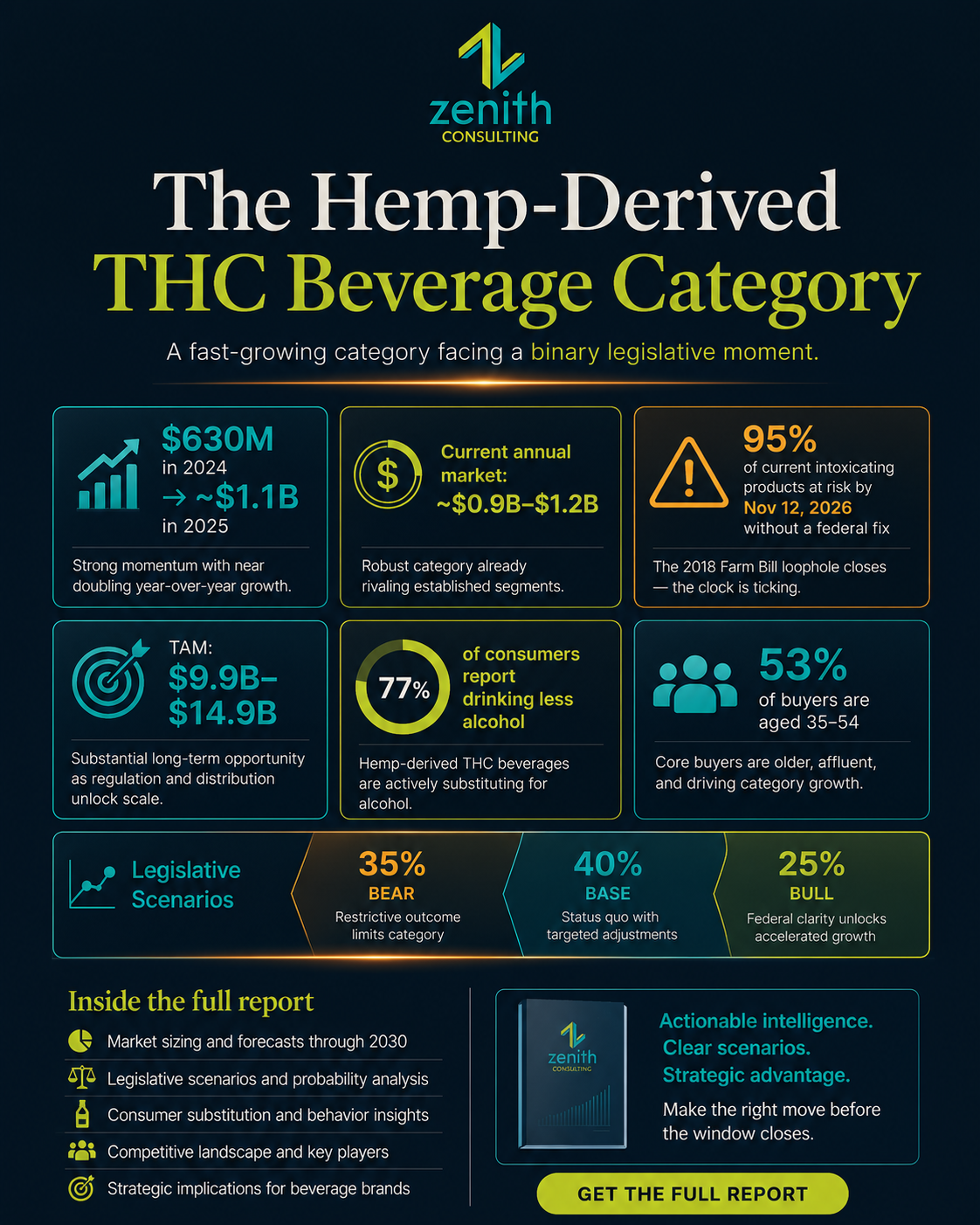
$1.1bn
Zenith estimate of the US hemp-derived THC beverage category
4
Independent market-sizing methods reconciled
34
Sources used in the analysis
10
Leading indicators monitored through the regulatory window
12 Nov 2026
Critical date shaping the industry's regulatory outlook
All figures refer to the US hemp-derived THC beverage category as defined in this study. They are not estimates of the global cannabis beverage market.
How Large Is the US THC Beverage Market?
Zenith Global Commercial estimates the US hemp-derived THC beverage category at approximately $1.1 billion. That figure describes the US hemp-derived THC drinks category specifically — not CBD beverages, not licensed dispensary cannabis drinks, and not the broader global cannabis beverage market that headline estimates often bundle together.
The category is genuinely difficult to size. Hemp-derived THC beverages grew up outside the traditional licensed cannabis system, which means most of the volume never passes through state seed-to-sale tracking. Sales are spread across liquor stores, convenience retail, grocery, bars and taprooms, and direct-to-consumer shipping, with no single reporting body sitting above them. Scanner data covers only part of the trade. Definitions differ from source to source: some counts include hemp-derived CBD or low-dose functional drinks, others exclude entire distribution channels, and state-by-state legality means the addressable footprint itself changes depending on the date and the statute.
The result is a market where widely quoted numbers can differ by a multiple, and where a single recycled headline estimate tells a board very little about the risk attached to it. Zenith's response is a triangulated estimate rather than a single derivation. Four independent sizing approaches are built separately, each from its own evidence base, and their outputs are then reconciled into one stated figure — with the divergences between them examined rather than averaged into silence.
That reconciliation is the point. It shows where the evidence is strong, where it is thin, and how much of the estimate depends on assumptions that could move. Confidence levels are stated alongside the numbers, so the estimate can be defended, challenged and updated as the category and its regulation evolve. The full derivation, the four methods and their reconciliation sit inside the report.
Zenith estimate
$1.1bn
US hemp-derived THC beverage category, reconciled from four independent sizing methods and 34 dated sources.
Access the complete analysisWhat Market Does This Report Cover?
In scope
US hemp-derived THC beverages
Ready-to-drink beverages infused with THC sourced from hemp and sold in the United States, largely through channels outside the licensed dispensary system. Focus: United States. Currency: USD.
Not the same market
- CBD beverages — non-intoxicating hemp drinks, a separate category with different economics and regulation.
- Licensed dispensary cannabis beverages — sold inside state-licensed cannabis systems, under different rules and distribution.
- Broader cannabis beverage estimates — aggregate figures that combine several of the above, and are not comparable with the $1.1bn estimate in this study.
Why November 12, 2026 Matters for THC Beverages
Very few consumer categories have a single date on which their legal basis can change. Hemp-derived THC beverages do. The report identifies November 12, 2026 as the critical point in the federal regulatory outlook for the category, and treats it as the organising question of the study rather than a footnote to it.
The category exists in its current form because hemp-derived THC has been able to move through ordinary retail and distribution rather than through state cannabis licensing. That is what made national scale possible: liquor stores, convenience chains, grocery, bars and direct-to-consumer shipping. It is also what makes the federal question so consequential. A change to the federal treatment of hemp-derived THC does not adjust the category at the margin; it can change which products may legally be made and sold, which channels can carry them, and in which states.
The consequences run through the whole value chain. For operators, the window governs how hard to push inventory, hiring and distribution ahead of an outcome they do not control. For distributors and retailers, it determines shelf-space commitments, buy-back terms and the risk carried on a category that can be repriced quickly. For investors and private equity, it is the single largest input into valuation: the same asset is worth materially different amounts on either branch of the tree. For alcohol and CPG companies, it shapes entry timing, M&A appetite and how much substitution exposure they are willing to carry in their core portfolios. For co-packers and ingredient suppliers, it decides whether capacity committed now finds demand.
Zenith's position is not that any outcome is certain — it is that the outcome is knowable in probability terms before it happens, and that the trade is already leaving evidence about which way it is leaning. The report sets out the regulatory state of play, assesses the alternative outcomes around the deadline with the reasoning behind each, and tracks a set of leading indicators that signal which scenario is becoming more likely. This page describes the framework; the scenario assessment itself, including how Zenith weighs each branch, sits inside the paid report.
Nothing on this page is legal advice. Operators should take their own counsel on federal and state compliance.
How Zenith Sizes the THC Beverage Market
The US hemp-derived THC beverage market does not have a single definitive public dataset. Zenith Global Commercial therefore approaches the category through multiple independent sizing methods and reconciles the results, rather than relying on a single recycled headline estimate.
Four independent sizing methods
The category is approached from four separate angles, each built and stress-tested on its own before any comparison is made.
Explicit reconciliation
The four results are reconciled into a single stated estimate, with the gaps between them explained rather than averaged away.
34 dated sources
A full source register, every entry dated November 2025 to June 2026, so each figure can be traced and challenged.
Stated confidence levels
Where the evidence is thin, the report says so. Confidence is stated alongside the numbers instead of implied by precision.

Akos Petri
Managing Director, Zenith Global Commercial
Zenith Global Commercial is a market intelligence and strategy consultancy covering the global food, beverage and packaging industries.
What Is Driving the US THC Beverage Market?
Consumer adoption
Hemp-derived THC drinks have moved out of novelty retail and into mainstream beverage occasions, changing who buys the category and how often.
Alcohol substitution
The overlap with drinking occasions makes the relationship with alcohol a first-order strategic question for brewers, spirits groups and NA-beverage teams.
Distribution
Availability through liquor, convenience and grocery channels outside the dispensary system is the mechanism that made the category scalable — and the mechanism most exposed to regulation.
Regulation
Regulatory structure is currently the single largest determinant of category value, at both federal and state level.
THC Beverages and Alcohol Substitution
The reason beverage, alcohol and CPG companies watch this category so closely is not its current size — it is where its consumption sits. Hemp-derived THC drinks are bought and consumed in occasions traditionally associated with alcohol: the evening drink at home, the social round, the bar or taproom visit. That overlap makes potential substitution a strategic question rather than a curiosity.
It is a question, not a settled finding. Consumer experimentation with a new format does not on its own demonstrate that alcohol volume is being displaced, and much of the available survey evidence carries known biases in how respondents are recruited and how consumption is self-reported. Zenith's report presents the alcohol substitution evidence with those biases explicitly flagged, so readers can see which numbers are solid and which are soft, rather than inheriting a causal claim the data does not support.
What is not in doubt is the strategic exposure. Brewers, spirits groups and no- and low-alcohol teams are already competing for the same occasions, and the emergence of an adjacent intoxicating beverage category changes the competitive set regardless of whether measurable substitution has yet occurred. For THC beverage operators, the same overlap defines the route to scale — the channels, price points and consumption habits they are borrowing from are alcohol's. For established alcohol companies, it frames entry timing, partnership and M&A decisions that may be harder to reverse once the regulatory picture resolves.
Who Uses THC Beverage Market Intelligence?
THC beverage brands & founders
Operators deciding how hard to push distribution, inventory and hiring into a binary regulatory window.
Beverage-alcohol distributors & retailers
Wholesalers, liquor chains and c-store groups weighing shelf space, buy-back terms and portfolio risk through 2026.
Investors & private equity
Funds pricing regulatory optionality in hemp beverage assets, or positioning for post-resolution consolidation.
Alcohol & CPG strategics
Brewers, spirits and NA-beverage companies assessing entry timing, M&A targets and substitution risk to their core.
Co-packers & ingredient suppliers
Manufacturers modelling demand scenarios before committing capacity to the category.
Strategy & corp dev leaders
C-suite and BD teams who need a defensible, sourced view for their next board discussion.
Triangulated numbers. Honest probabilities. Decision support.
A market size you can defend
Four independent sizing methods reconciled, with confidence levels stated — not a single recycled headline number.
The regulatory clock, decoded
What Section 781 actually does, every live rescue vehicle in Congress, and a probability-weighted scenario tree.
Consumer evidence, source-criticised
Alcohol substitution data with its biases flagged, so you know which numbers are solid and which are soft.
Competitive & capital map
Who is winning, which distributors and retailers are committing, and where the capital chill has exceptions.
Category graduation scorecard
Five measurable criteria for when THC beverages become a standalone multi-billion-dollar category, and the weighted timeline.
A leading-indicator dashboard
Ten signals to track through November, ranked by decision value.
What's Inside the Report
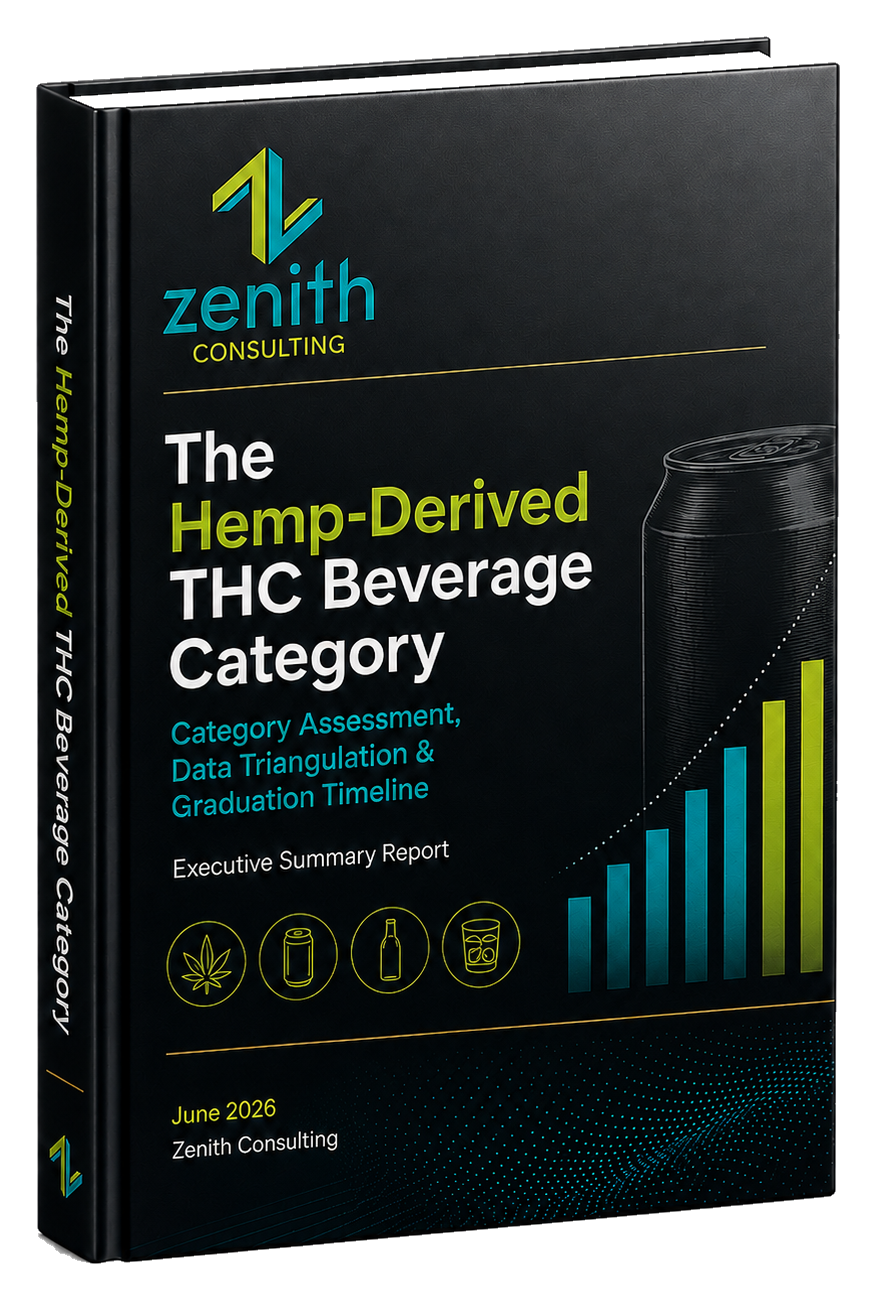
Twenty pages of sizing, regulatory, consumer and competitive intelligence — engineered for boardroom use, with all 34 sources dated and registered.
- 20-page executive report
- Market sizing: four-method triangulation
- Regulatory state of play & Section 781 scenario tree
- Consumer behavior & alcohol substitution
- Competitive & capital landscape
- Category analogs & graduation criteria
- Scenarios, timing & strategic implications
- Leading-indicator dashboard & source register
Two access bonuses, included with every purchase.
Unlimited access to the Zenith Infographs Vault
Every Zenith market-intelligence infographic, downloadable on demand for as long as the vault is published.
Full access to Zenith Market Intel
Editorial intelligence on global food & beverage categories — analyses, signals and briefings as they publish.
What to Watch Through November 2026
Zenith tracks ten leading indicators covering the developments most relevant to the regulatory and commercial outlook for hemp-derived THC beverages. They fall into three broad groups.
Federal regulatory developments
Legislative vehicles, agency positions and the mechanics of the November 12, 2026 deadline.
State-level policy and enforcement
State statutes, potency rules, licensing regimes and enforcement posture, which already differ sharply market to market.
Commercial and distribution signals
Distributor and retailer commitments, capital flows and operator behaviour — the signals that reveal how the trade is really pricing the outcome.
The consumer already voted.
Congress votes by November 12.
This is not a trend piece. It is a decision document for a category whose entire graduation question collapses into one legislative window — and a playbook for every branch of the tree.
Frequently Asked Questions About the US THC Beverage Market
How large is the US hemp-derived THC beverage market?
Zenith Global Commercial estimates the US hemp-derived THC beverage category at approximately $1.1 billion. The estimate is based on four independent sizing approaches that are reconciled rather than relying on a single market headline.
What are hemp-derived THC beverages?
Hemp-derived THC beverages are ready-to-drink products infused with THC sourced from hemp and sold largely outside the licensed cannabis dispensary system, through channels such as liquor stores, convenience retail, bars and direct-to-consumer. This report covers that US category specifically, and does not aggregate it with CBD drinks or dispensary cannabis beverages.
Is the THC beverage market growing?
The category has developed rapidly enough to attract significant attention from beverage operators, retailers, distributors, alcohol companies and investors. Zenith does not publish a single growth rate for the category on this page; the report sets out the sizing evidence, its confidence levels and the regulatory scenarios that will shape the category's trajectory.
Why is November 12, 2026 important for hemp-derived THC beverages?
The report identifies November 12, 2026 as a critical date in the federal regulatory outlook for hemp-derived THC. Zenith assesses the alternative outcomes around that date and the indicators that may signal which one is becoming more likely. The detailed scenario assessment sits inside the paid report.
How does Zenith estimate the THC beverage market?
Zenith uses four independent market-sizing approaches and reconciles the results using multiple research sources, rather than relying on one published estimate. The analysis draws on 34 registered sources dated November 2025 to June 2026.
What does the THC beverage report cover?
The 20-page executive report covers market sizing through four-method triangulation, the regulatory state of play and scenario analysis, consumer behaviour and alcohol substitution, the competitive and capital landscape, category analogs and graduation criteria, strategic implications, and a leading-indicator dashboard with a full source register.
Are THC beverages competing with alcohol?
THC beverages increasingly overlap with drinking occasions traditionally associated with alcohol, making potential substitution and consumer behaviour an important strategic question for both THC beverage operators and established alcohol companies.
Get the US THC Beverage Market Report 2026
One-time payment · Instant PDF delivery · B2B only
- 20-page executive PDF report
- Bonus: companion category infographic (1 page)
- Probability-weighted scenario tree with stated reasoning
- Four-method market sizing with confidence levels
- State-by-state regulatory matrix
- Graduation scorecard & weighted timeline
- 10-signal leading-indicator dashboard
- Full 34-source register, all dated Nov 2025–Jun 2026
- B2B invoicing on request
- Bonus — Unlimited access to the Zenith Infographs Vault
- Bonus — Full access to Zenith Market Intel
Secure checkout powered by Stripe. VAT invoice provided.