Arla and DMK Are Building a €19 Billion Dairy Giant. The Real Antitrust Fight Is Over Farmers, Not Shoppers.
Arla Foods and DMK are weeks from forming Europe's largest dairy cooperative — around €19 billion in revenue, 12,200 farmer-owners, and roughly 13% of all EU milk. With the European Commission's decision due 28 May, the real antitrust fight is over farmers' options to sell their milk, not what shoppers pay.
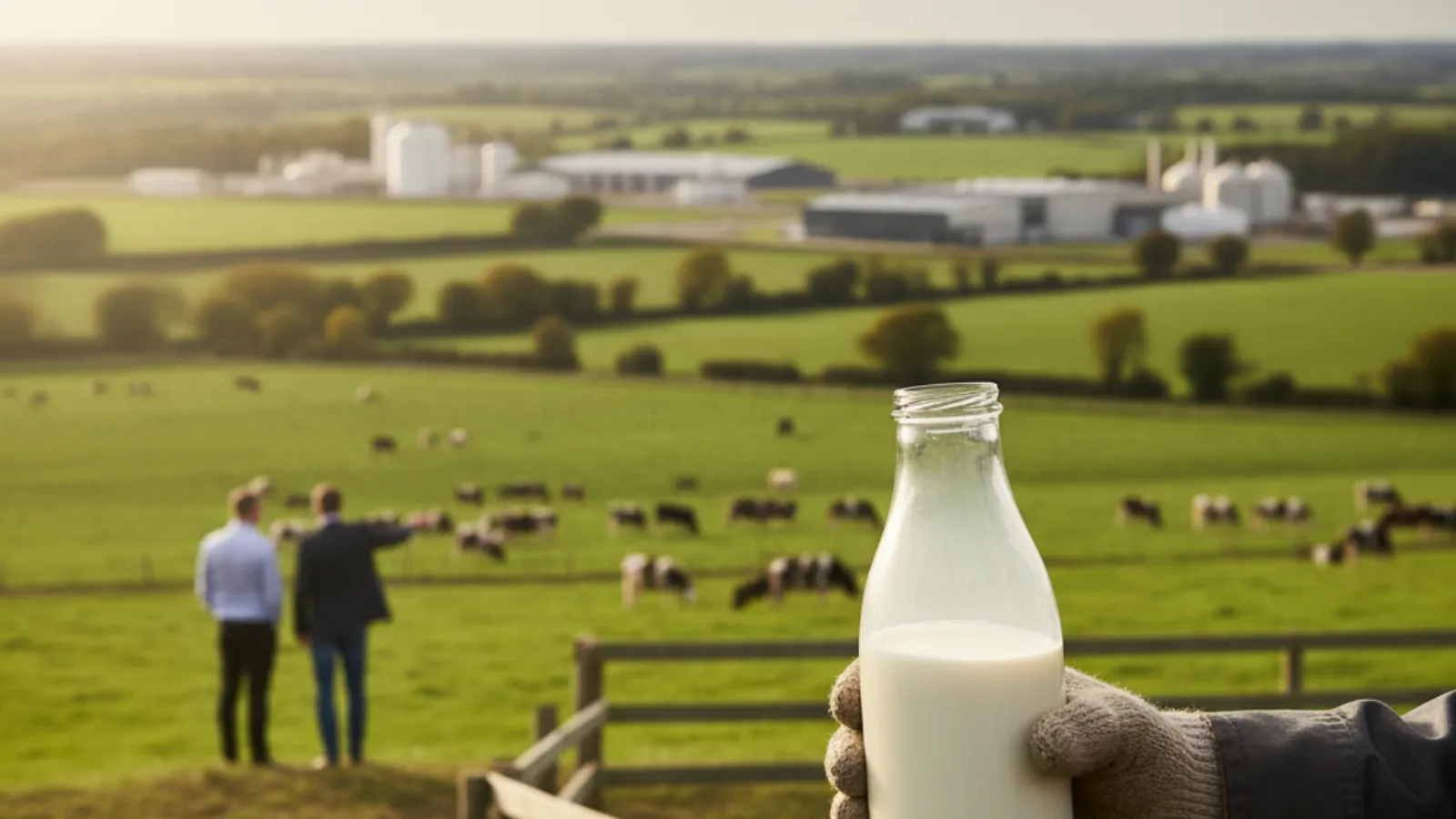
Most merger battles are fought over what shoppers will pay. The largest dairy deal in European history will be decided by the opposite question: where a farmer is allowed to sell.
Arla Foods, the Danish-Swedish cooperative, and DMK Group, Germany's biggest dairy company, are weeks away from forming the largest dairy cooperative Europe has ever seen. The European Commission has set a provisional deadline of 28 May to clear the deal — or open an in-depth investigation that could stall it for months. The combined business would unite roughly 12,200 farmer-owners and post around €19 billion in annual revenue.
The strategic point is not the headline number. It is who, exactly, the regulator is trying to protect — and the answer is not the consumer.
What the merger actually creates
On paper, this is a scale story. Arla contributes about €13.8 billion in revenue and roughly 7,600 farmer-owners across seven countries; DMK adds about €5.1 billion and around 4,600 farmers, concentrated in Germany and the Netherlands. Together the cooperative would process close to 19 billion kilograms of milk a year, employ about 28,700 people, and run more than 80 dairy plants. It would keep the Arla name, base itself in Viby J, Denmark, and operate under chair Jan Toft Nørgaard and chief executive Peder Tuborgh.
That makes it comfortably larger than the FrieslandCampina-Milcobel tie-up that has dominated European dairy headlines, and gives the merged group control of roughly 13% of all the milk produced in the European Union. So what? In a sector where a single percentage point of milk volume is hard-won, one cooperative steering one-eighth of the bloc's raw milk is a structural shift, not an incremental one.
Why the antitrust risk runs the wrong way
Most food mergers draw scrutiny because a bigger company can charge shoppers more. This one is different. The competition question here is monopsony — buyer power over raw milk — not monopoly power over butter or cheese. The Commission's reported focus is whether the deal would shrink the options farmers have to sell their milk, particularly in Germany, where Arla and DMK together would process a commanding share of the regional pool.
Farmers have noticed. Two associations representing German producers have formally asked Brussels to block the merger or force concessions, arguing it would leave them with too few buyers and weaken their hand on price. The cooperatives are simultaneously resisting EU efforts to make producer-processor contracts mandatory — which, to critics, means fair prices and transparent terms become harder to enforce as the buyer gets bigger. To smooth the transition, DMK and DOC Kaas farmers are being offered an extra 2.2 euro cents per kilogram of milk through to early 2028.
This is consolidation by cooperative, not by private equity
The deals that have defined food and beverage this year were written by private capital — Mars buying Kellanova, private equity circling Nestlé Waters, sponsors rolling up ingredients suppliers. The Arla-DMK merger is the opposite model: farmer-owned cooperatives combining to gain the scale that listed and PE-backed rivals already enjoy. There is no premium paid to shareholders, no debt package, no exit clock. The owners are the suppliers, and the logic is defensive — pool volume, share processing capacity, and negotiate harder with the retailers who have spent a decade squeezing dairy margins.
That structure is exactly what makes the antitrust call hard. A cooperative does not behave like a profit-maximising buyer in the textbook sense; its members are both the sellers of milk and the owners of the business. Brussels has to decide whether that ownership alignment protects farmers — or whether 13% of EU milk in one set of hands simply leaves the farmers outside the tent with nowhere else to go.
Looking ahead
If the Commission clears the deal on 28 May, Europe gains a dairy champion with the scale to compete globally against Lactalis, Nestlé and the US giants — and a template that Fonterra, FrieslandCampina and others will study closely. If it opens a Phase II probe, the message to every cooperative weighing consolidation is that supply-side concentration is now the regulatory frontier. Either way, the next decade of dairy M&A will be shaped less by what happens on the supermarket shelf and more by what happens at the farm gate.

Global Aseptic Packaging Market Report 2026
148.4bn litres and 344bn packs in 2025. Aseptic volumes across dairy, dairy alternatives, beverages and food in 39 markets — 2025 actuals and forecasts to 2030. Buy online and receive it within 24 hours.
More information
Global Cheese Database 2026
Production, imports, exports and consumption for 39 cheese types across 48 countries, with actuals through 2025 and forecasts to 2030. Join the waitlist for early access, pre-launch pricing and a free sample country chapter.
Get early accessStrategic Insights
📊 Analytics & Strategic Insight
Why dairy's next decade will be decided by buyer power, not brand power
The decision most in this industry are avoiding:
👉 The antitrust risk in dairy has flipped to the supply side. Executives still model consolidation through a consumer-pricing lens. The Arla-DMK review shows the binding constraint is now monopsony — how much raw milk one buyer controls — and most deal models do not price that risk in.
👉 Cooperative scale is not a regulatory free pass. The assumption that farmer-owned structures sail through competition review because the owners are also the suppliers is exactly what Brussels is testing. If concessions are demanded here, every co-op consolidation thesis needs re-underwriting.
👉 The losers in a winning deal sit inside the tent. A merger that strengthens the cooperative can still weaken the individual farmer's bargaining position. That tension — owner and supplier being the same person with opposing interests — is the non-obvious fault line investors should watch.
Here's the full context:
→ 2000: Arla Foods is formed from the cross-border merger of Denmark's MD Foods and Sweden's Arla — the original proof that European dairy co-ops can combine across national lines.
→ 2011: DMK is created from the merger of Nordmilch and Humana, consolidating German milk processing into the country's largest dairy.
→ April 2025: Arla and DMK announce their intention to merge; the boards of representatives later approve the plan with a strong farmer-owner majority.
→ Early 2026: German farmer associations file formal objections with the European Commission, arguing the deal would cut their options to sell milk.
→ Most recent: The Commission sets a provisional 28 May 2026 deadline to clear the merger or open an in-depth Phase II investigation; combined milk volume would reach about 19 billion kg and roughly 13% of EU supply.
What this means for food and beverage operators and investors:
✅ Reprice supply-side risk into every dairy and ingredients deal. If a buyer controls a dominant share of regional raw milk, that is now a live antitrust exposure — not a back-of-pack detail. Diligence models built only on consumer-market shares are incomplete.
✅ Treat the 28 May outcome as a precedent, not a one-off. A Phase I clearance signals Brussels will tolerate co-op scale; a Phase II probe signals the regulatory frontier has moved to the farm gate, reshaping the calculus for Fonterra, FrieslandCampina and the next wave of dairy tie-ups.
✅ Retailer leverage is the unspoken driver. Co-ops are combining because a decade of retailer margin pressure has made standalone scale untenable. Anyone invested in branded dairy or private label should expect more defensive consolidation, not less.
3 moves you can make this week:
1️⃣ Stress-test your milk-buyer concentration. If you process, supply, or buy dairy in Germany, the Netherlands, or the Nordics, map how a merged Arla-DMK changes your sourcing options and pricing leverage before 28 May, not after.
2️⃣ Re-screen co-op consolidation targets for monopsony exposure. Add regional raw-milk control as an explicit risk line in any dairy or ingredients screen — a deal that looks clean on consumer share can still draw a Phase II probe.
3️⃣ Pressure-test your contract terms now. If you sell milk into either cooperative, model your position under fewer buyers and push for the contract transparency the co-ops are resisting — the negotiating window narrows the moment the deal clears.
Take the Next Step
🌊 Interested in owning a stake in one of Earth's largest secured natural spring sources?
A rare asset-backed investment opportunity: 50+ year water and land rights, carbon-neutral infrastructure, B2B and white-label focus, and a 33% projected IRR. USD 28M raise, USD 80M post-money valuation.
→ View the investment opportunity
Zenith Consulting
Submit your food & beverage project enquiry.
Share your requirements. If there is a strong fit, we’ll come back with an indicative investment range, project timeline and recommended strategic approach.
Reviewed by Zenith Consulting’s senior food & beverage strategy team.
Related analyses
- M&A, Investment & Valuation
Parmigiano Reggiano Takes On Australian Parmesan: The EU Trade Deal Protected 53 Cheese Names And Left Parmesan Out
The Parmigiano Reggiano Consortium has opened a three-year campaign in Australia, where cheese output runs at 455,000 tonnes a year. Australia agreed to protect 53 EU cheese names, and parmesan is not one of them.
Read analysis → - M&A, Investment & Valuation
Parmigiano Reggiano Takes On Australian Parmesan: The EU Trade Deal Protected 53 Cheese Names And Left Parmesan Out
The Parmigiano Reggiano Consortium has opened a three-year campaign in Australia, where cheese output runs at 455,000 tonnes a year. Australia agreed to protect 53 EU cheese names, and parmesan is not one of them.
Read analysis → - M&A, Investment & Valuation
Müller Closes Sachsenmilch Semi-Hard Cheese Dairy At Leppersdorf: Mozzarella And Acid Curd Lines Stay
Müller will close the semi-hard cheese dairy at Sachsenmilch Leppersdorf on 31 December 2026, with about 160 staff affected. Mozzarella and acid curd cheese carry on at a site that takes 1.7 billion kg of milk a year.
Read analysis →
Share it with your peers
Pass this analysis to colleagues who track the food and beverage market.
Zenith Market Intel
Need a specific food or beverage market report?
Tell us which category, region or question would be useful for your team.
Sister Publication
Also follow our Water Dispense Market Intelligence
Category analyses, operator briefings, and investor signals across the global water dispense market.