Big Food's Regenerative Agriculture Report Card: Investors Find Fewer Hard Targets and Not One Pesticide Pledge
Investor network FAIRR scored 78 food companies with $3.3 trillion in combined sales and found regenerative agriculture targets went backward, with zero pesticide-reduction pledges. Days earlier the industry launched its first third-party verification framework, so the gap between claiming and proving is now measurable.
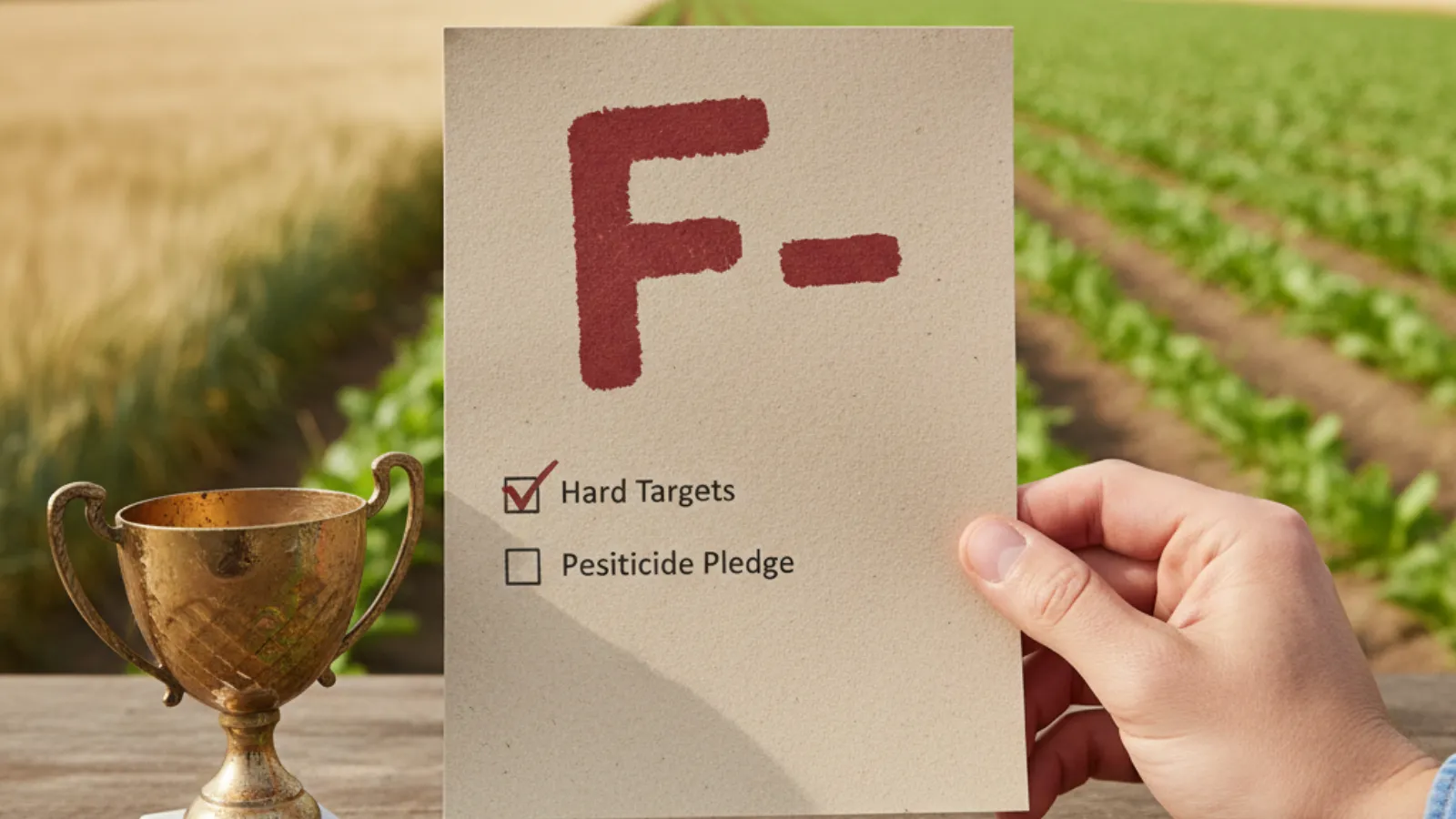
The world's biggest food companies talk about regenerative farming more than ever. The number that back the talk with hard targets just went down. On 29 June, the FAIRR investor network released its new study of 78 listed food and agriculture companies. In 2023, 35% of them had quantified regenerative agriculture targets. That figure is now 28%. Fewer of the world's biggest food companies have hard regenerative farming targets today than three years ago.
FAIRR is a network of institutional investors that tracks risk in the global food system. The companies in its study sell a combined $3.3 trillion of food and drink a year, and the list includes Nestlé, Danone, PepsiCo, General Mills and Conagra Brands. FAIRR's verdict is blunt: there is a "widening credibility gap" between what companies say about regenerative farming and what they can show.
More measuring, fewer promises
On the surface, the report carries good news. The share of companies measuring regenerative agriculture outcomes jumped from 16% in 2023 to 54% today. More than half now connect regenerative farming to their Scope 3 emissions plans, up from 24% three years ago. Then comes the catch. Only 4% of companies have set outcome-based targets. More companies than ever say they measure results, and almost none promise one. Most of that measurement also sits at the project level, a field here and a pilot there. Very little covers the whole company. That makes it nearly impossible for an outsider to judge the real scale of any programme.
The pesticide contradiction
The sharpest finding is about chemicals. 52% of the companies name cutting agrochemical inputs as a goal of their regenerative programmes. Not one of the 78 companies has set a target to reduce pesticide use. The reason is awkward. Popular regenerative practices such as cover crops and reduced tillage often rely on herbicides to work at scale. Only four companies, Conagra Brands, Danone, Nestlé and Sysco, even measure herbicide use in their programmes. FAIRR's María Montosa Ródenas put it plainly: "potential is not the same as progress," and companies "cannot credibly claim to be restoring nature while deploying practices that undermine that goal."
A rulebook arrived the same week
The timing makes the report sting more. Four days earlier, on 25 June, the industry launched its answer to exactly this problem. SAI Platform, the sector's main sustainable farming body, unveiled its Regenerating Together Programme at its annual event in Saskatoon, Canada, with a livestream into London Climate Action Week. More than 40 food and agriculture businesses signed a declaration of intent to scale regenerative agriculture, including Nestlé, Danone, Unilever, Arla, Diageo, McCain Foods and Louis Dreyfus Company. The framework is the first of its kind to include guidance for independent third-party verification and benchmarking. Four days before the scorecard landed, the industry got its first common rulebook for proving regenerative claims.
Who came out well, and why targets vanish
FAIRR did hand out some praise. General Mills was cited for being clear about the scope of its programme. PepsiCo was noted for farmer payment schemes that pay for outcomes rather than activity. But the direction of travel worries the people holding the shares. Arthur van Mansvelt of Achmea Investment Management, a FAIRR member, said investors "are still struggling to assess the credibility of initiatives." Some of the retreat is legal caution, since green-claims rules and eco-label lawsuits have made loose environmental language expensive. Investors read a dropped target as a tell. Pledges shrank just as delivery dates drew near.
What happens when proof becomes possible
Regenerative agriculture now sits where organic food sat decades ago: a story anyone can tell, about to become a standard only some can pass. Verification changes the economics of the claim. When proof becomes possible, unproven claims turn into a liability. For operators, verified regenerative supply could earn the shelf access and pricing power that organic certification once delivered. For investors, the 4% of companies with outcome-based targets is a ready-made screen. For buyers, every supplier deck that says "regenerative" now deserves one question: verified by whom? The next reporting season will show who treats proof as a budget line and who treats it as a slogan.

Global Aseptic Packaging Market Report 2026
148.4bn litres and 344bn packs in 2025. Aseptic volumes across dairy, dairy alternatives, beverages and food in 39 markets — 2025 actuals and forecasts to 2030. Buy online and receive it within 24 hours.
More information
Global Cheese Database 2026
Production, imports, exports and consumption for 39 cheese types across 48 countries, with actuals through 2025 and forecasts to 2030. Join the waitlist for early access, pre-launch pricing and a free sample country chapter.
Get early accessStrategic Insights
📊 Analytics & Strategic Insight
The Gap Between Claiming and Proving Just Became Measurable
The decision most in this industry are avoiding:
👉 Dropping a target can be a confession. Quantified pledges fell from 35% to 28% just as green-claims rules and lawsuits made loose language expensive; the retreat tells you which promises were marketing all along.
👉 Someone has to pay for proof, and it will mostly be the buyer. Third-party verification costs money farmers do not have, so the food companies that budget for it now will set the terms, own the data and take the credit.
👉 The first pesticide target will set the industry benchmark. With 52% naming agrochemical reduction as a goal and zero committing to it, the first mover gets to define what "reduction" means before a regulator does it for them.
Here's the full context:
→ 2010s: Regenerative agriculture moves from a farming niche onto Big Food strategy decks; pledges multiply with no common definition or measurement standard.
→ 2023: FAIRR's first scorecard finds 35% of assessed food companies carry quantified regenerative targets; COP28-era climate alliances push sustainability pledges to a peak.
→ 2024-2025: EU green-claims rules tighten and eco-label lawsuits rise; several food giants quietly trim, soften or drop environmental pledges.
→ 25 June 2026: SAI Platform launches Regenerating Together, the industry's first regenerative framework with third-party verification, backed by more than 40 companies including Nestlé, Danone, Unilever and Arla.
→ Most recent: FAIRR's 29 June report finds quantified targets down to 28%, outcome-based targets at 4%, and no pesticide-reduction target anywhere among 78 companies selling $3.3 trillion a year.
What this means for food and beverage operators and investors:
✅ Audit your claims before an investor does. If your packaging or deck says regenerative and your reporting cannot show an outcome, that gap is now visible, comparable and searchable.
✅ Outcome-based targets are becoming the price of credibility. Hectares enrolled and farmers trained impress no one anymore; soil, water and input numbers with dates attached will separate leaders from the pack.
✅ Verified supply is turning into a sellable asset. As retailers and regulators start asking for proof, independently verified regenerative ingredients could command the access and margin organic certification once delivered.
3 moves you can make this week:
1️⃣ Grade every public claim. List each regenerative or sustainability claim your company makes and mark it verified, partial or unsupported; fix or retire the unsupported ones first.
2️⃣ Cost a verification pilot. Read the Regenerating Together framework and price independent verification for one crop or one sourcing region to learn what proof costs.
3️⃣ Put one outcome in next year's plan. Pick a single measurable outcome, soil organic matter, water use or input reduction, and give it a target, an owner and a budget.
Take the Next Step
🧾 Go deeper on a category.
See our latest deep-dive reports, like our THC beverage report and our China market report.
→ See the latest reports
Zenith Consulting
Submit your food & beverage project enquiry.
Share your requirements. If there is a strong fit, we’ll come back with an indicative investment range, project timeline and recommended strategic approach.
Reviewed by Zenith Consulting’s senior food & beverage strategy team.
Related analyses
- M&A, Investment & Valuation
Parmigiano Reggiano Takes On Australian Parmesan: The EU Trade Deal Protected 53 Cheese Names And Left Parmesan Out
The Parmigiano Reggiano Consortium has opened a three-year campaign in Australia, where cheese output runs at 455,000 tonnes a year. Australia agreed to protect 53 EU cheese names, and parmesan is not one of them.
Read analysis → - M&A, Investment & Valuation
Parmigiano Reggiano Takes On Australian Parmesan: The EU Trade Deal Protected 53 Cheese Names And Left Parmesan Out
The Parmigiano Reggiano Consortium has opened a three-year campaign in Australia, where cheese output runs at 455,000 tonnes a year. Australia agreed to protect 53 EU cheese names, and parmesan is not one of them.
Read analysis → - M&A, Investment & Valuation
Müller Closes Sachsenmilch Semi-Hard Cheese Dairy At Leppersdorf: Mozzarella And Acid Curd Lines Stay
Müller will close the semi-hard cheese dairy at Sachsenmilch Leppersdorf on 31 December 2026, with about 160 staff affected. Mozzarella and acid curd cheese carry on at a site that takes 1.7 billion kg of milk a year.
Read analysis →
Share it with your peers
Pass this analysis to colleagues who track the food and beverage market.
Zenith Market Intel
Need a specific food or beverage market report?
Tell us which category, region or question would be useful for your team.
Sister Publication
Also follow our Water Dispense Market Intelligence
Category analyses, operator briefings, and investor signals across the global water dispense market.