
Know where aseptic packaging demand is actually growing
39 markets. 2025 actuals. Forecasts to 2030. Market size, category, pack format, filling technology and competitive landscape — built from the bottom up.
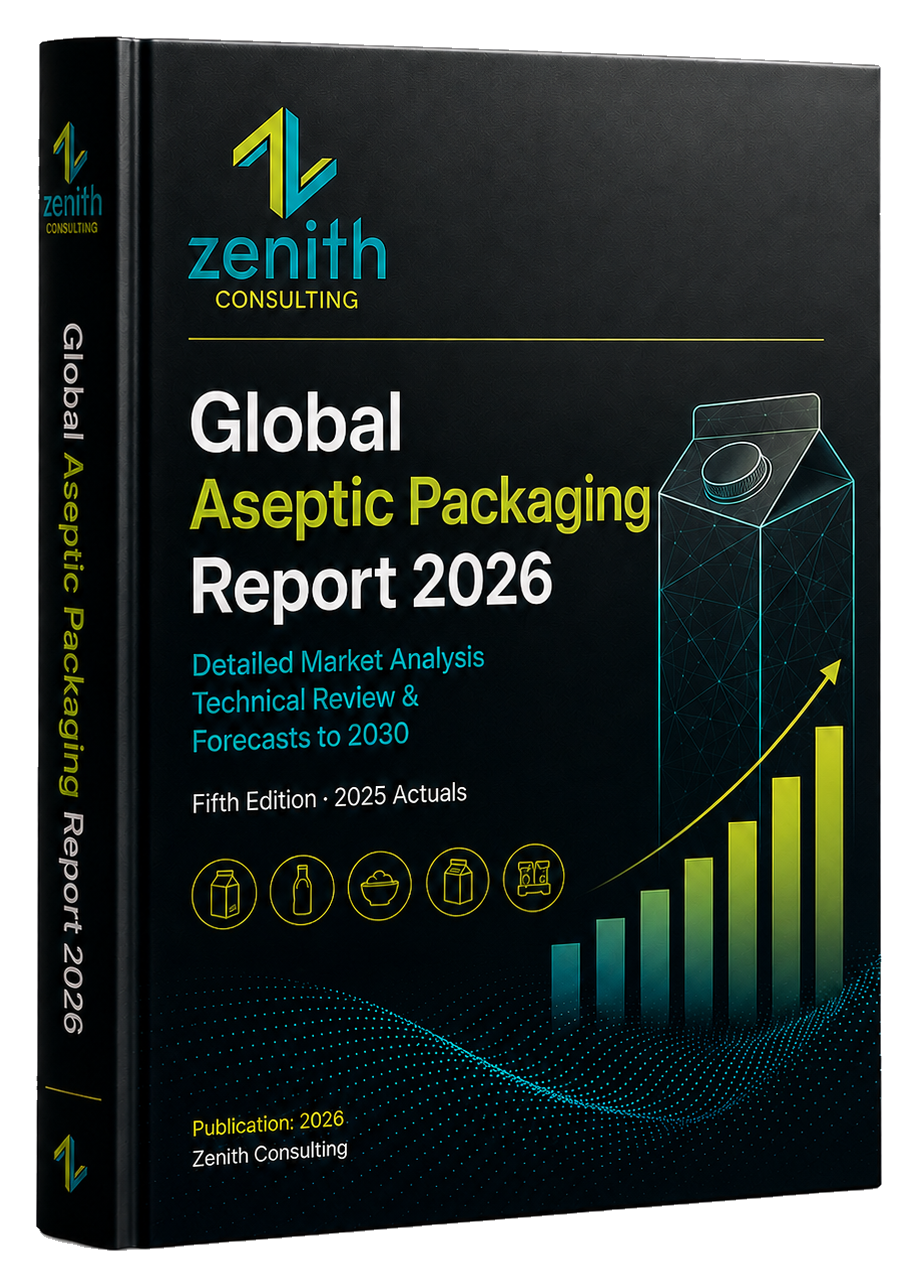
Make better-informed decisions on market entry, capacity, sales priorities and investment with Zenith's fifth global study of aseptic packaging.
148.4bn litres in 2025 · 344bn packs · 39 markets · Forecasts to 2030
A global market number isn't enough to make an investment decision
Two companies can both be exposed to “aseptic packaging” while facing completely different opportunities. Growth differs substantially by country, product category, pack format and filling technology.
A mature European UHT milk market dominated by cartons creates a very different commercial opportunity from a fast-growing Asian beverage market adding aseptic PET capacity.
Global Aseptic Packaging 2026 was built to show those differences. Instead of beginning with a global estimate and dividing it between regions, Zenith reconstructs individual markets from local production, filling activity, installed capacity and trade.
What do you need to know before you invest?
- Which countries are adding the most aseptic volume?
- Which product categories are creating incremental demand?
- Where is PET gaining against carton?
- Which markets are likely to require additional filling or converting capacity?
- How large is the opportunity in the specific countries relevant to our business?
- Which suppliers, technologies and pack formats are established in each market?
- Where should we prioritise sales, capacity or investment through 2030?
Not Another Top-Down Packaging Forecast
Most global market reports start with a worldwide number and divide it into regions. Zenith works in the opposite direction. We research individual markets first.
39 markets → local production and filling activity → product categories and pack formats → regional totals → global market
This production-based approach helps show where aseptic products are actually being manufactured and packed — and therefore where filling equipment, packaging materials and converting demand are being generated.
Zenith has tracked the global aseptic packaging market for more than two decades. The fifth edition rebuilds the dataset market by market using 2025 actual data and forecasts to 2030.
39 individual markets
Modelled market by market, not derived from a single global total.
Eight regions
Regional roll-ups sit above the country detail for comparison.
2025 latest actual year
Forecast horizon runs to 2030 alongside the historical series.
Production basis
Local production, filling activity, capacity, imports and exports.
Four product groups
White milk, other dairy, beverages and food products.
Pack type and pack size
Cartons, bottles, pouches and cups, split by size band.
Production-based market measurement
The study measures products manufactured and aseptically packed within each market rather than simply estimating domestic consumption. This enables filling activity, production capacity and pack demand to be assessed more accurately.
Akos Petri
Managing Director, Zenith Global Commercial
Zenith Global Commercial is a market intelligence and strategy consultancy covering the global food, beverage and packaging industries.
- Global Aseptic Packaging 2026 is the current edition.
- 2025 is the latest actual year.
- Forecast horizon: 2030.
One Study. From the Global Market Down to the Individual Country.
The report combines global and regional analysis with 39 consistently structured country markets, allowing you to move from the headline market to the geography, category and pack format relevant to your business.
- Global aseptic packaging volumes by country, region and category
- Pack-format split: aseptic cartons, bottles, pouches, cups and other formats
- Filling capacity and local production validated market by market
- Category performance across dairy, dairy alternatives, juice, still drinks and liquid food
- Five-year forecast series to 2030 with growth drivers and headwinds
- Trade flow and import/export adjustments applied to consumption estimates
- Competitive landscape across filling equipment and packaging suppliers
- Named supplier profiles across filling equipment, packaging systems and materials, plus an other-suppliers directory
- Volume series in million litres and million units by region and country
- Methodology notes and definitions consistent with earlier Zenith editions
Part 1 — World markets for aseptic packaging
- Global aseptic and ultra-clean volumes by category
- Regional roll-ups and comparative growth
- Pack-format split: cartons, bottles, pouches, cups and other
- History plus a five-year forecast series
Part 2 — Regional and country markets
- 39 country chapters with a consistent structure
- White milk, other dairy and dairy alternatives, beverages and food
- Local suppliers, UHT and aseptic usage per market
- Ambient processing and packaging trends by country
Part 3 — Technical developments and supplier profiles
- Filling equipment and packaging system developments
- Named profiles of leading equipment and packaging suppliers
- Material supplier landscape
- Directory of other suppliers
Inside every country chapter
- Overview — use of aseptic packaging by product
- White milk — market size, suppliers, UHT and aseptic use
- Other dairy and dairy alternatives — flavoured milk and milk drinks, cream and creamer, soft ice and thick shake base, yogurt and desserts, drinking yogurt, condensed milk, baby milk, soya
- Beverages — market size, suppliers, ambient processing and packaging, future trends
- Food products — soups and sauces, tomato products, baby foods
Scope and definitions
Covered
- • Aseptic and ultra-clean filling systems
- • Retail and catering pack sizes up to 25 litres/kg
- • Volumes in million litres and million units
- • History, current-year actuals and a five-year forecast
Not covered
- • Alcoholic beverages
- • Medical and pharmaceutical applications
- • Bulk and industrial packs above 25 litres/kg
39 Markets Researched Individually
Compare production, categories, filling technologies and pack formats across the world's major aseptic packaging markets — using a consistent methodology.
- Algeria
- Argentina
- Australia
- Belgium
- Brazil
- Canada
- Chile
- China
- Colombia
- Egypt
- France
- Germany
- Hungary
- India
- Indonesia
- Israel
- Italy
- Japan
- Kenya
- Malaysia
- Mexico
- Netherlands
- Nigeria
- Pakistan
- Philippines
- Poland
- Russia
- Saudi Arabia
- South Africa
- South Korea
- Spain
- Taiwan
- Thailand
- Turkey
- Ukraine
- United Arab Emirates
- United Kingdom
- United States
- Vietnam
Regional roll-ups for Europe, the Americas, Asia Pacific, the Middle East and Africa are included alongside the country detail. All figures are presented on a production basis.
Built for Commercial Decisions
Packaging converters & material suppliers
Identify priority markets, categories and formats and understand where packaging demand is moving.
Filling & processing equipment manufacturers
Track where production and filling activity are expanding and where capacity requirements may change.
Food, dairy & beverage producers
Benchmark markets and packaging formats and understand how aseptic production is developing internationally.
Strategy & corporate development teams
Size opportunities before entering a market, allocating capital or developing international growth plans.
Investors & M&A teams
Understand the underlying market drivers behind packaging, filling and equipment businesses.
Three Shifts Reshaping the Market
From Milk to Beverages
Beverages have overtaken white milk as the largest use of aseptic packaging globally.
From West to East
Incremental aseptic beverage growth is increasingly concentrated in Asia, led by China.
From Carton toward PET
Cartons remain the dominant global aseptic format, but PET is capturing an increasing share of incremental beverage volume.
Global Aseptic Packaging Market 2026 — Key Findings
148.4bn litres
Global aseptic packaging volume in 2025
344bn packs
Aseptic packs filled worldwide in 2025
159.6bn litres
Forecast global volume by 2030
1.4% CAGR
Global volume growth, 2020–2025
60.2bn litres
Aseptic beverage volume in 2025
Beverages overtook white milk during the review period to become the world's largest single use of aseptic packaging, accounting for 40.6% of global aseptic volume in 2025.
UHT white milk accounted for 52.7 billion litres, or 35.5% of global volume. Other dairy products reached 27.2 billion litres and food products 8.3 billion litres.
Aseptic Packaging Market Outlook 2026–2030
Global aseptic packaging remains a growth market, but the growth is shifting between categories, regions and pack formats rather than lifting the whole market evenly. Global aseptic volume reached 148.4 billion litres in 2025 and is forecast to reach 159.6 billion litres by 2030. The headline rate — 1.4% a year between 2020 and 2025 — conceals major differences beneath it.
The clearest structural change is that beverages have overtaken white milk as the largest use of aseptic packaging. In 2025 beverages accounted for 60.2 billion litres, or 40.6% of global aseptic volume, against 52.7 billion litres and 35.5% for UHT white milk. Other dairy products contributed 27.2 billion litres and food products 8.3 billion litres. That mix matters commercially: a mature UHT milk market losing momentum and a fast-expanding Asian beverage market can sit inside the same global growth figure while following completely different trajectories, and a supplier's exposure to one tells you very little about its exposure to the other.
Aseptic filling also competes for the same litres as other ambient technologies. Of the 154.6 billion litres of ambient long-life beverages produced worldwide in 2025, hot filling took 42.6%, aseptic filling 38.9% and preservative-based filling 18.5%. By 2030 Zenith forecasts hot filling at 40.5%, aseptic filling at 40.0% and preservative-based filling at 19.5% — so aseptic filling is forecast to close most of its historical gap with hot filling over the period, without displacing it outright.
Geographically, the centre of incremental aseptic beverage growth is increasingly Asian. China alone accounted for 17.9 billion litres of aseptic beverage volume in 2025 and grew at 8.5% a year between 2020 and 2025 — a scale and pace that reshapes where filling capacity, converting capacity and equipment demand are added.
Pack format is moving too. Large PET reached 25.9 billion litres and became the world's largest aseptic beverage pack format, reflecting how beverage growth and PET filling capacity have advanced together. Across total aseptic packaging, however, cartons remain dominant and still account for 66.5% of world aseptic volume, carried by the dairy and liquid food base.
Exposure to aseptic packaging alone is increasingly an insufficient measure of opportunity. Geography, product category and pack format determine where growth is actually taking place.
Ambient long-life beverage volume by filling technology
Share of 154.6bn litres produced worldwide, 2025 actual and 2030 forecast.
| Technology | 2025 | 2030 |
|---|---|---|
| Hot filling | 42.6% | 40.5% |
| Aseptic filling | 38.9% | 40.0% |
| Preservative-based filling | 18.5% | 19.5% |
Three Factors Shaping the Aseptic Packaging Market to 2030
- 01
Whether aseptic PET filling capacity in Asia continues expanding.
- 02
Whether juices and nectars stabilise after several years of decline.
- 03
Whether UHT milk growth in the Middle East, Africa and South East Asia offsets weaker mature markets.
For equipment suppliers, converters, producers and investors, the resulting opportunities differ substantially by geography, category and pack format.
See Exactly What You're Buying
Review the research approach, structure and level of market detail before deciding whether the full study is right for you. The free 40-page sample includes the introduction and methodology, product and packaging definitions, the full table of contents, world market extracts, East Europe analysis and an extract from the Hungary country chapter.
This is an extract from the actual 2026 study — not a separate marketing brochure.
Illustrative sample pages. Click to enlarge.
What the sample shows
- Introduction, research method and the production-basis explanation
- Product and packaging definitions
- Full table of contents for the report
- Extracts from the world market overview, including product and pack-type data
- Extracts from the East Europe overview and Hungary country chapter
Instant browser access plus PDF download. Enter your name, company and business email and we will also email the link so you can return to it or forward it to colleagues.
Free sample access
Get the sample edition
Buy Global Aseptic Packaging 2026
Choose the licence that fits your organisation. Every licence includes direct analyst support, with follow-up questions answered by Akos Petri, Managing Director of Zenith Global Commercial. Your report and invoice are delivered within 24 hours of purchase. No VAT is charged outside the UK.
Buy now and if we publish the next edition within 3 months of your purchase, you receive it free of charge.
Single-user licence
One named user within your organisation.
- Full report PDF for one named user
- 39 country chapters plus world and regional markets
- Supplier profiles and technical developments
- Emailed by Akos Petri within 24 hours
- Follow-up questions answered by Akos Petri
Departmental licence
Unlimited use within one team or department.
- Everything in the single-user licence
- Share internally across one department or team
- Use in internal presentations and planning packs
- Emailed by Akos Petri within 24 hours
- Follow-up questions answered by Akos Petri
Global corporate licence
Your entire organisation, worldwide.
- Everything in the departmental licence
- Unlimited internal users across all sites and countries
- Group-wide strategy, M&A and capacity planning use
- Emailed by Akos Petri within 24 hours
- Follow-up questions answered by Akos Petri
Secure card payment. No VAT outside the UK — UK-registered businesses are charged UK VAT at 20%.
Report delivered by email within 24 hours of purchase, with your invoice sent immediately.
Need multi-site terms, a purchase order or an invoice-first purchase? Talk to us.
Purchased the 2018 fourth edition? Email us before you buy and we will honour your original 2018 pricing.
Frequently Asked Questions
What is the size of the global aseptic packaging market?
Zenith Global Commercial estimates that 148.4 billion litres of product were aseptically packed worldwide in 2025, equivalent to approximately 344 billion packs. Global volume is forecast to reach 159.6 billion litres by 2030.
What is the largest use of aseptic packaging?
Beverages became the world's largest use of aseptic packaging during the 2020–2025 review period, reaching 60.2 billion litres in 2025, or 40.6% of total aseptic volume. UHT white milk accounted for 52.7 billion litres, or 35.5%.
Is the aseptic packaging market growing?
Yes. Global aseptic packaging volume grew at an average rate of 1.4% a year between 2020 and 2025. Zenith Global Commercial forecasts further growth to 159.6 billion litres by 2030, although performance varies substantially by geography, product category and pack format.
Which regions are driving aseptic packaging growth?
Growth in aseptic beverages is increasingly concentrated in Asia. China accounted for 17.9 billion litres of aseptic beverage volume in 2025 and was the largest source of incremental aseptic beverage volume during the review period.
Are cartons still the largest aseptic packaging format?
Yes. Cartons still carry 66.5% of global aseptic volume across all product categories. However, PET is becoming increasingly important in beverages, with large PET reaching 25.9 billion litres in 2025.
What does the Global Aseptic Packaging 2026 report cover?
The study models 39 individual markets across eight regions, covering white milk, other dairy products, beverages and food products by pack type and size. Figures are presented on a production basis, with 2025 as the latest actual year and forecasts to 2030.
How does Zenith calculate aseptic packaging market volumes?
Zenith Global Commercial uses a bottom-up research approach based on local production, filling activity, capacity and trade flows rather than relying solely on top-line market extrapolation.