Milkfat Is Winning the Dairy Glut: Why Butter Is Firm and Milk Powder Is Crashing for Arla, Fonterra and Lactalis
The world is making far too much milk, yet butter keeps getting more expensive while milk powder collapses. Here is why the dairy glut is splitting in two and quietly redrawing the margin map for Arla, Fonterra, Lactalis and every big dairy processor.
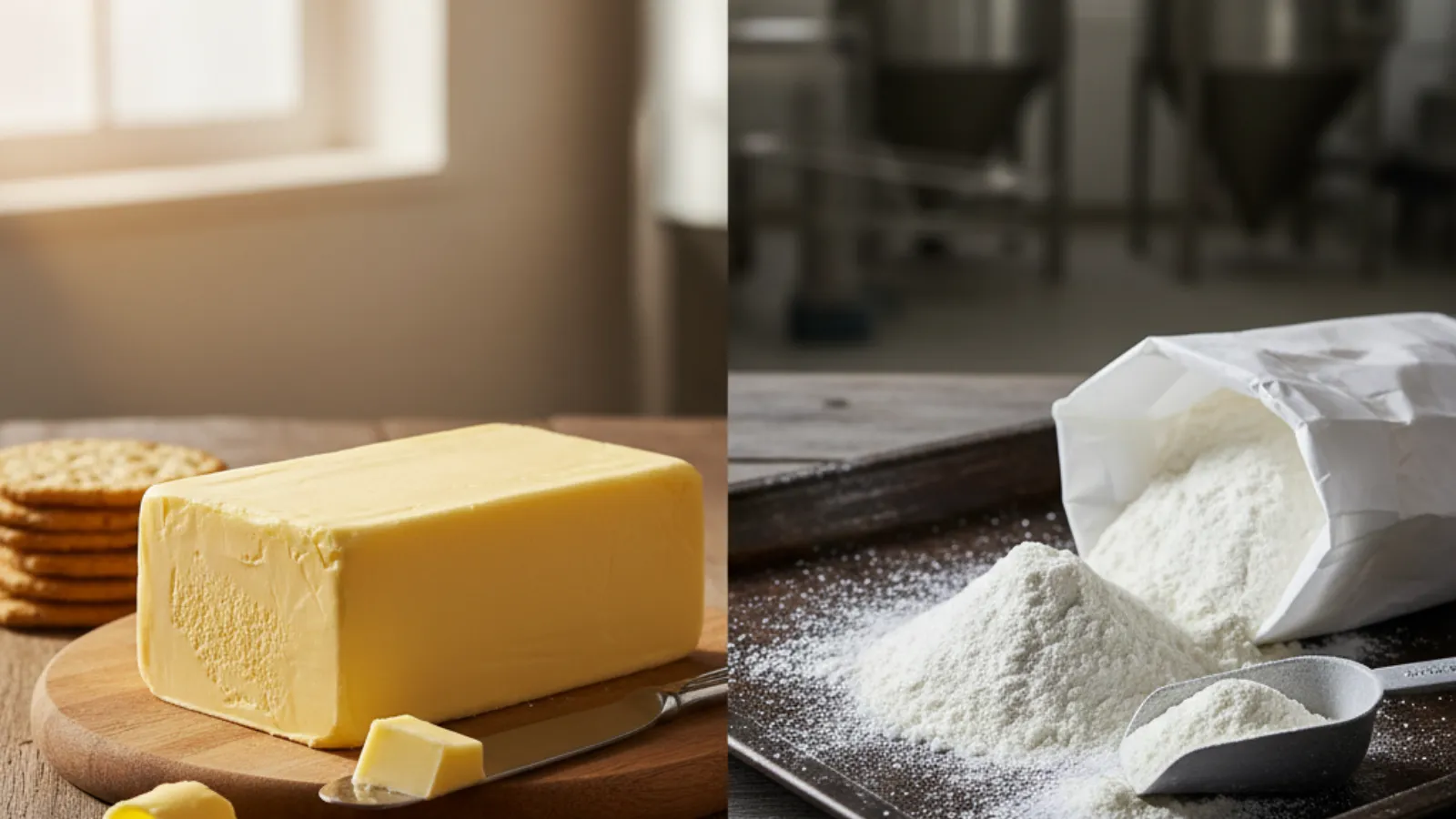
The world is drowning in milk. Yet butter keeps getting more expensive. That gap is the most important story in dairy right now, and most of the industry is reading it wrong.
The wall of milk is real
Farmers in the US, the EU, New Zealand and South America are all milking more cows. Late in 2025, global milk output grew about 5.5% from a year earlier. The long-run average is closer to 1.4%. That is a flood, not a trickle.
Normally a flood of milk crushes every price. In the US it did exactly that. The all-milk price fell below $20 per hundredweight by late 2025, more than 20% lower than a year before. Many farmers are now selling milk for less than it costs to make.
But the glut split in two
Here is the twist: the surplus is not spread evenly. Milk has two main parts that sell on their own markets. One is fat, which becomes butter, cream and anhydrous milk fat. The other is protein, which is dried into powders like skim milk powder.
Right now those two halves are moving in opposite directions. At the Global Dairy Trade auction on 2 June 2026, butter rose 1.2% to $5,734 a tonne and anhydrous milk fat jumped 5.3% to $6,668 a tonne. In the same sale, skim milk powder fell 3.0% to $3,457 a tonne. In Europe the gap is even wider: butter is up about 14% on the year, while skim milk powder is down roughly 46%. Fat is scarce. Protein is drowning.
Why fat is winning
The reason is demand, not supply. Shoppers gave up on the low-fat rule years ago. They want real butter, full-fat dairy, cream and cheese. That pulls milk solids toward fat products and leaves less skim behind. The thing everyone was told to fear, fat, is now the part that pays.
Cheese tells the same story. Cheddar edged up 1.8% to $4,621 a tonne at the same June auction, because cheese is fat-rich and rides the same demand wave. The US has tipped so far that analysts at CoBank describe its dairy system as short on protein and long on butterfat. Europe shows the mirror image in its powder stockpiles. Either way the message is the same: the easy money is in fat.
The problem for big dairy
This is awkward, because the big processors spent the last decade chasing protein. Arla, FrieslandCampina, Fonterra, Danone and Lactalis all built their growth story on protein. High-protein yogurt, whey for sports drinks, and milk powders for infant formula were supposed to be the premium future. Plain butter and cream were the boring base.
Now the boring base is the profit. Companies that can swing more milk into butter, cream and cheese are catching the better price. Pure powder exporters, especially those leaning on skim, are stuck on the wrong side of the split. A plant built to dry skim cannot turn into a butter churn overnight.
What happens next
None of this lasts forever. Low farmgate prices will eventually slow the cows, and the protein powders will find a floor. But the lesson for operators and investors is bigger than one auction. A glut is not one price falling. It is a sorting machine that decides which part of the cow gets paid. For now it is paying fat.
For anyone buying a dairy asset this year, the question is no longer just how much milk it handles. It is how much fat it can capture, and how fast it can shift the mix when the market turns again. The companies that can move milk solids toward the scarce half will protect their margins. The ones locked into commodity powder will keep explaining a price they cannot control.
Global Aseptic Packaging Market Report 2026
148.4bn litres and 344bn packs in 2025. Aseptic volumes across dairy, dairy alternatives, beverages and food in 39 markets — 2025 actuals and forecasts to 2030. Buy online and receive it within 24 hours.
More information
Global Cheese Database 2026
Production, imports, exports and consumption for 39 cheese types across 48 countries, with actuals through 2025 and forecasts to 2030. Join the waitlist for early access, pre-launch pricing and a free sample country chapter.
Get early accessStrategic Insights
📊 Analytics & Strategic Insight
The dairy glut is a sorting machine, not a price crash
The decision most in this industry are avoiding:
👉 Treating the glut as one number. Most boards model dairy prices down by some percentage. The real action is the fat-versus-protein split, and few profit-and-loss statements are built to show it.
👉 Defending the protein pivot after the scarcity premium moved to fat. A decade of spending went into whey and powder; the better margin now sits in the butter and cream that got dismissed as commodity.
👉 Quoting a single milk price in deal models. Underwriting a dairy asset on one blended milk value hides whether the plant captures fat or just dries skim into a soft world market.
Here's the full context:
→ 2024: The low-fat rule fully reverses; demand for full-fat dairy, butter and cream climbs across developed markets.
→ Late 2025: Global milk output grows about 5.5% year on year against a long-run average near 1.4% — the wall of milk. The US all-milk price falls below $20 per hundredweight, more than 20% lower than a year earlier.
→ Winter 2025-26: Fat prices correct hard from their 2025 highs, but protein powders stay soft as supply keeps building underneath them.
→ May 2026: EU butter sits up about 14% year on year while skim milk powder is down roughly 46% — the split widens.
→ Most recent: At the 2 June 2026 Global Dairy Trade auction, butter (+1.2% to $5,734 a tonne) and anhydrous milk fat (+5.3% to $6,668 a tonne) rise while skim milk powder falls 3.0% to $3,457 a tonne.
What this means for food and beverage operators and investors:
✅ Mix beats volume. Processors that can swing milk solids into butter, cream and cheese will out-earn pure powder exporters through 2026.
✅ Protein is not dead, it is crowded. The premium compressed because everyone built the same capacity; differentiated protein for infant, clinical and functional use still pays, plain skim does not.
✅ Farmgate pain is a buy signal. Milk selling near or below cost will force consolidation and asset sales, and strategic buyers who are long butterfat get the cleaner entry.
3 moves you can make this week:
1️⃣ Re-cut your dairy exposure by stream, not by milk. Split butterfat and protein in every model and supply contract so you can see which half actually drives the margin.
2️⃣ Pressure-test capex tilted to powder. If a project assumes a scarcity premium that has shifted to fat, re-rank it against fat-capture or cheese projects.
3️⃣ Screen distressed milk regions now. Map the processors selling near or below cost; the ones long butterfat are the better acquisition or supply targets.
Take the Next Step
💧 Also covering the water dispense market?
Water dispense is one of the fastest-growing segments in food and beverage. Operator data, revenue benchmarks, and market intelligence across 32 countries.
→ Explore water dispense insights
Zenith Consulting
Submit your food & beverage project enquiry.
Share your requirements. If there is a strong fit, we’ll come back with an indicative investment range, project timeline and recommended strategic approach.
Reviewed by Zenith Consulting’s senior food & beverage strategy team.
Related analyses
- Health, Nutrition & Functional
US Bans Canadian Whey From 29 September: The Cheese Vat Now Sets The Protein Price
Washington shuts eight lines of Canadian whey out of the country from 29 September 2026. The ban lands on a protein market with nothing spare, and every extra pound of whey protein has to come off a cheese vat.
Read analysis → - Health, Nutrition & Functional
Canada Puts 25% On All US Cheese: Cheddar And Mozzarella Now Pay Duty Inside The USMCA Quota
Canada's 25% surtax on US cheese took effect on 8 September 2026. It lands inside the duty free quota, where American cheddar and mozzarella have paid nothing since USMCA began.
Read analysis → - Health, Nutrition & Functional
Allulose Lawsuits Hit Liquid Death, WK Kellogg And KIND: The FDA Green Light That Was Never A Defence
Five food and drinks brands were sued in one week over zero sugar claims on packs sweetened with allulose. The FDA said it would not act on the back panel, and it never changed the rule on the front.
Read analysis →
Share it with your peers
Pass this analysis to colleagues who track the food and beverage market.
Zenith Market Intel
Need a specific food or beverage market report?
Tell us which category, region or question would be useful for your team.
Sister Publication
Also follow our Water Dispense Market Intelligence
Category analyses, operator briefings, and investor signals across the global water dispense market.