Mondelez Added 100,000 Indian Stores in One Quarter While European Pricing Turned Negative
Mondelez added 100,000 stores in India in a single quarter and passed one million outlets in Brazil, while European organic revenue fell 3.5% with pricing down 1.4 points. The Q2 2026 numbers show where snacking growth now comes from, and what happens when the pricing lever runs out.
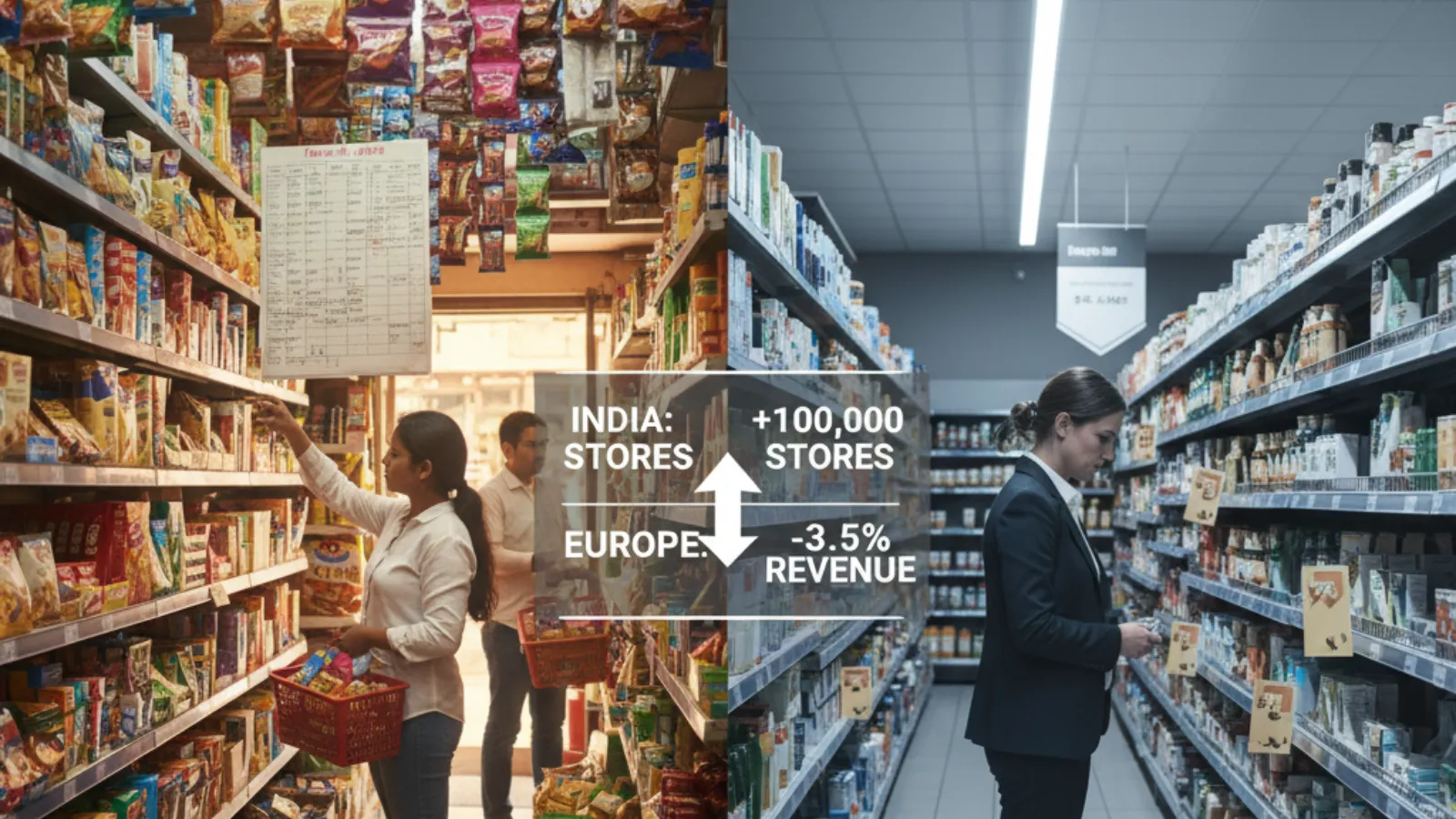
Mondelez put its snacks into 100,000 more Indian shops in three months. In Brazil it crossed one million stores. Those two numbers explain the second quarter better than any brand campaign the company ran, and they point at the biggest quiet change in how large food businesses now grow.
One half sold more. The other half sold the same.
The owner of Oreo, Cadbury Dairy Milk, Ritz and Milka reported net revenue of $9,355m for the quarter to 30 June 2026, up 4.1%. Organic net revenue, which strips out currency and deals, rose 2.2%. Underneath that single average sit two businesses moving in opposite directions.
Emerging markets delivered $3,909m of revenue and organic growth of 4.4%, with volume and mix adding 1.6 percentage points and pricing 2.8. Developed markets delivered $5,446m, organic growth of 0.7%, and volume and mix of exactly zero. Every point of growth in the richer half of the portfolio came from price, and none of it came from anyone eating more.
Asia, Middle East and Africa was the standout, with organic growth of 7.1% built mostly on volume and mix of 5.2 points. Latin America grew 8.4% organically, though 7.9 of those points were price. North America returned to 3.4% organic growth with volume and mix positive at 1.2 points, and the company said it gained share in every category there.
Half the growth is new customers, not fuller baskets
On the 28 July call, chief executive Dirk Van de Put gave analysts the number that matters. In markets such as India and China, roughly half of revenue growth consistently comes from shops that were not customers a year earlier. India added 100,000 outlets in the quarter to reach around 400,000. Brazil passed the million mark. Van de Put described the pattern as structural rather than cyclical, which is a polite way of saying the growth is bought with vans, coolers, credit terms and salespeople rather than with advertising.
That distinction matters more than it sounds. Growth from new outlets is a sales and logistics achievement. Growth from existing outlets is a brand achievement. They cost different money, they need different skills, and they stop for different reasons. A company that adds 100,000 shops in a quarter has a finite runway, because eventually the map fills up. A company whose existing shoppers buy more has no ceiling at all.
In Europe, the price lever went into reverse
Europe remains the largest region at $3,377m of revenue, and it went backwards. Organic revenue fell 3.5%, with volume and mix down 2.1 points. Pricing in Europe was negative 1.4 points, which means the company sold at lower prices than a year ago and still shifted fewer units.
Management blamed the summer heatwave for weak chocolate sales and pointed to subdued consumer confidence, energy costs and a broad shift into value products. Volumes should recover in the second half, Van de Put said, helped by easier comparisons and activity behind Biscoff and Milka. The wider signal is harder to argue with. Price has been the main growth engine across packaged food since 2021. In the biggest region of one of the biggest snacking companies in the world, it has stopped being one.
Reach costs margin before it pays
The reported figures look spectacular. Gross margin of 42.6%, up 9.9 percentage points. Operating margin of 20.8%, up 7.8 points. Diluted earnings per share of $1.20, up 144.9%, flattered heavily by swings in commodity and currency derivatives.
The adjusted figures describe the actual operating year. Adjusted gross margin rose 0.2 points to 34.0%. Adjusted operating margin fell 1.2 points to 13.1%. Adjusted earnings per share fell 2.7% in constant currency to $0.73. Mondelez grew its top line and shrank its operating margin in the same quarter, held back by higher raw material costs, heavier advertising and promotion, an ERP programme and extra costs from the Middle East conflict.
Cocoa has not gone away either. Operating chief Luca Zaramella flagged a below-average pod count, a short squeeze in the futures market and the risk of a strong El Nino weather event. The industry now sits on roughly ten months of forward cover, against seven months during the 2024 crisis, so the pain arrives later rather than never.
What to take from it
Mondelez raised its full-year organic revenue guidance to at least 2%, held adjusted EPS growth at flat to 5% in constant currency, kept free cash flow guidance near $3bn and lifted the dividend 4%. The company is choosing volume and reach over near-term margin, and telling investors plainly that any upside gets reinvested.
For operators, the lesson is that route to market has quietly become the highest-return investment in packaged food, and it is the one most western businesses stopped funding a decade ago. For investors, the screening question changes: ask any consumer goods company how much of its growth came from new points of sale, and how much came from the ones it already had. For buyers, assets with a built distribution network in India, Brazil, Mexico or Southeast Asia are about to get more expensive, because the acquirers have just been shown what that network is worth.

Global Aseptic Packaging Market Report 2026
148.4bn litres and 344bn packs in 2025. Aseptic volumes across dairy, dairy alternatives, beverages and food in 39 markets — 2025 actuals and forecasts to 2030. Buy online and receive it within 24 hours.
More information
Global Cheese Database 2026
Production, imports, exports and consumption for 39 cheese types across 48 countries, with actuals through 2025 and forecasts to 2030. Join the waitlist for early access, pre-launch pricing and a free sample country chapter.
Get early accessStrategic Insights
📊 Analytics & Strategic Insight
Growth from new shops and growth from the same shops are two different businesses
The decision most in this industry are avoiding:
👉 Splitting the growth number in two. Most boards look at one figure. Two very different things sit inside it. Selling to shops you did not sell to last year is a sales job. Getting the same shops to sell more is a brand job. They need different people and different money.
👉 Saying out loud that price has stopped working at home. In the biggest region here, prices went down and units still fell. Many teams still build next year on the idea that a price rise is always there if they need it.
👉 Paying for reach before it pays back. New shops cost money today. They pay you later. Profit per sale drops first. Very few plans say that in plain words to the board.
Here's the full context:
→ 2021 to 2023: Food and drink firms pushed prices up hard to cover higher costs. Sales figures grew. Shoppers slowly bought fewer units.
→ 2024: Cocoa hit record highs. Chocolate makers put through another round of price rises and lost more volume.
→ 2025: Mondelez sold about $38.5bn of snacks across more than 150 countries, with the fastest growth well away from Europe and the United States.
→ First half of 2026: Shoppers in Europe and North America kept trading down. Cheap store brands took more shelf. Big food firms started spending on getting into more shops instead of charging more in the ones they had.
→ Most recent: On 28 July 2026 Mondelez reported adding 100,000 Indian shops in three months and passing one million shops in Brazil, while European sales fell 3.5% with prices down 1.4 points.
What this means for food and beverage operators and investors:
✅ A growth number without a shop count is half a number. Two firms can both report 4% and be in completely different health. One found new buyers. One squeezed the buyers it had.
✅ Reach has a ceiling and price does not have a floor. Adding shops works until the map is full. Cutting prices to hold units can run a lot further down than most plans allow for.
✅ The worth of a sales network just went up. Any business with vans, fridges and a real route into small shops in India, Brazil, Mexico or Southeast Asia is now worth more to a buyer than it was six months ago.
3 moves you can make this week:
1️⃣ Split last year into new outlets and old outlets. Ask your sales team for two lines: money from shops that were not customers 12 months ago, and money from the rest. Most teams have never been asked, and the answer usually surprises the board.
2️⃣ Write down what happens if you cannot raise prices next year. One page. What you cut, what you keep, where the units come from. Do it while things are calm, not in the middle of a budget round.
3️⃣ Count the shops you could reach and do not. Pick one region. Work out how many outlets sell your category and how many sell you. That gap is your cheapest growth, and it is usually bigger than anyone guesses.
Take the Next Step
💬 You don't need a written brief.
Tell us what you are weighing up, and we will come back with the likely project scope, recommended direction and cost range.
→ Tell us what you're planning
Zenith Consulting
Submit your food & beverage project enquiry.
Share your requirements. If there is a strong fit, we’ll come back with an indicative investment range, project timeline and recommended strategic approach.
Reviewed by Zenith Consulting’s senior food & beverage strategy team.
Related analyses
- Corporate Strategy & Portfolio
Cheddar Jumps 16.5% While Mozzarella Falls 6%: The GDT Cheese Spread Swung $824 A Tonne In Two Weeks
Cheddar rose 16.5% and mozzarella fell 6.0% at the same Global Dairy Trade auction on 15 September. Two cheeses made from the same milk moved $824 a tonne apart in a fortnight, and the reason sits in the vats.
Read analysis → - Corporate Strategy & Portfolio
SIG Backs India's Regional Drinks: Aseptic Filling Has Fallen To 40.3% Of Indian Ambient Beverage Volume
SIG argues that aseptic cartons can take India's regional drinks national. Zenith's India data shows aseptic filling losing 17 points of ambient beverage share since 2020, while UHT milk grows at 12.3% a year.
Read analysis → - Corporate Strategy & Portfolio
China Aseptic Packaging: Litres Keep Rising, Packs Have Stopped, And The Average Pack Is Now 343ml
China filled 37,391 million litres of aseptic product in 2025 and used no more packs than it did in 2020. Zenith's Global Aseptic Packaging Market Report 2026 shows why the litre line and the pack line have split.
Read analysis →
Share it with your peers
Pass this analysis to colleagues who track the food and beverage market.
Zenith Market Intel
Need a specific food or beverage market report?
Tell us which category, region or question would be useful for your team.
Sister Publication
Also follow our Water Dispense Market Intelligence
Category analyses, operator briefings, and investor signals across the global water dispense market.