Coca-Cola's Braun Era Begins With a Beat — Mondelez Operating Income Crashes 19%: Q1 2026 Results Verdict
Coca-Cola's new CEO Henrique Braun delivered 3% global volume growth and a guidance upgrade in his debut quarterly report, outpacing PepsiCo's -2.5% beverage volume decline from two weeks earlier. On the same morning, Mondelez beat revenue expectations by over $300 million but saw adjusted operating income collapse 19% at constant currency — confirming that Big Food's commodity cost hangover will not lift before 2027.
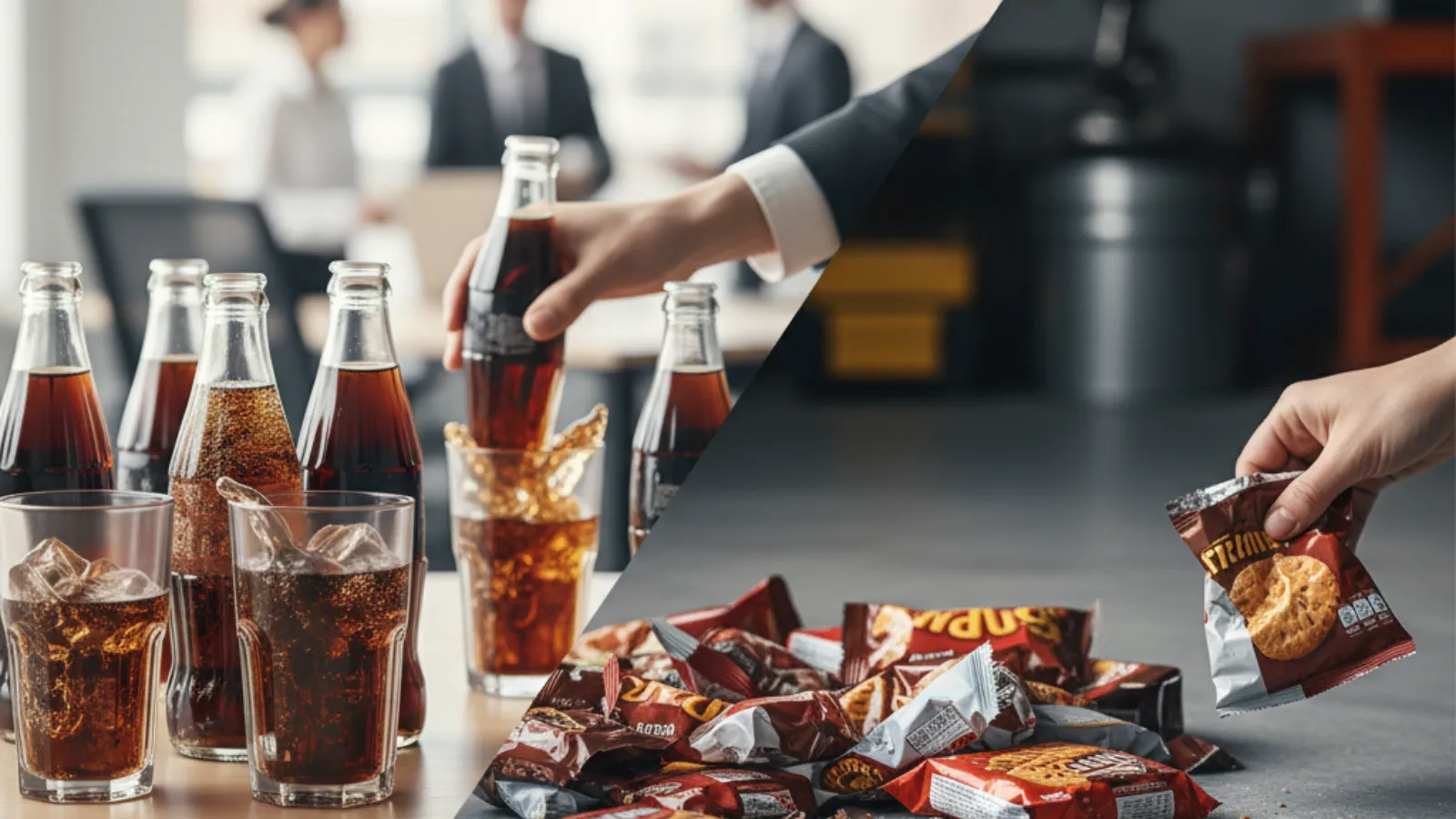
Two of the world's largest food and beverage companies reported on the same morning. One raised its full-year earnings guidance on its CEO's first day at the helm. The other beat revenue estimates by more than $300 million and still saw its profit fall by nearly a fifth. April 28, 2026 did not resolve Big Food's uncertainty — it clarified exactly which franchises are absorbing commodity shocks and which are compounding structural volume.
Coca-Cola Under Braun: Volume Where PepsiCo Found None
Henrique Braun's first quarterly report as Coca-Cola CEO arrived with a 3% increase in global unit case volume — a number that deserves context. Three weeks earlier, PepsiCo reported -2.5% North American beverage volume for the same quarter, funding a food recovery through price cuts of up to 15%. Coca-Cola grew volume across every category except juice and value-added dairy, where it declined 1%. Sparkling soft drinks added 2%, led by a 13% surge in Coca-Cola Zero Sugar. Water, sports, coffee, and tea — the fastest-growing combined segment — rose 5%.
Revenue came in at $12.47 billion, up 11.2% year on year, with organic growth of 10%. This beat the $12.3 billion analyst consensus by more than $150 million. Comparable EPS reached $0.86, up 18%, with the comparable operating margin expanding 70 basis points to 34.5%. Free cash flow of $1.8 billion was generated in the quarter alone.
Braun immediately raised full-year EPS guidance from 7–8% growth to 8–9%, citing a lower effective tax rate. Organic revenue growth guidance of 4–5% was maintained. The signal matters less for the specific number and more for its timing: a new CEO rarely upgrades guidance on their debut report unless the underlying business has genuine momentum beneath it.
The structural driver is Zero Sugar, not core Coke. A 13% volume increase in a single quarter is an execution number, not a trend number — reflecting new shelf space, expanded distribution, and reformulation decisions made 18 months prior now landing in consumer behaviour. For operators and acquirers assessing beverage platform value, the question is whether Coca-Cola has permanently bifurcated its carbonates portfolio into a declining full-sugar segment and a structural growth segment, or whether Zero Sugar's outperformance will moderate as it laps easier comparatives.
Mondelez: Revenue Strength, Profit Defeat
Mondelez reported $10.08 billion in revenue — more than $300 million above the $9.77 billion consensus — with organic growth of 3.0%. The numbers look like a beat. The economics tell a different story.
Adjusted operating income fell 19% at constant currency. The adjusted operating income margin dropped 310 basis points to 11.7%, driven by cocoa cost inflation still working through hedged inventory positions. Gross margin declined approximately 270 basis points year on year. Chocolate, which accounts for 33% of Mondelez's total revenue, grew 5.5% in revenue terms but saw volume and mix fall 2.1 percentage points — a clear signal that pricing is holding demand back even as the top line grows.
The critical data point for investors is not Q1 — it is the guidance reaffirmation. Mondelez confirmed flat-to-2% organic revenue growth and flat-to-5% adjusted EPS growth at constant currency for full-year 2026. The real margin recovery is a 2027 story. Morgan Stanley's 38–39% normalised margin target for 2027 implies that hedging contracts on peak cocoa — which hit approximately $12,000 per tonne in early 2025 — will continue to suppress profitability through at least Q3 2026, even as spot prices have now fallen to approximately $3,000–$4,000 per tonne.
The constructive signal is volume trend direction: base business chocolate volume, excluding Easter timing effects, turned slightly positive in the final month of Q1. If that trend extends into Q2, the investment thesis — own Mondelez now, capture the margin recovery in 2027 — gains the data point it has been missing.
What April 28 Tells the Rest of Big Food
The divergence between Coca-Cola and Mondelez on the same reporting day maps precisely onto the strategic split visible across the sector. Companies with minimal commodity exposure and structural volume recovery — Coca-Cola, PepsiCo in snacks, KDP's Beverage Co. — are reporting operational beats and raising guidance. Companies with commodity-indexed cost bases and consumer price elasticity risk — Mondelez, and to a lesser degree any confectionery-heavy operator — are reporting top-line strength but profit compression that will persist for at least two more quarters.
The sector's next test arrives May 6, when Kraft Heinz reports its first full quarter under CEO Steve Cahillane. After scrapping the company's planned breakup in February and committing $600 million to brand reinvestment, Cahillane needs to show volume stabilisation in North American retail — specifically in Oscar Mayer, Kraft Singles, and Lunchables — to validate the anti-divestiture bet. If Kraft Heinz volume trends continue to decline, the argument for restoring brand equity before splitting becomes harder to sustain. If volume stabilises, the May 6 result will represent the first empirical evidence that the Cahillane playbook can replicate the Kellanova outcome.
April 28 did not determine who wins Big Food's restructuring decade. But it told investors which companies have volume momentum, which are carrying commodity cost overhangs, and exactly how long the margin recovery cycle will take to run its course. For executives and operators watching from the sidelines, the message is precise: the commodity cycle has not resolved — it has merely bifurcated the sector into those who are through it and those who are still inside it.

Global Aseptic Packaging Market Report 2026
148.4bn litres and 344bn packs in 2025. Aseptic volumes across dairy, dairy alternatives, beverages and food in 39 markets — 2025 actuals and forecasts to 2030. Buy online and receive it within 24 hours.
More information
Global Cheese Database 2026
Production, imports, exports and consumption for 39 cheese types across 48 countries, with actuals through 2025 and forecasts to 2030. Join the waitlist for early access, pre-launch pricing and a free sample country chapter.
Get early accessStrategic Insights
Volume Beats Pricing Power in the Race to Define Big Food's 2026 Pecking Order
The decision most in this industry are avoiding:
👉 Most Big Food executives are treating margin compression as a temporary input cost problem. The Coca-Cola/Mondelez divergence on the same reporting day suggests it is a permanent competitive re-sorting: companies with consumer-funded, volume-led recovery will compound ahead of those with commodity-indexed cost structures, even as both recover top-line growth.
👉 Operators are underpricing the strategic value of Zero Sugar. A 13% volume gain in a single quarter is not just a reformulation win — it is Coca-Cola systematically recapturing premium shelf placement and consumer occasions that would otherwise migrate to functional hydration, energy drinks, and private-label low-sugar alternatives. The window to build a competing platform narrows every quarter.
👉 The investment decision most are avoiding is buying Mondelez at peak pain. With adjusted OI margin at 11.7% versus a normalised 38–39% target, the recovery asymmetry is significant. The hesitation is the timeline — two to three more quarters of compressed earnings before the cocoa hedge roll creates visible margin improvement. Most institutional buyers are waiting for confirmation rather than anticipation.
Here's the full context:
→ Early 2025: Cocoa peaks at approximately $12,000 per tonne — a 40-year record driven by West African crop failures and speculative positioning, forcing confectionery manufacturers into extended high-cost hedging contracts.
→ Q4 2025: Mondelez gross margin collapses from 38.6% to 28.2% as peak-priced cocoa hedges roll through the P&L; Mondelez announces a ~$500M inventory accounting reset effective January 1, 2026.
→ April 16, 2026: PepsiCo reports North American beverage volume -2.5% in Q1, funding a food segment recovery via up to 15% price cuts on Lay's, Doritos, and Cheetos — establishing a weak comparable for Coca-Cola's upcoming result.
→ April 16–28, 2026: Cocoa spot prices fall to approximately $3,000–$4,000 per tonne, a decline of roughly 70% from the 2025 peak — but hedged cost relief will not reach Mondelez's P&L in volume until H2 2026 at the earliest.
→ April 28, 2026: Coca-Cola reports +3% global volume, +13% Zero Sugar, $12.47B revenue (+11.2%), and raises EPS guidance to 8–9%; Mondelez beats revenue by $300M+ but sees adjusted OI fall 19% at CC and OI margin drop to 11.7% — the sector divergence is now empirically confirmed for the first time in a single reporting cycle.
What this means for food and beverage operators and investors:
✅ Beverage platform valuations should now weight volume trend over pricing trajectory. Coca-Cola's +3% global volume versus PepsiCo's -2.5% North American beverage volume, in the same macro environment, is a brand equity signal, not a geography signal. Operators building RTD or functional hydration platforms should benchmark against Zero Sugar's growth rate, not total carbonates averages.
✅ Confectionery M&A timing is asymmetric in 2026. Mondelez's 11.7% OI margin is near its trough. Buyers looking at confectionery or chocolate assets this year will acquire at compressed earnings multiples, with normalised 2027 margins providing the IRR — not 2026 exit EBITDA. The window to enter before the recovery is visible in the numbers is narrowing.
✅ Kraft Heinz on May 6 is a sector read, not just a company read. If Cahillane shows volume stabilisation in North American packaged food while delivering on the $600M brand reinvestment commitment, Big Food's rehabilitation playbook has its first replication data point since Mars's $36B Kellanova bet. If volume continues declining, the anti-divestiture thesis loses its empirical base before it has begun.
3 moves you can make this week:
1️⃣ Map your portfolio's commodity hedge exposure and roll schedule now. Cocoa is today's pressure point, but the pattern — high hedged costs persisting two to three quarters after spot price declines — applies equally to edible oils, agricultural inputs, and packaging materials. Identify which of your assets or targets will face the same 2027 margin lag, and price the recovery timeline into your valuation model.
2️⃣ Reassess any carbonated beverage platform using Zero Sugar as the primary growth unit. If you are evaluating a beverage business with no credible reduced-calorie or Zero Sugar transition underway, assign it a structural volume discount relative to Coca-Cola's 13% Zero Sugar benchmark. The full-sugar segment is a declining share of the category regardless of overall volume performance.
3️⃣ Build a Kraft Heinz watch file before the May 6 earnings call. The Q1 results will contain volume data on Oscar Mayer, Kraft Singles, Lunchables, and Philadelphia — the four brands most exposed to private label substitution in North American retail. Trends in those four products will tell you whether brand reinvestment can reverse volume erosion in mature packaged food, or whether Cahillane needs to revisit the separation plan sooner than the market expects.
Take the Next Step
♻️ Looking for a high-growth investment in sustainable beverage technology?
An iF Design Award-winning, IoT-enabled product line solving the single-use plastic crisis from the inside — designed for the home and B2B market. Strong structural tailwinds as plastic regulations tighten across Europe.
→ Request the investor deck: info@zenithglobalcommercial.com
Zenith Consulting
Submit your food & beverage project enquiry.
Share your requirements. If there is a strong fit, we’ll come back with an indicative investment range, project timeline and recommended strategic approach.
Reviewed by Zenith Consulting’s senior food & beverage strategy team.
Related analyses
- Corporate Strategy & Portfolio
Oji Liquid Pak's USD 110 Million Vietnam Aseptic Carton Plant Adds 8 Billion Packs To A Region Already At 62 Billion
Oji Liquid Pak broke ground on a USD 110 million aseptic carton material plant in Dong Nai, rated at up to 8 billion packs a year from 2028. Zenith puts Vietnam at 10,358.7 million aseptic packs in 2025, and South East Asia already holds about 62 billion packs of documented converting capacity.
Read analysis → - Corporate Strategy & Portfolio
Spain Swaps HDPE Milk Bottles For Aseptic PET: 170 Million Litres Left And Only Three Aseptic PET Dairy Lines
Spanish UHT milk in large HDPE bottles fell from 307 million litres in 2020 to 170 million in 2025, and Zenith's model takes it to 88.5 million by 2030. Aseptic PET is taking the volume, and only three aseptic PET dairy lines have been documented in the country.
Read analysis → - Corporate Strategy & Portfolio
US Parmesan Output Jumps 25.9% While Cheddar Slips: Italian Cheese Takes Four In Five Pounds Of Growth
USDA figures published on 5 October show US Parmesan output up 25.9% in August while cheddar fell 0.9%. Italian types have supplied nearly four in every five pounds of US cheese growth so far in 2026.
Read analysis →
Share it with your peers
Pass this analysis to colleagues who track the food and beverage market.
Zenith Market Intel
Need a specific food or beverage market report?
Tell us which category, region or question would be useful for your team.
Sister Publication
Also follow our Water Dispense Market Intelligence
Category analyses, operator briefings, and investor signals across the global water dispense market.