Coca-Cola's First Quarter Under Braun and Mondelez's $500M Cocoa Hit: What Tuesday's Dual Earnings Release Reveals About Big Food 2026
Tomorrow, April 28, Coca-Cola reports its first results under new CEO Henrique Braun while Mondelez absorbs a $500 million cocoa inventory charge. Together, the two reports define whether Big Food's 2026 margin recovery narrative holds — or gets complicated.
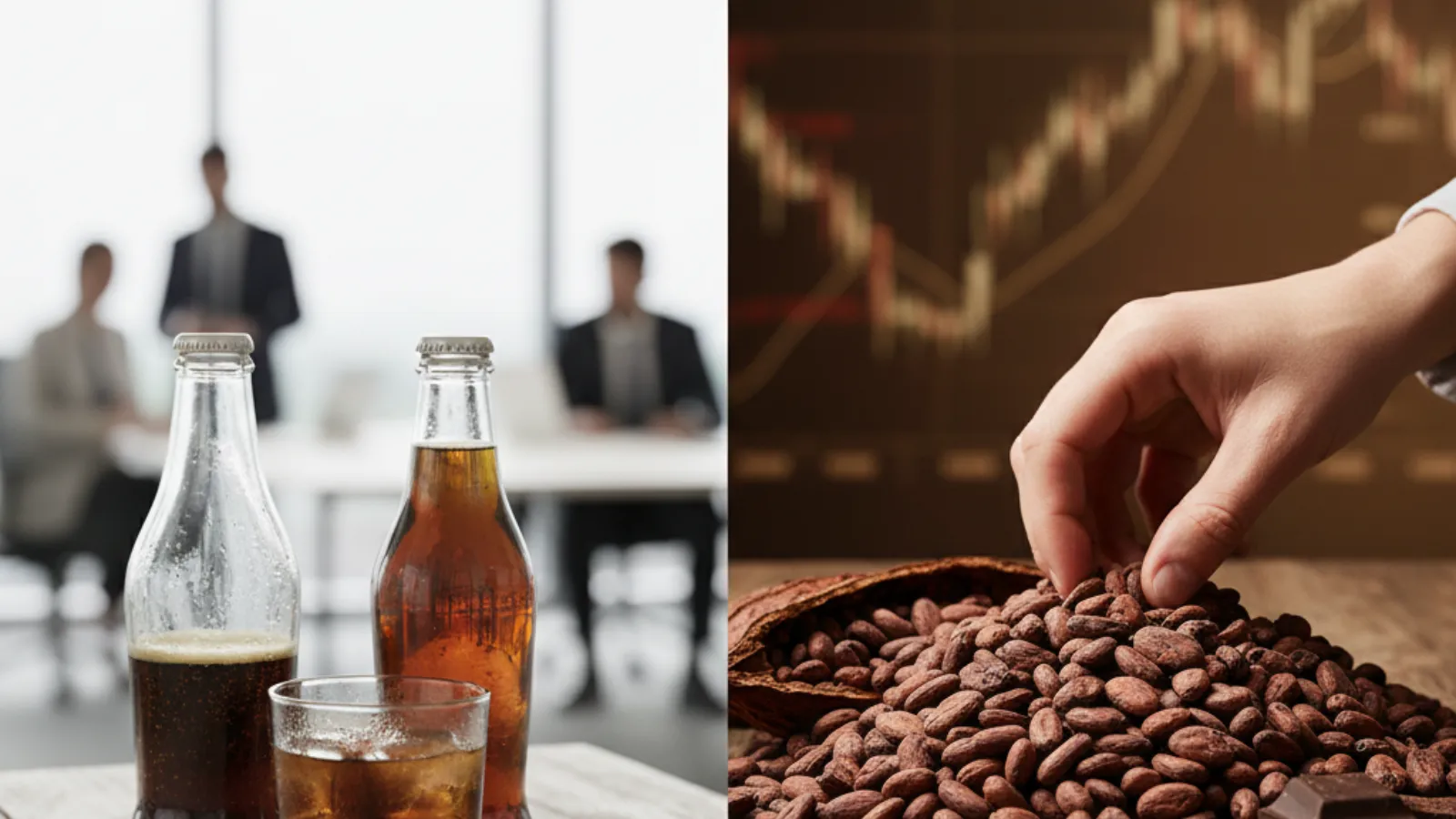
On Tuesday April 28, two of the world's largest food and beverage companies release first-quarter 2026 earnings within hours of each other. One is presenting its first financial results under a new chief executive. The other is absorbing a deliberate $500 million accounting blow from the most extreme commodity price event in chocolate's modern history. What both companies report will establish whether 2026 is the year Big Food's margin recovery story finally closes.
Coca-Cola: Braun's First Quarter
Henrique Braun officially became Coca-Cola's chief executive on March 31, 2026, succeeding James Quincey who moves to Executive Chairman. Tuesday's results are Braun's first as CEO, though the quarter largely ran under Quincey's final weeks of oversight.
Wall Street consensus sits at approximately $12.3 billion in Q1 revenue — up around 10.6% year-on-year — and EPS of $0.81. Full-year guidance communicated in February holds at 4–5% adjusted revenue growth, 7–8% EPS growth, and approximately $12.2 billion in free cash flow.
The more important context is strategic. Braun has publicly identified three priorities: accelerating AI integration into Coca-Cola's commercial and marketing infrastructure; improving the company's speed from insight to shelf; and recruiting younger consumers who are increasingly being diverted to functional beverages, hydration brands, and non-alcoholic alternatives.
Braun inherits a portfolio with one conspicuous liability. Costa Coffee, acquired in 2019 for £3.9 billion, generated an operating loss of £13.5 million in 2024 on revenues of £1.2 billion — and a planned sale to TDR Capital fell through in January 2026 when bids came in below expectations. Braun now owns a coffee chain that is losing money, cannot be sold at an acceptable price, and is strategically peripheral to a beverages company whose core competency is ambient, RTD product at global scale.
The contrast with Coca-Cola's other bets is sharp. The company has committed $650 million to expand its Fairlife premium protein and dairy beverage facility — a capital deployment that signals precisely where Braun's portfolio logic points. High-margin, high-growth, nutrition-adjacent beverages. Not legacy coffee retail.
Analysts will be watching whether Braun's first earnings call signals any shift in the Costa position, and whether the company shows North America beverage volume divergence from PepsiCo. PepsiCo reported North America beverage volume down 2.5% in Q1, while food volumes recovered. If Coca-Cola's volumes hold where PepsiCo's declined, the strategic premium of Coca-Cola Zero Sugar's continued investment thesis gains a significant data point.
Mondelez: The $500M Inventory Reset
Mondelez enters Tuesday with a known structural headwind the market has largely priced in. On January 1, the company reset its cocoa inventory at current market prices — a necessary accounting adjustment that creates an approximately $500 million charge hitting predominantly in Q1.
The backdrop is extraordinary. Cocoa spot prices peaked at approximately $12,000 per metric tonne in early 2025 — a level that compressed Mondelez's gross margin from 38.6% in Q4 2024 to 28.2% in Q4 2025, a ten-percentage-point collapse driven entirely by input costs the company could not fully pass through to consumers.
Cocoa has since fallen sharply, trading at approximately $3,000–$4,000 per metric tonne in April 2026. That relief does not pass through to Mondelez's P&L immediately. The company's hedging programme means cost relief is backloaded: management expects sequential margin improvement through H2 2026, with the largest recovery materialising in 2027.
Morgan Stanley has named Mondelez a top pick in its consumer staples coverage on the strength of this recovery trajectory. The thesis is straightforward: if cocoa holds at current levels, Mondelez's gross margin recovers toward 38–39% by 2027, and earnings approach a near-double from their 2025 trough. Full-year 2026 guidance sits at flat-to-2% organic revenue growth — cautious, but deliberately buffered against further cocoa volatility and continued North American consumer softness.
Why Tuesday Matters Beyond Two Companies
Taken together, Tuesday's releases answer a question that has been live since the second half of 2025: can Big Food's structural recovery thesis survive a volatile consumer environment, stalling volumes, and a leadership transition at the world's most iconic beverage brand?
If Coca-Cola beats consensus and Braun articulates a credible innovation agenda, the premium the market assigns to focused, globally distributed beverage businesses is validated. If North America volumes disappoint — where PepsiCo already reported a 2.5% decline — the category repricing that functional beverage brands have been banking on accelerates further.
For Mondelez, the result matters less than the commentary. Any signal that Q2 margins are improving ahead of schedule, or that North American biscuit volume softness is stabilising, would trigger a material re-rating of a stock that Morgan Stanley considers deeply undervalued relative to its normalised earnings power.
Operators and investors with exposure to chocolate, confectionery, or premium beverage should pay close attention to Tuesday morning. This is the day 2026's recovery narrative either gains traction — or gets complicated.

Global Aseptic Packaging Market Report 2026
148.4bn litres and 344bn packs in 2025. Aseptic volumes across dairy, dairy alternatives, beverages and food in 39 markets — 2025 actuals and forecasts to 2030. Buy online and receive it within 24 hours.
More information
Global Cheese Database 2026
Production, imports, exports and consumption for 39 cheese types across 48 countries, with actuals through 2025 and forecasts to 2030. Join the waitlist for early access, pre-launch pricing and a free sample country chapter.
Get early accessStrategic Insights
📊 Analytics & Strategic Insight
Braun's Inheritance and Mondelez's Delayed Relief: Why April 28 Is the Most Consequential Day in 2026 F&B Earnings
The decision most in this industry are avoiding:
👉 Most operators are waiting for proof before repositioning around Big Beverage. But the question that actually matters is whether Braun can run a distributed innovation model at Coca-Cola's scale — something Quincey centralised and tightened over nine years. The beverage category's mid-term trajectory is being set now, before results confirm it.
👉 Nobody in confectionery wants to be the first to reverse pricing. Mondelez passed significant cocoa cost inflation through to consumers via price increases that are now stranded above a commodity that has fallen approximately 70% from its peak. Walking them back trains consumers to wait for promotions. Holding them risks permanent private label conversion.
👉 The Costa Coffee situation is structurally unresolvable at Coca-Cola's target valuation. The decision most executives avoid is acknowledging that £3.9 billion paid in 2019 is simply gone — and that the fastest path to shareholder value is a write-down and a willing buyer at a realistic price, not a further three years of operating losses inside a company investing in protein beverages.
Here's the full context:
→ 2019: Coca-Cola acquires Costa Coffee for £3.9 billion, signalling intent to compete in premium coffee as a standalone category alongside its core ambient and RTD beverage business.
→ 2022–2024: Costa's retail and express machine formats face structural headwinds from hybrid working patterns, reduced urban footfall, and intensifying competition on value from McDonald's and Greggs.
→ Early 2025: Cocoa futures hit approximately $12,000 per metric tonne — the highest in modern records — as West African crop failures coincide with accelerating demand from emerging markets.
→ Q4 2025: Mondelez reports gross margin at 28.2%, down from 38.6% one year earlier, as hedged inventory absorbs near-peak cocoa costs with no comparable consumer price increase buffer available.
→ Most recent: Braun takes the Coca-Cola CEO seat on March 31, 2026; cocoa trades at $3,000–$4,000/mt. April 28 is the first earnings data point for each company's 2026 recovery thesis.
What this means for food and beverage operators and investors:
✅ For Mondelez, the recovery is a question of timing, not direction. Operators and investors who position ahead of the Q2 and H2 inflection — rather than after confirmation — capture the largest risk-adjusted return window before consensus reprices the normalised earnings trajectory.
✅ Coca-Cola's Costa problem has a simpler resolution than management is currently admitting. The lesson for any brand operator holding a mismatch acquisition: the original purchase price is not a reason to continue holding a structurally misaligned asset. Braun's first-call language on Costa will reveal how clearly he sees this.
✅ If North America beverage volumes continue declining at Coca-Cola, acquisition price inflation for functional beverage brands accelerates. Private equity and strategic buyers targeting assets in hydration, functional drinks, and protein beverages should expect higher entry multiples by Q3 2026 if Tuesday's numbers confirm a category gap.
3 moves you can make this week:
1️⃣ Model Mondelez's margin recovery against current cocoa prices. Run a scenario in which cocoa holds at $3,000–$4,000/mt through 2027 and calculate the implied gross margin versus current stock pricing. Morgan Stanley's top pick thesis implies material upside before consensus fully reprices normalised earnings.
2️⃣ Audit your chocolate and confectionery sourcing contracts. With cocoa down approximately 70% from its 2025 peak, any long-term supply contracts signed at elevated rates now represent above-market commitments. Renegotiation windows are open now — before manufacturers begin passing margin recovery back through to buyers via pricing strategies.
3️⃣ Track Braun's tone on Costa and innovation speed on Tuesday's call. His language on both will signal whether Coca-Cola intends to be an active M&A participant in adjacent beverage categories in 2026 — or whether it enters a consolidation phase around its core carbonates and Coca-Cola Zero Sugar franchise.
Take the Next Step
♻️ Looking for a high-growth investment in sustainable beverage technology?
An iF Design Award-winning, IoT-enabled product line solving the single-use plastic crisis from the inside — designed for the home and B2B market. Strong structural tailwinds as plastic regulations tighten across Europe.
→ Request the investor deck: info@zenithglobalcommercial.com
Zenith Consulting
Submit your food & beverage project enquiry.
Share your requirements. If there is a strong fit, we’ll come back with an indicative investment range, project timeline and recommended strategic approach.
Reviewed by Zenith Consulting’s senior food & beverage strategy team.
Related analyses
- Corporate Strategy & Portfolio
Oji Liquid Pak's USD 110 Million Vietnam Aseptic Carton Plant Adds 8 Billion Packs To A Region Already At 62 Billion
Oji Liquid Pak broke ground on a USD 110 million aseptic carton material plant in Dong Nai, rated at up to 8 billion packs a year from 2028. Zenith puts Vietnam at 10,358.7 million aseptic packs in 2025, and South East Asia already holds about 62 billion packs of documented converting capacity.
Read analysis → - Corporate Strategy & Portfolio
Spain Swaps HDPE Milk Bottles For Aseptic PET: 170 Million Litres Left And Only Three Aseptic PET Dairy Lines
Spanish UHT milk in large HDPE bottles fell from 307 million litres in 2020 to 170 million in 2025, and Zenith's model takes it to 88.5 million by 2030. Aseptic PET is taking the volume, and only three aseptic PET dairy lines have been documented in the country.
Read analysis → - Corporate Strategy & Portfolio
US Parmesan Output Jumps 25.9% While Cheddar Slips: Italian Cheese Takes Four In Five Pounds Of Growth
USDA figures published on 5 October show US Parmesan output up 25.9% in August while cheddar fell 0.9%. Italian types have supplied nearly four in every five pounds of US cheese growth so far in 2026.
Read analysis →
Share it with your peers
Pass this analysis to colleagues who track the food and beverage market.
Zenith Market Intel
Need a specific food or beverage market report?
Tell us which category, region or question would be useful for your team.
Sister Publication
Also follow our Water Dispense Market Intelligence
Category analyses, operator briefings, and investor signals across the global water dispense market.