India's Cola War Has Become a Refrigerator Arms Race: Why Campa, Coke and PepsiCo Will Install One Million Chillers in 2026
Reliance's Campa Cola hit $493M in sales in FY26 and broke a 30-year Coke-Pepsi duopoly — but the real battle in Indian soft drinks is no longer being fought on shelves. It is being fought on the refrigerators that hold them, with roughly one million new commercial chillers being installed in Indian retail every year.
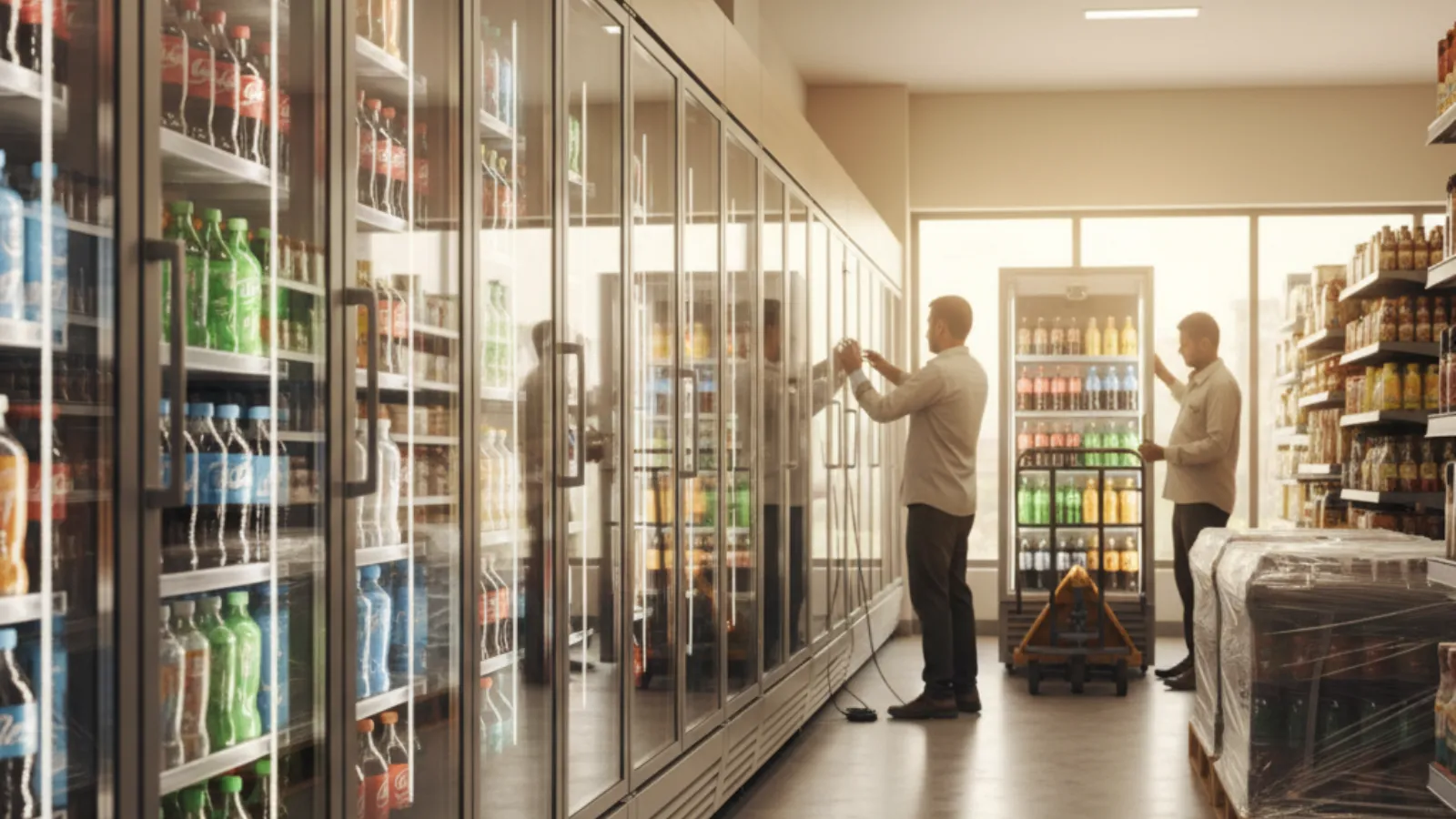
India's cola war is no longer being fought on the shelf. It is being fought on the appliance underneath it.
Reliance's Campa Cola brand — relaunched in March 2023 from a 1970s Indian brand the conglomerate bought for around ₹22 crore — generated ₹47 billion (around $493 million) in gross sales in the year to March 2026, according to a Reliance Industries investor presentation released last month. That makes Campa the country's fourth-largest carbonated soft-drinks brand with double-digit market share in several states, and the first credible domestic challenger to the Coca-Cola-PepsiCo duopoly in three decades. Coca-Cola India posted ₹51.7 billion in revenue in the year to March 2025, according to filings collated by Tofler. The gap between the incumbent and the disruptor has narrowed to a single-digit growth quarter.
What is more striking is what the three players are doing with the cash. They are building refrigerators.
The chiller is the shelf in India
At PepsiCo's largest Indian bottler Varun Beverages, chairman Ravi Jaipuria told the April 27 earnings call that Reliance, Coca-Cola and Varun are collectively installing close to half a million visi-coolers a year across Indian retail outlets. Independent retailers are buying another 400,000 to 500,000 cooling units on their own account, adding up to roughly one million chilling units entering the Indian trade every year — most of them into stores that previously had no refrigeration capacity at all.
India's commercial refrigeration market, the bulk of it driven by beverage visi-coolers, was worth $2.8 billion in 2025 and is forecast to reach $3.9 billion by 2034, according to IMARC Group estimates. Mohit Sud, group president for Unitary Cooling Products at Blue Star Ltd., told Bloomberg the segment is "growing faster than Blue Star's annual growth." Voltas (a Tata Group company), Haier Appliances India and Western Refrigeration are the other principal beneficiaries.
In developed markets, the refrigerator is a kitchen appliance. In India, the refrigerator is distribution infrastructure — owned by a beverage brand and rented to a retailer in exchange for shelf exclusivity. The fight to install the next million chillers is a fight to lock retail outlets into a beverage relationship for the five-to-eight year operating life of the cooler.
How Campa rewired the price floor and forced a distribution war
For thirty years, Coca-Cola and PepsiCo controlled the Indian carbonated category through a single architectural trick: install branded chillers, supply them with branded SKUs, and prevent independent kirana stores from displaying any other soft drink at the cold point of purchase. The fridge was both shelf and exclusivity contract. Campa broke that lock by attacking the price point underneath it. The 200ml Campa bottle sells for ₹10 — about 12 US cents — roughly half the price of a 250ml Coke or Pepsi unit.
Cheap product alone would have produced a flash promotion, not a category event. What turned Campa into a structural problem for the incumbents was the simultaneous decision to invest in visi-cooler installations at scale alongside the price cut. Reliance is not just selling a cheaper SKU into existing fridges. It is rolling out its own fridges, into stores its retail arm already serves, on the same logistical network that distributes its grocery, telecom and consumer-electronics brands.
The Varun Beverages signal
The clearest proof that this is now treated as a structural arms race rather than a marketing programme came inside Varun Beverages' Q1 CY2026 results. Consolidated revenue reached ₹6,721 crore (+18.3% year-on-year), profit after tax rose 20.1%, sales volumes hit 363.4 million cases (+16.3%), India volume grew 14.4% and international volume grew 21.4%. Inside the release was a strategic move that received less attention: Varun has entered a joint venture with Everest International Holdings to manufacture visi-coolers in-house, rather than continuing to source them from third-party appliance OEMs.
PepsiCo's largest emerging-market bottler is buying its way upstream into the chiller supply chain. That decision only makes sense if the visi-cooler is treated as a cost-of-distribution input on the manufacturing income statement, not a discretionary marketing expense. It is the strongest tell to date that the incumbents now believe the contest will run for a decade.
What the refrigerator boom is really telling the rest of the industry
The implications travel well beyond Coca-Cola, PepsiCo and Reliance. First, the cost of holding share in fast-growing emerging beverage markets has structurally re-rated upwards. Incumbents that once spent on advertising will now spend on refrigeration capex, and the marketing-versus-capex line will quietly migrate on income statements. Second, the model is replicable in any beverage-led emerging market where neighbourhood retail dominates — Indonesia, Nigeria, Vietnam, parts of Mexico — and Reliance has effectively published the playbook.
Third, Indian appliance OEMs are now leveraged proxies on Indian carbonated soft drinks competition in a way no analyst model captures cleanly. Fourth, the next leg of competition will be data. Every visi-cooler installed in 2026 is, in principle, a connected asset that can be metered, geo-tagged and used to enforce SKU exclusivity in real time. The brand that controls the chiller will increasingly control the shelf data — and through that, the merchandising contract.
India's carbonated soft drinks market is forecast to grow from $11.7 billion in 2025 to $17.6 billion by 2034, per IMARC Group. The terminal share map will depend less on whether consumers prefer Campa, Pepsi or Coke than on whose chiller sits in the corner store. For the first time in three decades, the answer is not obvious. For Coca-Cola and PepsiCo, defending India will require capital allocation discipline they have not had to demonstrate domestically in a generation. For Reliance, the question is whether the visi-coolers were the cheapest part of the campaign, or the most expensive.

Global Aseptic Packaging Market Report 2026
148.4bn litres and 344bn packs in 2025. Aseptic volumes across dairy, dairy alternatives, beverages and food in 39 markets — 2025 actuals and forecasts to 2030. Buy online and receive it within 24 hours.
More information
Global Cheese Database 2026
Production, imports, exports and consumption for 39 cheese types across 48 countries, with actuals through 2025 and forecasts to 2030. Join the waitlist for early access, pre-launch pricing and a free sample country chapter.
Get early accessStrategic Insights
📊 Analytics & Strategic Insight
The chiller is the new shelf — India's cola war is now a capex contest, not a marketing one
The decision most in this industry are avoiding:
👉 Stop modelling Indian carbonated soft drinks as a brand-share battle. Start modelling it as a refrigeration-installed-base battle. With roughly one million chilling units entering the Indian trade every year and a typical 5-8 year asset life, share over the next decade will be heavily determined by who funded the chiller, not who advertised the SKU.
👉 Reliance has reset the cost of holding share in any large emerging beverage market. Cola is no longer a marketing-led category in India — it is a distribution-infrastructure-led category. Incumbents will have to migrate spend from advertising to chillers, which compresses reported margins and makes capex disclosure the new battleground for sell-side analysts.
👉 Varun Beverages has signalled the new operating model by integrating upstream into visi-cooler manufacturing via the Everest International joint venture. Treating chillers as a manufacturing input line rather than a marketing expense is the strongest tell that the incumbents now believe this contest will run for a decade.
Here's the full context:
→ 1977: Coca-Cola exits India under FERA; Pure Drinks' Campa Cola fills the vacuum and dominates Indian cola through the 1980s.
→ 1989-1993: PepsiCo re-enters India (1989); Coca-Cola re-enters (1993); the duopoly forms and visi-cooler placement becomes the primary distribution weapon.
→ August 2022: Reliance Consumer Products acquires the dormant Campa Cola brand from Pure Drinks Group for around ₹22 crore.
→ March 9, 2023: Campa Cola, Campa Lemon and Campa Orange relaunched at a ₹10 (around $0.12) 200ml price point — roughly half the price of Coke and Pepsi 250ml SKUs.
→ FY26 (year to March 2026): Campa hits ₹47B ($493M) gross sales — fourth-largest carbonated brand in India, double-digit share in key states; Coca-Cola India FY25 revenue ₹51.7B.
→ Most recent (May 12, 2026): Bloomberg reports the three players are now installing around 500,000 visi-coolers a year combined; retailers buying another 400,000-500,000; Varun Beverages confirms JV with Everest International Holdings to manufacture chillers in-house.
What this means for food and beverage operators and investors:
✅ Coca-Cola and PepsiCo will have to demonstrate disciplined India capex over the next 3-5 years. Expect rising visi-cooler-related capex disclosure pressure on the next two earnings cycles. Watch the Hindustan Coca-Cola Beverages and Coca-Cola Beverages Africa investor materials for parallel chiller-rollout commentary as Coca-Cola refranchises its bottling footprint.
✅ The "control the cold chain to control the shelf" playbook is now replicable in Indonesia, Nigeria, Vietnam and Mexico. In any emerging market where neighbourhood retail dominates and refrigeration penetration is low, beverage incumbents should expect local challengers backed by retail-led conglomerates to copy Reliance's blueprint within 24-36 months.
✅ Indian appliance OEMs — Blue Star, Voltas, Haier Appliances India, Western Refrigeration — are now leveraged proxies on Indian beverage share, not consumer-discretionary plays. Their commercial refrigeration order books are a beverage-competition signal that arrives 1-2 quarters before bottler capex disclosures.
3 moves you can make this week:
1️⃣ Pull the chiller-installation language from Reliance Consumer Products, Varun Beverages and Hindustan Coca-Cola Beverages investor materials and reconcile against IMARC's $3.9B 2034 commercial refrigeration forecast. The delta between disclosed bottler capex plans and OEM market projections is your real-time indicator of who is winning the asset race.
2️⃣ Map your emerging-market beverage portfolio against neighbourhood-retail dominance, refrigeration penetration, and chiller-replacement cycle length. Any market that fits the Indian profile (Indonesia, Nigeria, Vietnam, parts of Mexico) is exposed to a Campa-style local challenger inside 36 months. Flag those markets for defensive capex planning now.
3️⃣ Add Blue Star (BSE: 500067) and Voltas (BSE: 500575) to your watchlist as long-duration proxies on Indian beverage competition. If Reliance's chiller installation rate accelerates further, expect OEM commercial refrigeration order books to lead bottler capex disclosure by one to two quarters — a leading indicator most beverage analysts are not yet tracking.
Take the Next Step
🌊 Interested in owning a stake in one of Earth's largest secured natural spring sources?
A rare asset-backed investment opportunity: 50+ year water and land rights, carbon-neutral infrastructure, B2B and white-label focus, and a 33% projected IRR. USD 28M raise, USD 80M post-money valuation.
→ View the investment opportunity
Zenith Consulting
Submit your food & beverage project enquiry.
Share your requirements. If there is a strong fit, we’ll come back with an indicative investment range, project timeline and recommended strategic approach.
Reviewed by Zenith Consulting’s senior food & beverage strategy team.
Related analyses
- Market & Category Growth
UK Cheese Supplies Fall 6,900 Tonnes As Exports Hit A Q2 Record: Cheddar Milk Use Down 14 Million Litres
AHDB put UK available cheese supplies down 6,900 tonnes in the second quarter of 2026, while exports rose 8,000 tonnes to an all-time quarterly high. Defra figures show milk into Cheddar down 14.1 million litres in August alone.
Read analysis → - M&A, Investment & Valuation
Parmigiano Reggiano Takes On Australian Parmesan: The EU Trade Deal Protected 53 Cheese Names And Left Parmesan Out
The Parmigiano Reggiano Consortium has opened a three-year campaign in Australia, where cheese output runs at 455,000 tonnes a year. Australia agreed to protect 53 EU cheese names, and parmesan is not one of them.
Read analysis → - M&A, Investment & Valuation
Parmigiano Reggiano Takes On Australian Parmesan: The EU Trade Deal Protected 53 Cheese Names And Left Parmesan Out
The Parmigiano Reggiano Consortium has opened a three-year campaign in Australia, where cheese output runs at 455,000 tonnes a year. Australia agreed to protect 53 EU cheese names, and parmesan is not one of them.
Read analysis →
Share it with your peers
Pass this analysis to colleagues who track the food and beverage market.
Zenith Market Intel
Need a specific food or beverage market report?
Tell us which category, region or question would be useful for your team.
Sister Publication
Also follow our Water Dispense Market Intelligence
Category analyses, operator briefings, and investor signals across the global water dispense market.