Ingredion's $3.7 Billion Tate & Lyle Bid Is a Bet on the Future of Food Reformulation
Ingredion has made a £2.74 billion non-binding offer for Tate & Lyle — a 64% premium that would create a $10 billion global speciality ingredients powerhouse. With a June 11 deadline to firm up or walk, this is the ingredients deal of the decade.
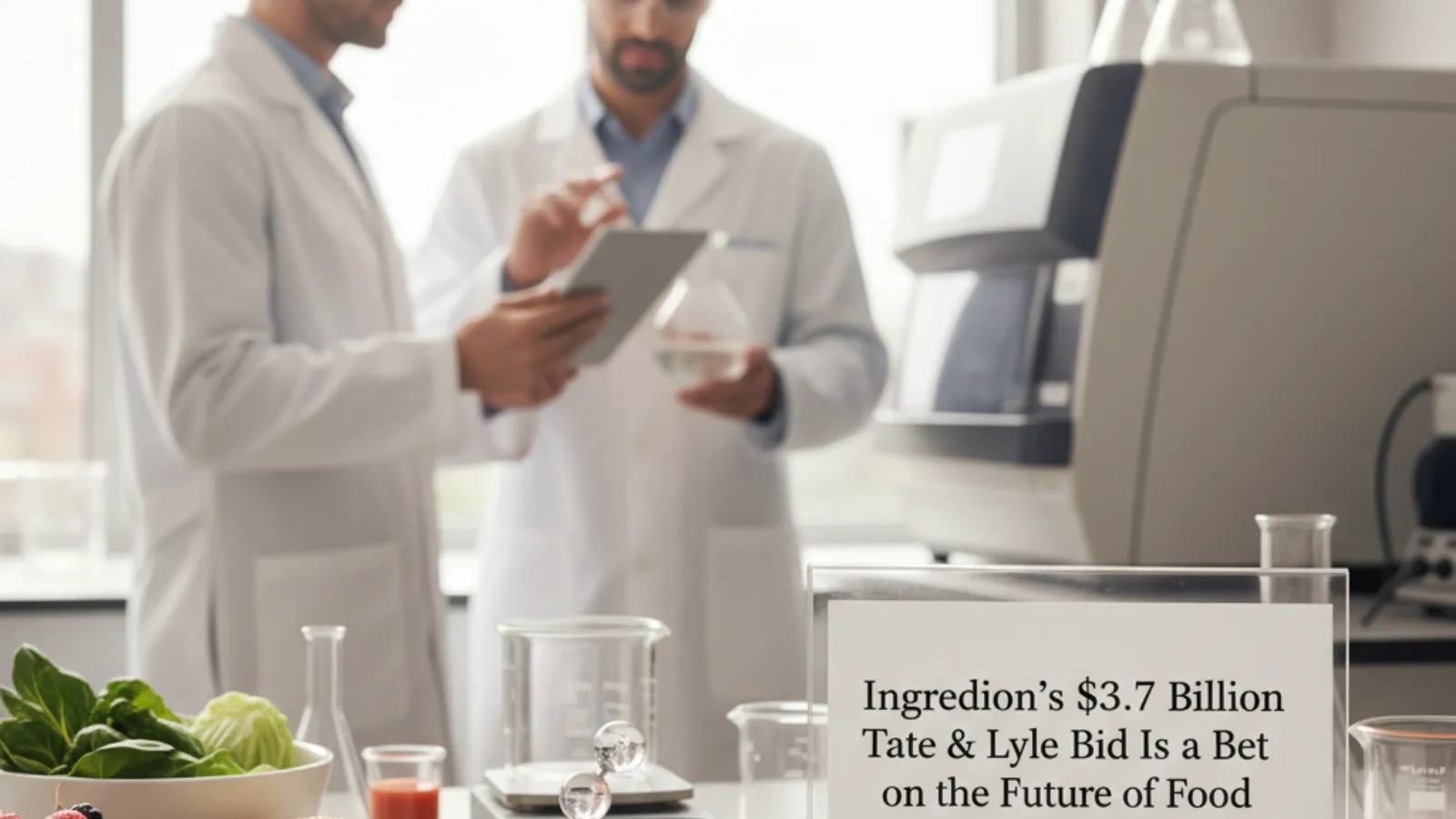
Tate & Lyle spent more than 150 years making sugar. Now it is being acquired because it figured out how to take sugar out of food.
On May 14, 2026, Ingredion made a non-binding all-cash offer of 595 pence per share for Tate & Lyle — worth £2.74 billion, or roughly $3.7 billion. Including two permitted dividends, the total value per share reaches 615 pence. That is a 64% premium over where Tate & Lyle's stock was trading the day before. A 64% premium is not a discount entry. It is a statement of conviction. Ingredion has until 5pm London time on June 11, 2026 to make a firm offer under UK Takeover Code Rule 2.7 — or walk away.
If the deal completes, it will create a combined ingredients business worth more than $10 billion. That would make it the largest speciality food ingredient company in the world.
A Company Transformed
To understand why this deal is happening, you need to understand what Tate & Lyle has become.
The company was formed in 1921 from the merger of two historic British sugar businesses. For most of its life it was a bulk commodity processor — sugar, corn syrup, industrial starches. Then in 2021 it sold its Primary Products division, the industrial sweeteners and starches business in the Americas, to private equity firm KPS Capital Partners for $1.3 billion. The commodity business was gone. What remained was a focused speciality ingredients company built around three platforms: sweetening, mouthfeel, and fortification.
The transformation kept going. In November 2024, Tate & Lyle acquired CP Kelco for $1.8 billion. CP Kelco produces pectin, xanthan gum, and nature-based hydrocolloids — the ingredients that give food its texture, body, and stability. That acquisition made Tate & Lyle a genuine leader in texture ingredients at commercial scale.
By the year ended March 31, 2026, Tate & Lyle reported £2.0 billion in revenue from continuing operations. In its FY2025 results, the combined Tate & Lyle and CP Kelco business generated pro forma EBITDA of £446 million, free cash flow of £190 million, and an EBITDA margin of 22.3% — up 200 basis points year-on-year. Net debt to EBITDA stood at 2.2 times, better than the company expected when it bought CP Kelco.
What Ingredion Is Really Buying
Ingredion is not buying a sugar business. It is buying the world's most complete toolkit for food reformulation.
About 70% of Tate & Lyle's products are used by food and drink manufacturers to reduce sugar or calories in their finished products. That figure sits at the intersection of two powerful trends: consumer demand for less sugar, and growing regulatory pressure — from sugar taxes in the UK, EU, and across Asia — that forces manufacturers to reformulate or face cost consequences.
Tate & Lyle's portfolio now spans sweeteners, fibres, starches, proteins, pectin, gums, and texturants — the full set of tools a food company needs to re-engineer a product without losing taste or appeal. CP Kelco's pectin alone appears in dairy, beverages, and confectionery products across the globe.
Ingredion has been building a parallel capability. It launched a $2.4 billion Texture & Healthful Solutions segment in early 2024 and committed $100 million to a new texture ingredients facility in Indianapolis. In its most recent results, Texture & Healthful Solutions delivered 4% volume growth while the rest of the business faced headwinds. The Tate & Lyle acquisition would give Ingredion significant scale in texture and nutrition ingredients overnight, and materially expand its footprint in Europe and Asia.
The Strategic Logic
The speciality ingredients industry is entering a phase of consolidation, and Ingredion is trying to get ahead of it.
The food industry faces a structural reformulation demand. GLP-1 drugs are changing what consumers eat and how much. MAHA regulatory pressure in the US is pushing scrutiny of additives and food quality. Sugar taxes are spreading across Europe, Asia, and Latin America. Ultraprocessed food legislation is being debated in multiple EU member states. Every one of these trends increases demand for ingredients that help manufacturers produce food with less sugar, more fibre, and a cleaner ingredient list.
A supplier that can offer a single-source solution across sweetening, texture, fibre, and mouthfeel — at global scale — has a structural advantage over smaller ingredient companies that only cover part of the problem. This deal is about building the kind of integrated, one-stop reformulation partner that large food companies want as complexity increases.
Ingredion made multiple approaches to Tate & Lyle's board before this bid was publicly disclosed. That history signals this is a strategic priority, not an opportunistic move.
What Happens Next
Ingredion must decide by June 11 whether to convert its non-binding proposal into a firm offer or step back. If it proceeds, the deal will face regulatory review in multiple jurisdictions — UK, US, EU, and likely China, where both companies have operations.
Ingredion generated $944 million in operating cash flow in 2025 and has a market cap of $6.51 billion. Funding a $3.7 billion acquisition alongside integration is achievable but will require careful capital management. Tate & Lyle's balance sheet — net debt to EBITDA at 2.2 times — means the combined entity would not be highly leveraged at close.
If Ingredion walks, Tate & Lyle does not go back to being a cheap stock. A 64% takeover premium at this scale tends to attract other bidders. The question then is who else in the ingredients, food, or private equity space has the appetite and the capital for a £2.74 billion transaction.
The food ingredient sector is entering a new phase. The companies that supply the science behind healthier food are becoming as strategically valuable as the brands that sell it. This deal, if it closes, will accelerate that shift.
Global Aseptic Packaging Market Report 2026
148.4bn litres and 344bn packs in 2025. Aseptic volumes across dairy, dairy alternatives, beverages and food in 39 markets — 2025 actuals and forecasts to 2030. Buy online and receive it within 24 hours.
More information
Global Cheese Database 2026
Production, imports, exports and consumption for 39 cheese types across 48 countries, with actuals through 2025 and forecasts to 2030. Join the waitlist for early access, pre-launch pricing and a free sample country chapter.
Get early accessStrategic Insights
📊 Analytics & Strategic Insight
The Ingredion–Tate & Lyle Deal Is About Who Controls the Science of Food Reformulation
The decision most in this industry are avoiding:
👉 Most ingredient companies are still competing on price, not platform. The companies that will win the next decade are building integrated reformulation platforms — not defending individual ingredient categories. Ingredion's bid signals that platform thinking is now being priced at a 64% premium.
👉 Food manufacturers are quietly consolidating their ingredient supplier relationships. Procurement teams at major food and beverage companies are reducing the number of strategic ingredient partners. A single supplier that can solve sugar reduction, texture, fibre, and mouthfeel in one relationship is worth paying more for — and Ingredion is betting Tate & Lyle gives them that position.
👉 Private equity already made this bet and won. When KPS Capital Partners paid $1.3 billion for Tate & Lyle's Primary Products division in 2021, the commodity side looked like the safer asset. The speciality business looked harder. Today, the speciality business commands a 64% takeover premium and the commodity side is not in this deal at all.
Here's the full context:
→ 2021: Tate & Lyle sells Primary Products — industrial sweeteners and starches — to KPS Capital Partners for $1.3 billion, pivoting entirely to speciality ingredients.
→ 2020–2022: Tate & Lyle makes a series of targeted acquisitions — Sweet Green Fields (stevia), Nutriati (chickpea protein), and Quantum Hi-Tech (prebiotic fibre, China, $237m) — building a health-focused ingredient portfolio.
→ November 2024: Tate & Lyle acquires CP Kelco for $1.8 billion, becoming a global leader in pectin, gums, and nature-based texturants. CP Kelco EBITDA grows 9% in its first year under Tate & Lyle, ahead of acquisition plan.
→ Early 2024: Ingredion launches a $2.4 billion Texture & Healthful Solutions segment and commits $100 million to a new Indianapolis facility, signalling texture ingredients as its core growth category.
→ May 14, 2026: Ingredion discloses a 595p non-binding offer for Tate & Lyle — 64% premium, multiple prior approaches, hard June 11 deadline. The speciality ingredients consolidation wave has begun in earnest.
What this means for food and beverage operators and investors:
✅ Reformulation supply costs are about to shift. If a combined Ingredion–Tate & Lyle controls leading positions in sweeteners, texturants, fibre, and mouthfeel, food manufacturers with narrow supplier relationships will have less negotiating leverage. The time to audit your ingredient supply chain and build optionality is before the deal closes, not after.
✅ The remaining independent speciality ingredient companies just became acquisition targets. IFF, Corbion, Roquette, and Kerry Group all have speciality ingredient capabilities that become more strategically attractive in a world where a combined Ingredion–Tate & Lyle sets the scale benchmark. Consolidation follows consolidation.
✅ Investors in food ingredients should apply the 64% premium as a new valuation reference. This deal establishes what a complete, integrated reformulation portfolio is worth. Companies with strong sugar-reduction, fibre fortification, or mouthfeel positions that have not yet been acquired or taken private are mispriced relative to that benchmark.
3 moves you can make this week:
1️⃣ If you are a food or beverage manufacturer, map your reformulation supplier dependencies now. Identify which key ingredient relationships — sugar reduction, fibre, texture — involve companies likely to be absorbed into a combined Ingredion–Tate & Lyle. A change of ownership changes pricing dynamics, service levels, and technical support.
2️⃣ If you are a PE or strategic investor with food ingredient exposure, update your exit comparables. The 64% premium in this deal resets what integrated reformulation platform businesses are worth at exit. Apply that logic to any portfolio company with overlapping capabilities.
3️⃣ Watch the June 11 deadline closely. If Ingredion pulls back, Tate & Lyle becomes the most obvious large-cap ingredient target on the market. Identify the realistic alternative bidders — DSM-Firmenich, Roquette, Kerry Group — and model what each scenario means for category pricing and supply dynamics in your segment.
Take the Next Step
♻️ Looking for a high-growth investment in sustainable beverage technology?
An iF Design Award-winning, IoT-enabled product line solving the single-use plastic crisis from the inside — designed for the home and B2B market. Strong structural tailwinds as plastic regulations tighten across Europe.
→ Request the investor deck: info@zenithglobalcommercial.com
Zenith Consulting
Submit your food & beverage project enquiry.
Share your requirements. If there is a strong fit, we’ll come back with an indicative investment range, project timeline and recommended strategic approach.
Reviewed by Zenith Consulting’s senior food & beverage strategy team.
Related analyses
- M&A, Investment & Valuation
Parmigiano Reggiano Takes On Australian Parmesan: The EU Trade Deal Protected 53 Cheese Names And Left Parmesan Out
The Parmigiano Reggiano Consortium has opened a three-year campaign in Australia, where cheese output runs at 455,000 tonnes a year. Australia agreed to protect 53 EU cheese names, and parmesan is not one of them.
Read analysis → - M&A, Investment & Valuation
Parmigiano Reggiano Takes On Australian Parmesan: The EU Trade Deal Protected 53 Cheese Names And Left Parmesan Out
The Parmigiano Reggiano Consortium has opened a three-year campaign in Australia, where cheese output runs at 455,000 tonnes a year. Australia agreed to protect 53 EU cheese names, and parmesan is not one of them.
Read analysis → - M&A, Investment & Valuation
Müller Closes Sachsenmilch Semi-Hard Cheese Dairy At Leppersdorf: Mozzarella And Acid Curd Lines Stay
Müller will close the semi-hard cheese dairy at Sachsenmilch Leppersdorf on 31 December 2026, with about 160 staff affected. Mozzarella and acid curd cheese carry on at a site that takes 1.7 billion kg of milk a year.
Read analysis →
Share it with your peers
Pass this analysis to colleagues who track the food and beverage market.
Zenith Market Intel
Need a specific food or beverage market report?
Tell us which category, region or question would be useful for your team.
Sister Publication
Also follow our Water Dispense Market Intelligence
Category analyses, operator briefings, and investor signals across the global water dispense market.