Mars Spent £190 Million on a Single Factory. The Cocoa Cycle Just Picked the Winners.
Mars committed £190 million to its Slough chocolate factory through 2028, five months after closing a $36 billion Kellanova deal. Mondelez and Hershey are guiding to a 2027 recovery — and the cocoa cycle has just exposed the structural gap between private long-cycle capital and public quarterly capital.
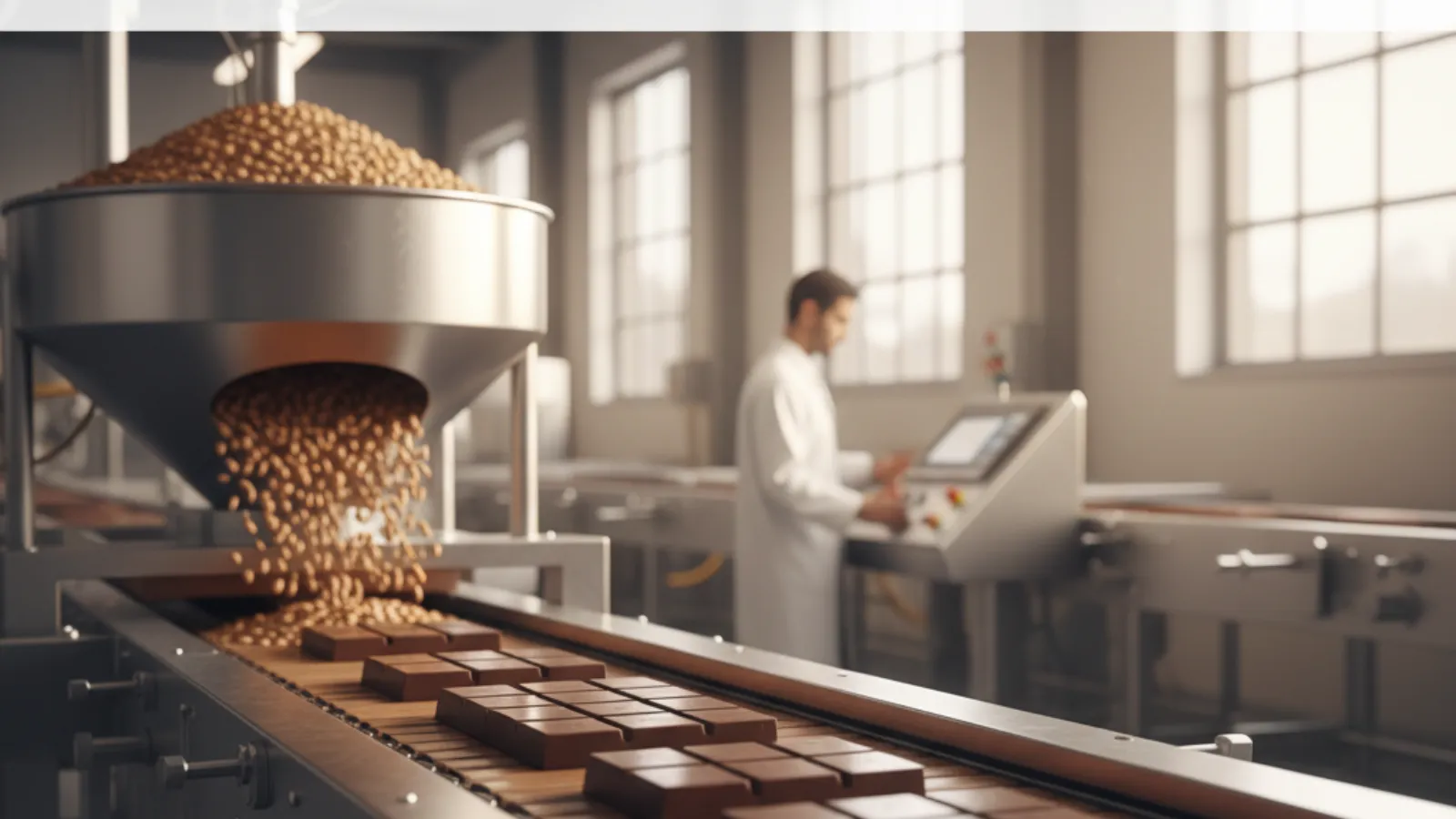
The next eighteen months in global chocolate will not be decided by brand share. They will be decided by who controls capital with patience.
On Friday, Mars announced a £190 million ($254 million) investment in its Slough factory in the United Kingdom — digital twin technology, AI-driven process control, robotics, and capacity expansion across the Mars Bar, Snickers, Galaxy and Maltesers lines, scheduled through 2028. Five months earlier, the same company closed a $36 billion acquisition of Kellanova, the largest food deal of the current cycle.
In the same eighteen-week window, Mondelez has guided 2026 organic sales growth at 0–2% — roughly half of analyst consensus — and admitted publicly that its 2026 cocoa cost base is locked in at hedge levels that the spot market has now fallen 55% below. Hershey reported Q1 2026 operating margin of 20.6%, but only because the prior-year comparable was depressed by derivative mark-to-market losses on the same hedges that have now flipped. Both told the market that material margin recovery does not arrive until 2027.
The defining contrast in global chocolate is no longer Mars versus Mondelez versus Hershey by category share. It is private long-cycle capital versus public quarterly capital, applied to the same commodity dislocation.
What Mars is actually building
The Slough plant has produced Mars Bars since Forrest Mars built it in 1932. It employs 1,850 people across multiple generations of the same families and supplies the UK, Ireland and the Netherlands. The £190 million is not a refresh. It is a multi-year build-out of digital twin software that mirrors the production line in real time, AI-driven yield and quality optimisation, robotics retrofitted onto legacy lines, and capacity expansion that will run through 2028.
The headline figure also flatters the announcement: investment began in 2023, and only £32 million is forward-looking for 2027 and 2028. The point is the cadence. Mars has been deploying capital into its physical cost structure continuously across the same period in which Mondelez and Hershey were running accelerated buybacks and absorbing cocoa hedge losses. Public chocolate has been protecting earnings per share. Mars has been building the next decade of unit-cost advantage.
The cocoa whiplash math
Cocoa traded near $3,883 per tonne on May 4 and around $4,220 in mid-May — down from the December 2024 peak of $12,906 and roughly 55% below year-ago levels. The structural cost story has reversed at speed.
Public chocolate cannot benefit. Mondelez has stated explicitly that it cannot take advantage of falling prices in the short term because 2026 is already covered. Hershey forecasts approximately 400 basis points of gross margin improvement this year, but only because the 2025 baseline was so distorted by hedge mark-to-market losses. Both expect material improvement in 2027 — the year after the current hedge book rolls off.
Mars, as a family-owned company with no shareholder meeting to face in May or August, can do the opposite of the public playbook. It can run inventory builds, spot purchases and physical capacity investment on a five-year cadence regardless of where cocoa trades quarter-to-quarter. £190 million through 2028, on top of a $36 billion Kellanova close, is what that flexibility looks like in operating terms.
The Kellanova integration overlay
The Kellanova close in December 2025 gave Mars Pringles, Cheez-It, Pop-Tarts, RXBAR, Rice Krispies Treats and the Kellogg's international cereal portfolio. Combined snacking revenue is projected at approximately $36 billion across nine billion-dollar brands. The Slough investment is the first visible signal of the post-merger industrial agenda.
Mars is not running a synergy-cut playbook. It is running a capacity-and-technology playbook on the surviving chocolate side while Kellanova brings the salty-snack engine into the same distribution and manufacturing footprint. That is the operating answer to the question of what private capital does with $36 billion of new revenue, depressed cocoa and an integration window all arriving at once.
What this means for the rest of the sector
The implication for Mondelez, Hershey, Lindt and Ferrero is structural. Mondelez has guided to a 2027 recovery; Hershey has done the same. Lindt, also family-controlled, has more flexibility than its public peers but a smaller absolute capital base. Ferrero, also family-controlled, just closed its $3.1 billion WK Kellogg deal and is integrating cereals in parallel. Among the major global chocolate operators, the family-controlled cohort — Mars, Ferrero, Lindt — is investing through the cycle. The publicly listed cohort is waiting for the cycle to pass.
For a private equity buyer running diligence on an LBO of an ingredient supplier, packaging vendor or contract manufacturer with chocolate-confectionery exposure, this is repricing input. The cost-of-capital premium attached to a cocoa-touching public-equity-funded buyer should now widen relative to a family-controlled or PE-backed buyer. That premium is the strategic price of being publicly listed in the wrong commodity cycle.
Looking ahead
Mars's £190 million was not the largest dollar-figure announcement of the week. It was the most strategically clarifying. The next eighteen months in chocolate will be a public-versus-private capital story written in capex commitments, line capacity and shelf-share gains. Mars is committing all three. The publicly listed competitors, for now, are committing only the third.

Global Aseptic Packaging Market Report 2026
148.4bn litres and 344bn packs in 2025. Aseptic volumes across dairy, dairy alternatives, beverages and food in 39 markets — 2025 actuals and forecasts to 2030. Buy online and receive it within 24 hours.
More information
Global Cheese Database 2026
Production, imports, exports and consumption for 39 cheese types across 48 countries, with actuals through 2025 and forecasts to 2030. Join the waitlist for early access, pre-launch pricing and a free sample country chapter.
Get early accessStrategic Insights
📊 Analytics & Strategic Insight
Why public chocolate cannot match private chocolate through the cocoa cycle
The decision most in this industry are avoiding:
👉 Public chocolate cannot price like private chocolate. Mondelez and Hershey have publicly conceded that 2026 is locked. The temptation is to model the 2027 recovery as automatic — but the family-controlled operators have a structural head start that will compound.
👉 Manufacturing capex is not a cost line. Mars is treating Slough as a strategic flex, not a maintenance item. Public chocolate has reported maintenance capex as if the line were already at terminal levels — that assumption is now visibly wrong.
👉 Family-controlled operators now own both chocolate and cereal scale. Mars-Kellanova, Ferrero-WK Kellogg, Lindt — three of the four most strategically positioned snacking operators in the world are not publicly listed. The sector has quietly migrated outside the public market.
Here's the full context:
→ 2017: Ferrero buys Nestlé's US confectionery business; Mars closes Wrigley earlier in the decade. Family-controlled chocolate begins building global platforms with private capital rather than bolt-ons.
→ December 2024: Cocoa peaks at $12,906 per tonne after the Côte d'Ivoire and Ghana supply shock. Public chocolate locks 2025 and 2026 hedges near the top of the spike.
→ December 2025: Mars closes its $36 billion Kellanova acquisition — the largest food deal of the cycle, adding Pringles, Cheez-It, Pop-Tarts and RXBAR to the family portfolio.
→ April 30, 2026: Hershey reports Q1 with 20.6% operating margin (vs. 13.2% prior year), but flags that the improvement is largely 2025 hedge-loss comp dynamics, not 2026 cost relief.
→ Most recent: May 15, 2026 — Mars commits £190 million to Slough through 2028 with digital twin AI and robotics; cocoa trades around $4,220 per tonne, 55% below year-ago levels.
What this means for food and beverage operators and investors:
✅ Family-controlled operators will compound the cycle. Mars, Ferrero and Lindt are investing while cocoa is cheap; their cost structures in 2028 will be structurally below public peers locked into 2026 hedges.
✅ Public chocolate is now a relative-value short candidate against private chocolate at the asset level. The 2027 margin recovery thesis is consensus; the asymmetric risk is implied multiple compression on a missed recovery.
✅ Suppliers should reweight to the family-controlled cohort. Mars and Ferrero are signing through-the-cycle volume commitments while public chocolate preserves optionality — that volume certainty is worth a revenue-quality premium.
3 moves you can make this week:
1️⃣ Map your supplier exposure to public vs. private chocolate buyers. If more than 60% of your chocolate-touching customer revenue is concentrated in Mondelez and Hershey, the 2026 volume risk is real — model a 2027-weighted recovery into your commercial plan.
2️⃣ Re-screen PE-backed ingredients, packaging and contract-manufacturing portfolios for family-chocolate exposure. Buyers willing to sign multi-year through-the-cycle volume commitments should command a premium in any forward valuation work.
3️⃣ If you are a category buyer at a UK or Irish retailer, request capacity-commitment language in your 2027 Mars supply agreements. The Slough investment is the leverage point — Mars is signalling capacity, and the smart retailers will lock in their share of it before the AI-driven yield gains arrive in the P&L.
Take the Next Step
♻️ Looking for a high-growth investment in sustainable beverage technology?
An iF Design Award-winning, IoT-enabled product line solving the single-use plastic crisis from the inside — designed for the home and B2B market. Strong structural tailwinds as plastic regulations tighten across Europe.
→ Request the investor deck: info@zenithglobalcommercial.com
Zenith Consulting
Submit your food & beverage project enquiry.
Share your requirements. If there is a strong fit, we’ll come back with an indicative investment range, project timeline and recommended strategic approach.
Reviewed by Zenith Consulting’s senior food & beverage strategy team.
Related analyses
- M&A, Investment & Valuation
Parmigiano Reggiano Takes On Australian Parmesan: The EU Trade Deal Protected 53 Cheese Names And Left Parmesan Out
The Parmigiano Reggiano Consortium has opened a three-year campaign in Australia, where cheese output runs at 455,000 tonnes a year. Australia agreed to protect 53 EU cheese names, and parmesan is not one of them.
Read analysis → - M&A, Investment & Valuation
Parmigiano Reggiano Takes On Australian Parmesan: The EU Trade Deal Protected 53 Cheese Names And Left Parmesan Out
The Parmigiano Reggiano Consortium has opened a three-year campaign in Australia, where cheese output runs at 455,000 tonnes a year. Australia agreed to protect 53 EU cheese names, and parmesan is not one of them.
Read analysis → - M&A, Investment & Valuation
Müller Closes Sachsenmilch Semi-Hard Cheese Dairy At Leppersdorf: Mozzarella And Acid Curd Lines Stay
Müller will close the semi-hard cheese dairy at Sachsenmilch Leppersdorf on 31 December 2026, with about 160 staff affected. Mozzarella and acid curd cheese carry on at a site that takes 1.7 billion kg of milk a year.
Read analysis →
Share it with your peers
Pass this analysis to colleagues who track the food and beverage market.
Zenith Market Intel
Need a specific food or beverage market report?
Tell us which category, region or question would be useful for your team.
Sister Publication
Also follow our Water Dispense Market Intelligence
Category analyses, operator briefings, and investor signals across the global water dispense market.