How Mars and Ferrero Carved Up the Kellogg Empire — And What It Means for the $700bn Snacking Race
The former Kellogg empire — split in two in 2023 — has been entirely absorbed by Mars and Ferrero within 15 months. Two privately owned confectionery giants now control Pringles, Cheez-It, Pop-Tarts, and Frosted Flakes, reshaping the $700bn global snacking race.
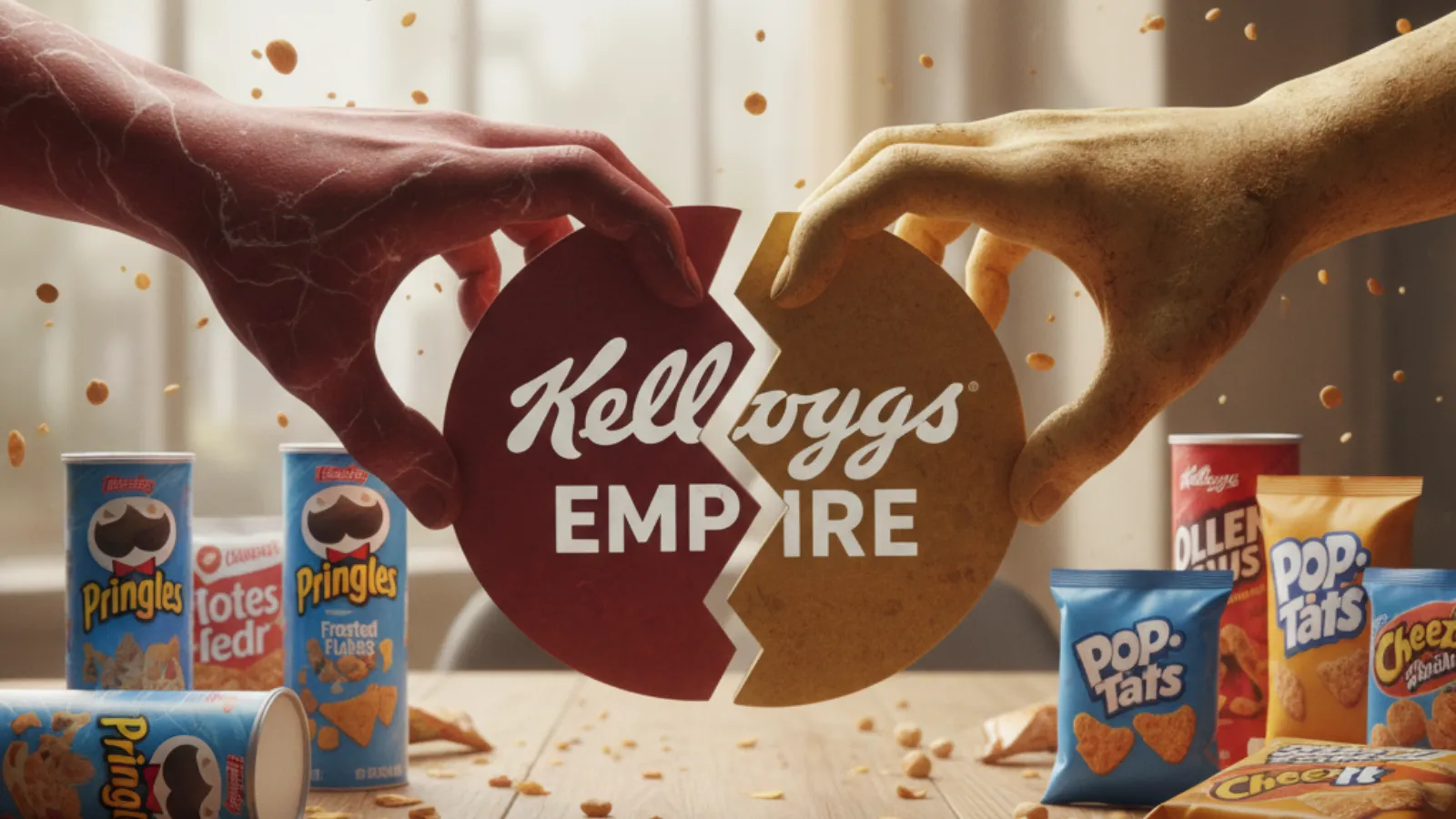
In under 15 months, the Kellogg Company effectively ceased to exist as an independent commercial force. Mars absorbed Kellanova for $36 billion in December 2025. Ferrero swallowed WK Kellogg for $3.1 billion in September 2025. Two privately owned confectionery giants — both built on chocolate and sugar — now control Pringles, Cheez-It, Pop-Tarts, Frosted Flakes, Corn Flakes, Special K, RXBAR, and Eggo. The snacking playbook has been rewritten. What makes this story unusual is not the scale of the deals. It is the speed, the structure, and the strategic silence: neither Mars nor Ferrero is publicly listed, neither answers to activist investors, and neither has disclosed synergy targets. The $700bn global snacking market has a new dominant architecture — and most of the industry is still catching up to what that means.
The Split That Created Two Acquisition Targets
In 2023, Kellogg Company divided itself into two separately listed businesses. Kellanova took the global snack portfolio — Pringles, Cheez-It, Pop-Tarts, Rice Krispies Treats, RXBAR, and the international cereal operations. WK Kellogg retained the North American cereal business: Frosted Flakes, Corn Flakes, Froot Loops, Raisin Bran, and Special K. The logic was textbook portfolio rationalization — separate the high-growth international snack business from the mature, low-growth cereal category, and allow each to attract the right class of buyer. It worked faster than expected. Within 26 months of the split, both businesses were gone.
Mars Redraws the Snacking Map
The $36 billion Kellanova acquisition is the largest deal in Mars' 114-year history. It brings Pringles — a $2 billion-plus brand — together with Cheez-It, Pop-Tarts, Rice Krispies Treats, RXBAR, and Nutri-Grain, alongside Mars' existing megabrands: Snickers, M&M's, Twix, Skittles, and Kind bars. Combined annual snacking revenues now reach approximately $36 billion, making Mars the single largest snacking operation by breadth of occasion coverage. For context, Frito-Lay — PepsiCo's snack division and long regarded as the industry benchmark — contributes $23.3 billion annually. Mars has not simply entered the snacking category. It has become the category's structural centre of gravity.
The integration has moved at pace. Mars opened a $42 million Global R&D Hub at its Chicago headquarters — occupying Kellanova's former home — and launched a proprietary AI trend-forecasting tool to accelerate new product development. The company has created 600 new jobs in Chicago, consolidating leadership teams across the combined snacking division. Industry analysts are already predicting the first cross-portfolio innovations: sweet-savory Pringles-Mars mashups, protein-enhanced RXBAR extensions, and Cheez-It formats carrying Mars branding. An M&M's x Marvel global campaign spanning 65-plus markets signals that Mars intends to use its confectionery megabrands as activation engines across the entire portfolio — not just the chocolate aisle.
Ferrero's Quiet North American Pivot
Ferrero moved more quietly. Its $3.1 billion acquisition of WK Kellogg gave the Italian group something it had not built organically in North America: a credible breakfast platform. Frosted Flakes, Corn Flakes, Froot Loops, Raisin Bran, and Special K now sit alongside Nutella, Kinder, Ferrero Rocher, Butterfinger, and Baby Ruth — the last two acquired from Nestlé in 2018. For Ferrero, WK Kellogg is not a cereal turnaround play. It is a distribution network acquisition and a breakfast-occasion beachhead. The scale of the DSD and retail logistics infrastructure that comes with a legacy North American cereal business takes a decade to build from scratch. Ferrero paid $3.1 billion and skipped that decade.
What the Consolidation Means for Everyone Else
The structural consequences for the broader snacking industry are significant. Distribution agreements, shelf space negotiations, and promotional volume commitments across the US grocery and convenience channels will all be renegotiated against a Mars-Kellanova combined entity — one with leverage that no regional or mid-tier snack operator can match. For Mondelez, PepsiCo, and Nestlé, the repositioning of Mars as a full-spectrum snacking company means a new competitor for every major snacking occasion, from savoury impulse to breakfast-to-go. The boundary between confectionery and snacking — which these companies have policed carefully for decades — has been dissolved from the inside.
The Mars-Ferrero carve-up of the Kellogg empire is also a signal about what private ownership enables that listed competitors cannot easily replicate. Both deals were structured, negotiated, and executed without quarterly earnings pressure, dilution concerns, or analyst-call synergy milestones. The timeline from announcement to close, the integration pace, and the capital deployed all reflect a conviction that public market discipline is not always an advantage in long-horizon, category-defining M&A. For operators, retailers, and investors, the relevant question is no longer whether Mars and Ferrero's ambitions are credible. It is how quickly the combined distribution, innovation, and shelf space leverage converts into durable category dominance — and who gets displaced when it does.

Global Aseptic Packaging Market Report 2026
148.4bn litres and 344bn packs in 2025. Aseptic volumes across dairy, dairy alternatives, beverages and food in 39 markets — 2025 actuals and forecasts to 2030. Buy online and receive it within 24 hours.
More information
Global Cheese Database 2026
Production, imports, exports and consumption for 39 cheese types across 48 countries, with actuals through 2025 and forecasts to 2030. Join the waitlist for early access, pre-launch pricing and a free sample country chapter.
Get early accessStrategic Insights
📊 Analytics & Strategic Insight
Why Private Ownership Is Winning the $700bn Snacking Race
The decision most in this industry are avoiding:
👉 Most listed snack operators are managing for quarterly EPS — Mars and Ferrero are managing for decade-long category dominance. The $36 billion and $3.1 billion acquisitions were each financed without public market pressure on dilution, timetable, or synergy milestone disclosure. That structural freedom is itself a competitive advantage that no amount of capital allocation discipline can fully replicate.
👉 The integration synergy targets being discussed publicly are underestimating the real prize: distribution infrastructure. Kellanova had one of the most sophisticated direct store delivery networks in North America. That infrastructure — not the brand portfolio — is the hardest and most time-consuming thing for any competitor to replicate organically. Mars acquired a decade of distribution build in a single transaction.
👉 Mid-tier snack operators benchmarking against pre-merger Kellanova are working with structurally outdated data. Shelf space allocations, promotional pricing floors, and co-manufacturing agreements are now negotiated against a $36 billion combined snacking entity. The category dynamics that governed 2024 planning cycles no longer apply.
Here's the full context:
→ 2019: Kellogg Company sells its cookie and fruit snack business to Ferrero for $1.3 billion — an early signal of portfolio rationalisation and Ferrero's North American ambition.
→ 2023: Kellogg splits into Kellanova (global snacks, Pringles, international cereal) and WK Kellogg (North American cereal). Both list separately, each positioned as a cleaner acquisition target.
→ 2024: Mars announces $36 billion bid for Kellanova — largest food acquisition in nearly a decade. Ferrero announces $3.1 billion acquisition of WK Kellogg months later. Both halves of the former Kellogg Company are in play simultaneously.
→ September 2025: Ferrero completes WK Kellogg acquisition. Frosted Flakes, Corn Flakes, Special K, and Froot Loops fold into Ferrero's North American snacking and breakfast platform alongside Nutella and Kinder.
→ Most recent: Mars completes Kellanova acquisition December 2025. Opens $42M Global R&D Hub in Chicago, launches AI innovation tool, creates 600 jobs. Combined snacking revenues reach approximately $36 billion, surpassing Frito-Lay's $23.3 billion annual contribution.
What this means for food and beverage operators and investors:
✅ Shelf space and promotional economics will reset across the snack aisle in 2026 and 2027. Mars-Kellanova's combined negotiating position with major US and international retailers means category reset conversations will be fought on materially different terms than any previous cycle. Operators dependent on secondary shelf positions or retailer goodwill should act before annual reviews begin.
✅ The private ownership model is now the benchmark for long-horizon snacking M&A execution. Mars and Ferrero both moved without quarterly earnings constraints, activist pressure, or public synergy guidance. PE-backed and family-owned F&B platforms with acquisition ambitions have a structural model to study — and a window to act before integration synergies harden the competitive gap further.
✅ WK Kellogg's cereal platform represents an underappreciated distribution foothold for Ferrero's US expansion. Distribution scale matters more than brand equity in breakfast cereal. Ferrero now has both — and a breakfast occasion platform that positions it to move further into morning snacking formats where margins are higher than traditional cereal.
3 moves you can make this week:
1️⃣ If you compete in snacking, commission a shelf space and distribution audit against the new Mars-Kellanova combined footprint. Your 2024 category review is structurally out of date. The promotional, co-manufacturing, and shelf allocation landscape has changed — and waiting for your next annual review risks missing the reset window.
2️⃣ If you are a co-manufacturer or ingredients supplier, open direct dialogue with Mars's Chicago R&D Hub now. A $42 million innovation centre with an AI-accelerated brief pipeline represents significant new procurement volume across savoury, confectionery, protein, and breakfast formats. First-mover supplier relationships formed during integration are structurally more durable than those negotiated post-consolidation.
3️⃣ If you are evaluating F&B acquisition targets in snacking, stress-test each asset's distribution network against the new Mars-Kellanova DSD benchmark. Assets relying on broker or third-party distribution face structural margin compression over the next 18 to 24 months as the combined entity extracts volume leverage across all retail channels.
Take the Next Step
♻️ Looking for a high-growth investment in sustainable beverage technology?
An iF Design Award-winning, IoT-enabled product line solving the single-use plastic crisis from the inside — designed for the home and B2B market. Strong structural tailwinds as plastic regulations tighten across Europe.
→ Request the investor deck: info@zenithglobalcommercial.com
Zenith Consulting
Submit your food & beverage project enquiry.
Share your requirements. If there is a strong fit, we’ll come back with an indicative investment range, project timeline and recommended strategic approach.
Reviewed by Zenith Consulting’s senior food & beverage strategy team.
Related analyses
- M&A, Investment & Valuation
Parmigiano Reggiano Takes On Australian Parmesan: The EU Trade Deal Protected 53 Cheese Names And Left Parmesan Out
The Parmigiano Reggiano Consortium has opened a three-year campaign in Australia, where cheese output runs at 455,000 tonnes a year. Australia agreed to protect 53 EU cheese names, and parmesan is not one of them.
Read analysis → - M&A, Investment & Valuation
Parmigiano Reggiano Takes On Australian Parmesan: The EU Trade Deal Protected 53 Cheese Names And Left Parmesan Out
The Parmigiano Reggiano Consortium has opened a three-year campaign in Australia, where cheese output runs at 455,000 tonnes a year. Australia agreed to protect 53 EU cheese names, and parmesan is not one of them.
Read analysis → - M&A, Investment & Valuation
Müller Closes Sachsenmilch Semi-Hard Cheese Dairy At Leppersdorf: Mozzarella And Acid Curd Lines Stay
Müller will close the semi-hard cheese dairy at Sachsenmilch Leppersdorf on 31 December 2026, with about 160 staff affected. Mozzarella and acid curd cheese carry on at a site that takes 1.7 billion kg of milk a year.
Read analysis →
Share it with your peers
Pass this analysis to colleagues who track the food and beverage market.
Zenith Market Intel
Need a specific food or beverage market report?
Tell us which category, region or question would be useful for your team.
Sister Publication
Also follow our Water Dispense Market Intelligence
Category analyses, operator briefings, and investor signals across the global water dispense market.