PepsiCo Cut Snack Prices and Won Back Shoppers — Mondelez Couldn't. Inside Big Snack's Great Pricing Divide.
PepsiCo cut prices on Lay's, Doritos and Cheetos by up to 15% and its North American food business returned to volume growth in the first quarter of 2026. Mondelez kept raising prices to cover surging cocoa costs — and watched volume slip, operating income fall 19%, and 2026 guidance drop to just 0–2%.
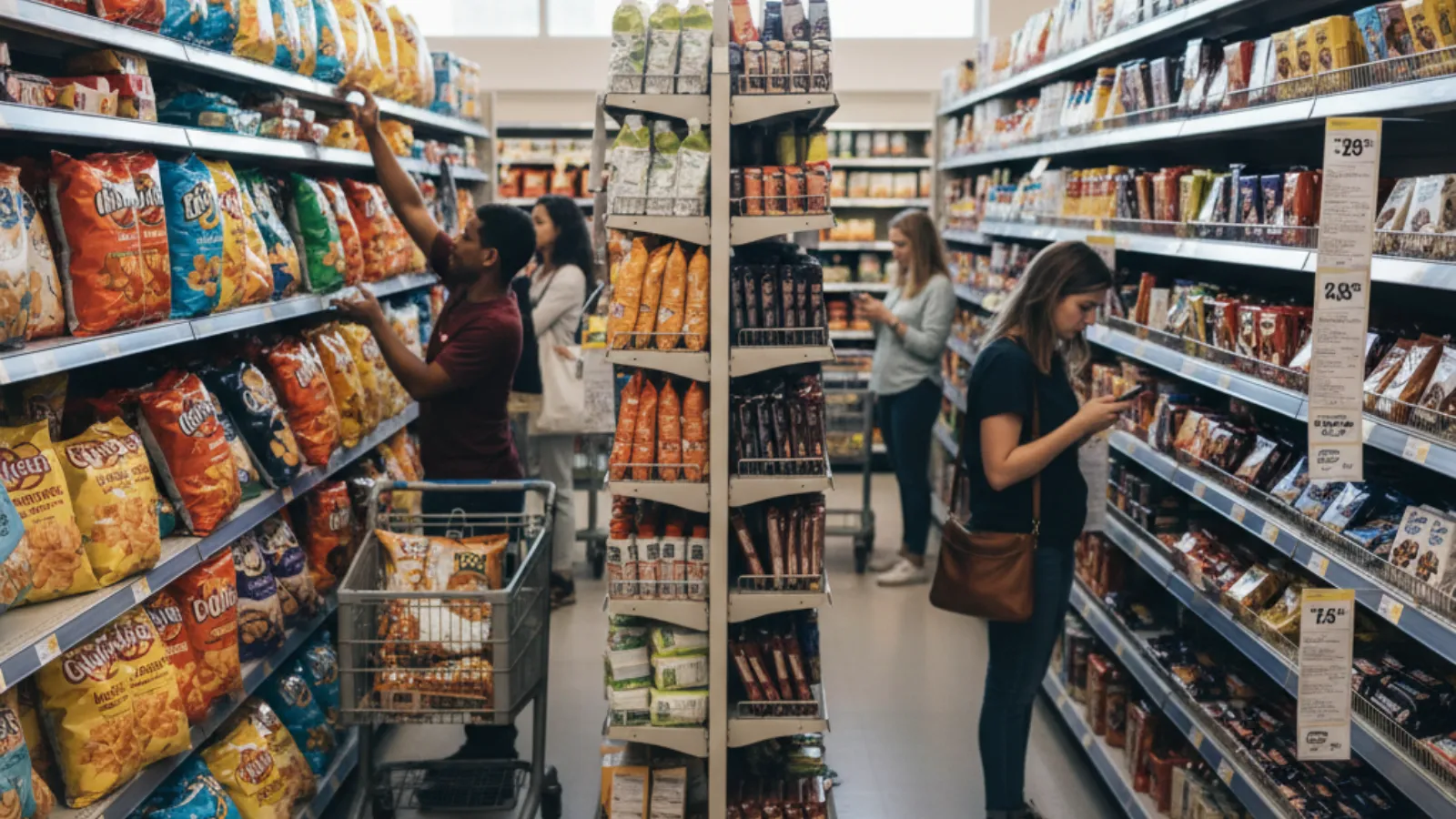
For three years, the simplest way to grow a snack company was to raise prices and let inflation do the rest. That playbook just ran out. The most telling move in consumer goods this year is not an acquisition — it is the world's largest salty-snack business quietly competing on price again. In February, PepsiCo cut shelf prices on Lay's, Doritos, Cheetos and Tostitos by as much as 15%, rolled them out before the Super Bowl, and pulled roughly a fifth of its US product range off the shelf. Then it told investors the cuts were working. The question every Big Food board is now asking is whether they can follow — and a look at Mondelez suggests not all of them can.
Why PepsiCo blinked first
PepsiCo did not cut prices out of generosity. It cut because the alternative was decline. Doritos had climbed almost 50% at Walmart since 2021, with some bags topping $7, and shoppers walked: Frito-Lay's organic volume fell 2% across 2025 and the unit missed its own revenue targets two years running by more than $1 billion. Cutting prices was not a discount — it was a rescue. The first-quarter result vindicated it. PepsiCo's North American food business returned to volume growth of 2% in Q1 2026, organic revenue rose 2.6%, and core earnings per share grew 9%. Management now expects Frito-Lay to grow volume, revenue and operating margin this year — a full reversal of the 2025 slide. So what? The company chose lower prices and higher volume over fat margins on a shrinking base, and the market rewarded it.
Why Mondelez can't
Mondelez ran the opposite experiment, and not entirely by choice. Its Q1 organic revenue rose 3.0% — but every point of that came from price, while volume and mix fell 0.5%. In chocolate the contrast is starker: 5.5% organic growth sitting on top of a 2.1% drop in volume. The company is selling less and charging more, and the bottom line shows the strain — adjusted operating income fell 19% at constant currency, with profit down in every region except Latin America. The culprit is cocoa. Bean prices have been so volatile that Mondelez has had to keep pricing up simply to defend its margins, and it has guided 2026 organic growth to just 0–2%, against a market expecting nearly 4%, while flagging a one-time $500 million hit. So what? Mondelez is trapped in the old playbook because its single most important input will not let it out.
The same era, two outcomes
Strip away the brands and this is one story told twice. Pricing power has not vanished evenly — it has become a function of whether your cost base lets you give it back. PepsiCo found the savings — closing plants, culling a fifth of its US range — to fund lower prices and buy back volume. Mondelez did not have that room, so it is still raising prices into a tired consumer and watching demand erode. The lesson for the rest of Big Food is uncomfortable: the winners of 2026 will be the companies whose commodities let them trade margin for volume, and the losers will be those chained to an input — cocoa, coffee, dairy — that forces them to keep pushing prices a fatigued shopper has stopped accepting. Volume, not price, is the scoreboard now.
What to watch next
The next two quarters will show whether PepsiCo's volume recovery holds once the novelty of lower prices fades, and whether Mondelez can break the cocoa cycle through hedging, reformulation or smaller packs before its guidance slips again. Every packaged-food management team is now sorting into two camps: those who can afford to cut, and those who cannot. For investors, the divergence is a screening tool — input exposure, not brand strength, increasingly predicts who can defend volume. For operators, it is a warning that the inflation-era growth model has quietly expired. The companies that win the next cycle will be the ones that worked out, before their competitors did, that the customer was finished paying more.

Global Aseptic Packaging Market Report 2026
148.4bn litres and 344bn packs in 2025. Aseptic volumes across dairy, dairy alternatives, beverages and food in 39 markets — 2025 actuals and forecasts to 2030. Buy online and receive it within 24 hours.
More information
Global Cheese Database 2026
Production, imports, exports and consumption for 39 cheese types across 48 countries, with actuals through 2025 and forecasts to 2030. Join the waitlist for early access, pre-launch pricing and a free sample country chapter.
Get early accessStrategic Insights
📊 Analytics & Strategic Insight
The real divide in packaged food is no longer brand strength — it is which commodity holds your pricing hostage
The decision most in this industry are avoiding:
👉 Treating a price cut as a sign of weakness rather than a deliberate trade of margin for volume. PepsiCo's reversal shows the discipline is in choosing when to give price back, not in defending it to the last point.
👉 Managing cocoa, coffee and dairy as a treasury problem instead of a strategic one. When an input decides whether you can compete on shelf, commodity risk belongs in the boardroom, not the back office.
👉 Assuming the consumer who absorbed three years of increases will keep absorbing them. Elasticity has snapped back, and the brands still pricing into it are mistaking inertia for loyalty.
Here's the full context:
→ 2021–2024: Big Food pushes through historic price increases; Doritos rises nearly 50% at Walmart, with some bags topping $7.
→ 2025: Frito-Lay organic volume falls 2% and misses internal revenue targets two years running by over $1 billion as shoppers trade down.
→ February 2026: PepsiCo cuts prices on Lay's, Doritos, Cheetos and Tostitos by up to 15%, trims a fifth of its US range, and begins closing plants.
→ April 2026: PepsiCo Q1 organic revenue rises 2.6% with North American food volume back to +2%; Mondelez posts 3.0% organic growth built entirely on pricing as volume and mix slip 0.5%.
→ Most recent: Mondelez guides 2026 organic growth to just 0–2% against a roughly 4% consensus, flags a $500 million one-time hit, and reports adjusted operating income down 19% on cocoa.
What this means for food and beverage operators and investors:
✅ Input exposure is now a forecasting variable. Screen packaged-food names by their dominant commodity — cocoa, coffee, dairy — before brand equity; it increasingly predicts who can defend volume.
✅ Margin defended on a shrinking base is a trap. Mondelez's 19% operating-income drop on positive pricing shows that protecting price while volume erodes destroys more value than a disciplined cut.
✅ The deflation pivot rewards the prepared. Firms that paired price cuts with cost takeout — PepsiCo's plant closures and range cull — can afford to compete; those without the savings cannot follow even if they want to.
3 moves you can make this week:
1️⃣ Map your portfolio by commodity dependence. Flag every brand whose pricing is dictated by a single volatile input and model what a forced 12-month price hold would do to volume.
2️⃣ Run the cut-versus-hold math on your top three SKUs. Quantify the volume you would need to recover to make a 10–15% price cut margin-neutral, the way Frito-Lay evidently did.
3️⃣ Pressure-test your cost-takeout pipeline. A price cut is only fundable if savings exist to pay for it — audit SKU rationalisation, network footprint and productivity before the next pricing decision.
Zenith Consulting
Submit your food & beverage project enquiry.
Share your requirements. If there is a strong fit, we’ll come back with an indicative investment range, project timeline and recommended strategic approach.
Reviewed by Zenith Consulting’s senior food & beverage strategy team.
Related analyses
- Market & Category Growth
UK Cheese Supplies Fall 6,900 Tonnes As Exports Hit A Q2 Record: Cheddar Milk Use Down 14 Million Litres
AHDB put UK available cheese supplies down 6,900 tonnes in the second quarter of 2026, while exports rose 8,000 tonnes to an all-time quarterly high. Defra figures show milk into Cheddar down 14.1 million litres in August alone.
Read analysis → - M&A, Investment & Valuation
Parmigiano Reggiano Takes On Australian Parmesan: The EU Trade Deal Protected 53 Cheese Names And Left Parmesan Out
The Parmigiano Reggiano Consortium has opened a three-year campaign in Australia, where cheese output runs at 455,000 tonnes a year. Australia agreed to protect 53 EU cheese names, and parmesan is not one of them.
Read analysis → - M&A, Investment & Valuation
Parmigiano Reggiano Takes On Australian Parmesan: The EU Trade Deal Protected 53 Cheese Names And Left Parmesan Out
The Parmigiano Reggiano Consortium has opened a three-year campaign in Australia, where cheese output runs at 455,000 tonnes a year. Australia agreed to protect 53 EU cheese names, and parmesan is not one of them.
Read analysis →
Share it with your peers
Pass this analysis to colleagues who track the food and beverage market.
Zenith Market Intel
Need a specific food or beverage market report?
Tell us which category, region or question would be useful for your team.
Sister Publication
Also follow our Water Dispense Market Intelligence
Category analyses, operator briefings, and investor signals across the global water dispense market.