PepsiCo's Snack Recovery Is Real — But Its Beverage Problem Is Deepening
PepsiCo beat Q1 2026 analyst estimates with $19.4 billion in revenue and a 27% jump in EPS — but the headline conceals a structural split. The North American food business just returned to volume growth for the first time in over two years. The beverage business contracted again. And the company's $3.15 billion acquisition spree is buying competitors to its own core portfolio.
When PepsiCo reported Q1 2026 results on April 16, the headline metrics were unambiguously strong: revenue up 8.5% to $19.4 billion, EPS up 27% to $1.70, organic growth of 2.6% against an uncertain consumer backdrop. Analysts had expected less. But inside those numbers, a structural split is widening — one that tells a more complicated story about the long-term architecture of the world's second-largest food and beverage company.
The North American food business just recorded its first volume growth in more than two years. The beverage business contracted for the third consecutive quarter. This is not a single quarter's anomaly. It is a structural divergence — and how PepsiCo resolves it will define the company's investment case for the rest of the decade.
The Snack Recovery Is Bought, Not Earned
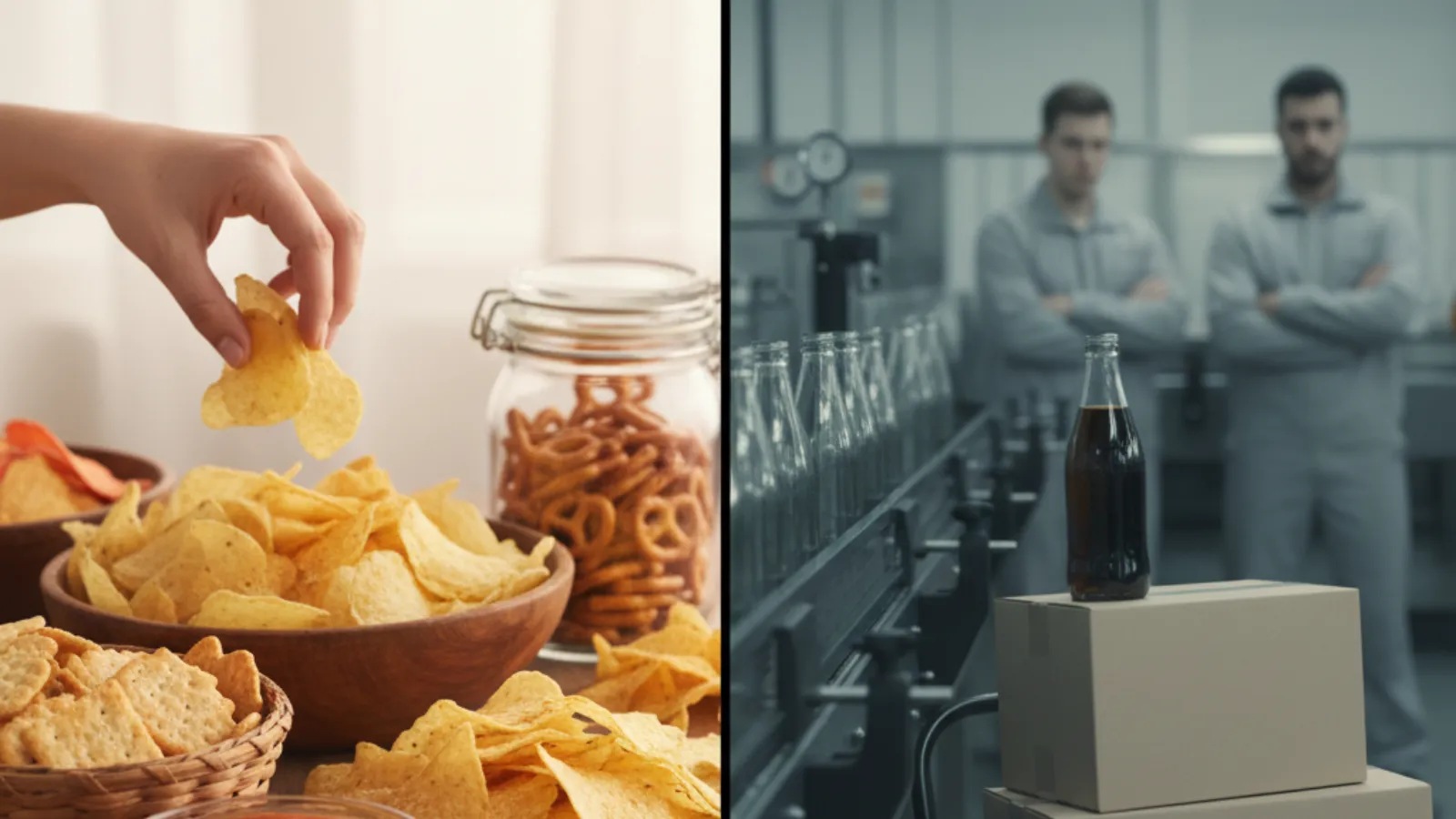
The mechanism behind Frito-Lay's return to volume growth is not subtle. In February 2026, PepsiCo cut prices by as much as 15% on Lay's, Tostitos, Doritos, and Cheetos — its four largest snack brands. Retailers, rewarded with more competitive pricing, responded by increasing shelf space. The result: 300 million incremental consumption occasions, volume up 2%, unit growth up 4%.
The price investment works, but it has a cost. Funding 15% price reductions across a portfolio generating billions in revenue compresses gross margins before it lifts brand equity. The Q1 recovery is real. Whether it holds at a sustainable margin level will only become clear when Q2 and Q3 data arrives. PepsiCo is effectively buying back volume it lost by overpricing — a legitimate tactic, but not a structural moat.
The $3 Billion Portfolio Bet on the Other Side of the Business
PepsiCo has spent the past 18 months making three significant acquisitions and portfolio moves that signal it has largely given up on growing its core carbonated beverage business through organic means alone.
In January 2025, it completed the $1.2 billion acquisition of Siete Foods — a Mexican-American better-for-you snack brand spanning chips, tortillas, and grain-free formats. In May 2025, it completed the $1.95 billion acquisition of Poppi — a prebiotic soda with no more than five grams of sugar per can, built explicitly on the premise that traditional carbonated soft drinks are losing. It simultaneously began distributing Alani Nu energy drinks and maintained a strategic relationship with Celsius. It divested Rockstar.
Taken together, PepsiCo has now spent approximately $3.15 billion acquiring brands that are direct or structural competitors to its own core beverage portfolio. That is not a diversification strategy. It is a managed transition.
Gatorade and the $15 Billion Restage Risk
At CAGNY in February 2026, CEO Ramon Laguarta disclosed that PepsiCo is simultaneously restaging four major brands: Lay's, Tostitos, Gatorade, and Quaker. Combined, these brands account for more than $15 billion in annual revenues. The scale of concurrent brand rebuilds at a single company is, by any historical measure, exceptional.
The Gatorade restage is the highest-stakes element. The brand is being repositioned from a performance-sport drink to an everyday hydration solution for all consumers — including those who never exercise. A lower-sugar variant is being introduced. Artificial colors are being removed. These changes are structurally sensible — but brands like PRIME, Liquid I.V., and Electrolit have already claimed the clean everyday hydration positioning with younger consumers. PepsiCo is not pioneering this repositioning; it is arriving second to it.
Quaker's restage is recovery, not growth: the brand was damaged by a product safety recall in late 2023 and needs trust rebuilt in a breakfast category increasingly contested by protein alternatives and private label.
Why April 28 Matters for the Whole Sector
PepsiCo's beverage volume decline becomes far more strategically significant this week, when both Coca-Cola and Mondelez report Q1 2026 results on April 28. Analysts expect Coca-Cola revenue of approximately $12.3 billion, up roughly 10.6% year over year. CEO Henrique Braun has been explicit about investing in the core sparkling portfolio — including a Coca-Cola Zero Sugar reformulation widely regarded as one of the most successful soft drink restages of the past decade.
If Coke reports volume growth in North American beverages while PepsiCo contracted at -2.5%, the competitive gap in the category will be structurally visible for the first time in a generation. This is no longer a market-share skirmish. It would signal a fundamental divergence in brand investment and portfolio discipline whose consequences will take years to fully price in.
PepsiCo's Q1 was a good quarter by every conventional metric. The real question for operators and investors is whether a food business recovering by cutting prices and a beverage business recovering by acquiring its own competitors represent a durable compounding engine — or a well-managed holding action while secular category shifts accelerate faster than any restage programme can respond.
Global Aseptic Packaging Market Report 2026
148.4bn litres and 344bn packs in 2025. Aseptic volumes across dairy, dairy alternatives, beverages and food in 39 markets — 2025 actuals and forecasts to 2030. Buy online and receive it within 24 hours.
More information
Global Cheese Database 2026
Production, imports, exports and consumption for 39 cheese types across 48 countries, with actuals through 2025 and forecasts to 2030. Join the waitlist for early access, pre-launch pricing and a free sample country chapter.
Get early accessStrategic Insights
📊 Analytics & Strategic Insight
PepsiCo's Two-Speed Portfolio Is the Most Important Structural Signal in Packaged Food and Beverages Right Now
The decision most in this industry are avoiding:
👉 Volume recovery via price cuts is a capital cost, not a brand recovery. PepsiCo bought back 300 million consumption occasions by subsidising purchase frequency — if margin compression continues into Q2 and Q3, the "turnaround" narrative will face serious credibility pressure regardless of volume lines.
👉 Acquiring $3.15 billion of brands that compete with your own core portfolio is the most honest admission a beverage company can make. Poppi and Alani Nu are structurally designed for consumers who no longer want what Pepsi cola offers. Owning both sides of that shift is rational; pretending it is additive rather than substitutive is not.
👉 Gatorade's restage is late by at least three years. The functional hydration category was already claimed by challenger brands before PepsiCo began the repositioning. The risk is not that the restage fails — it is that it succeeds in capturing 50+ demographics while permanently ceding the 16–34 consumer to PRIME, Liquid I.V., and Electrolit.
Here's the full context:
→ 2022–2023: PepsiCo takes cumulative price increases of 15–20% across Frito-Lay and beverage portfolios. Volume begins declining in North American food and beverage. Quaker hit by product recall in late 2023.
→ January 2025: PepsiCo completes $1.2 billion acquisition of Siete Foods. Portfolio strategy pivots toward better-for-you and permissible indulgence in snacks.
→ May 2025: PepsiCo completes $1.95 billion acquisition of Poppi. Simultaneously distributes Alani Nu and deepens Celsius relationship. Divests Rockstar energy.
→ February 2026 (CAGNY): CEO Laguarta discloses simultaneous restage of Lay's, Tostitos, Gatorade, and Quaker — more than $15 billion in combined revenues being rebuilt concurrently. Price cuts of up to 15% on core snack brands announced.
→ April 16, 2026: Q1 results. Food volume: +2% (first growth in 2+ years). Beverage volume: -2.5%. Revenue: $19.4B (+8.5%). EPS: $1.70 (+27%). The structural split is confirmed, not closed.
What this means for food and beverage operators and investors:
✅ Monitor PepsiCo's gross margin trajectory in Q2 and Q3 2026 — not just volume. Volume recovery funded by 15% price cuts is only strategically valuable if margins stabilise above a floor that sustains the brand investment programme. If margins compress while volume recovers, PepsiCo is effectively subsidising market share at the expense of long-term brand equity.
✅ PepsiCo's functional beverage acquisition playbook is now the industry template. Poppi ($1.95B) and Alani Nu distribution establish the pattern: large beverage companies cannot build functional credibility through R&D alone — they acquire brands with authentic consumer equity and use distribution leverage to scale. Founders and PE funds holding health and functional beverage brands should actively price this acquisition premium into exit expectations.
✅ The April 28 Coca-Cola Q1 result is the reference point that reframes PepsiCo's beverage decline as either market-wide or company-specific. A Coke volume growth print in North America confirms a competitive share shift — and moves the conversation from "tough category" to "strategic execution gap," with direct implications for relative equity positioning between the two companies.
3 moves you can make this week:
1️⃣ Watch the Coca-Cola North American beverage volume number on April 28 before drawing conclusions about the soft drink category. If Coke grows while Pepsi contracted, the differential is a company-specific signal — not a category headwind — and reprices PepsiCo's recovery timeline materially.
2️⃣ If you operate in or adjacent to the functional or better-for-you beverage space, benchmark your brand's positioning against Poppi's acquisition profile. The deal criteria were clear: prebiotic functionality, low sugar (under 5g per can), retail velocity, and a distinctive brand story. If your metrics align, PepsiCo — and its competitors who now face pressure to respond — are active acquirers.
3️⃣ Track Mondelez Q1 2026 results on April 28 for the gross margin line specifically. Cocoa prices have dropped from over $12,000 per metric ton in late 2024 to approximately $3,000–$3,300 in April 2026. If Mondelez shows margin recovery while maintaining pricing, confectionery becomes the standout Big Food category for investors in H2 2026 — and a direct contrast to PepsiCo's margin-for-volume trade.
Take the Next Step
🌊 Interested in owning a stake in one of Earth's largest secured natural spring sources?
A rare asset-backed investment opportunity: 50+ year water and land rights, carbon-neutral infrastructure, B2B and white-label focus, and a 33% projected IRR. USD 28M raise, USD 80M post-money valuation.
→ View the investment opportunity
Zenith Consulting
Submit your food & beverage project enquiry.
Share your requirements. If there is a strong fit, we’ll come back with an indicative investment range, project timeline and recommended strategic approach.
Reviewed by Zenith Consulting’s senior food & beverage strategy team.
Related analyses
- Market & Category Growth
UK Cheese Supplies Fall 6,900 Tonnes As Exports Hit A Q2 Record: Cheddar Milk Use Down 14 Million Litres
AHDB put UK available cheese supplies down 6,900 tonnes in the second quarter of 2026, while exports rose 8,000 tonnes to an all-time quarterly high. Defra figures show milk into Cheddar down 14.1 million litres in August alone.
Read analysis → - M&A, Investment & Valuation
Parmigiano Reggiano Takes On Australian Parmesan: The EU Trade Deal Protected 53 Cheese Names And Left Parmesan Out
The Parmigiano Reggiano Consortium has opened a three-year campaign in Australia, where cheese output runs at 455,000 tonnes a year. Australia agreed to protect 53 EU cheese names, and parmesan is not one of them.
Read analysis → - M&A, Investment & Valuation
Parmigiano Reggiano Takes On Australian Parmesan: The EU Trade Deal Protected 53 Cheese Names And Left Parmesan Out
The Parmigiano Reggiano Consortium has opened a three-year campaign in Australia, where cheese output runs at 455,000 tonnes a year. Australia agreed to protect 53 EU cheese names, and parmesan is not one of them.
Read analysis →
Share it with your peers
Pass this analysis to colleagues who track the food and beverage market.
Zenith Market Intel
Need a specific food or beverage market report?
Tell us which category, region or question would be useful for your team.
Sister Publication
Also follow our Water Dispense Market Intelligence
Category analyses, operator briefings, and investor signals across the global water dispense market.