Private Label Crosses 50% in Europe's Biggest Food Markets. The Branded Playbook Is Broken.
Circana's April 2026 data confirms private label has crossed 50% unit share across Europe's six biggest grocery markets simultaneously. With US store brands hitting $330 billion in annual sales and national brand growth trailing at barely 1%, the question for branded food operators is no longer how to stop private label — it's whether their current portfolio is built to survive it.
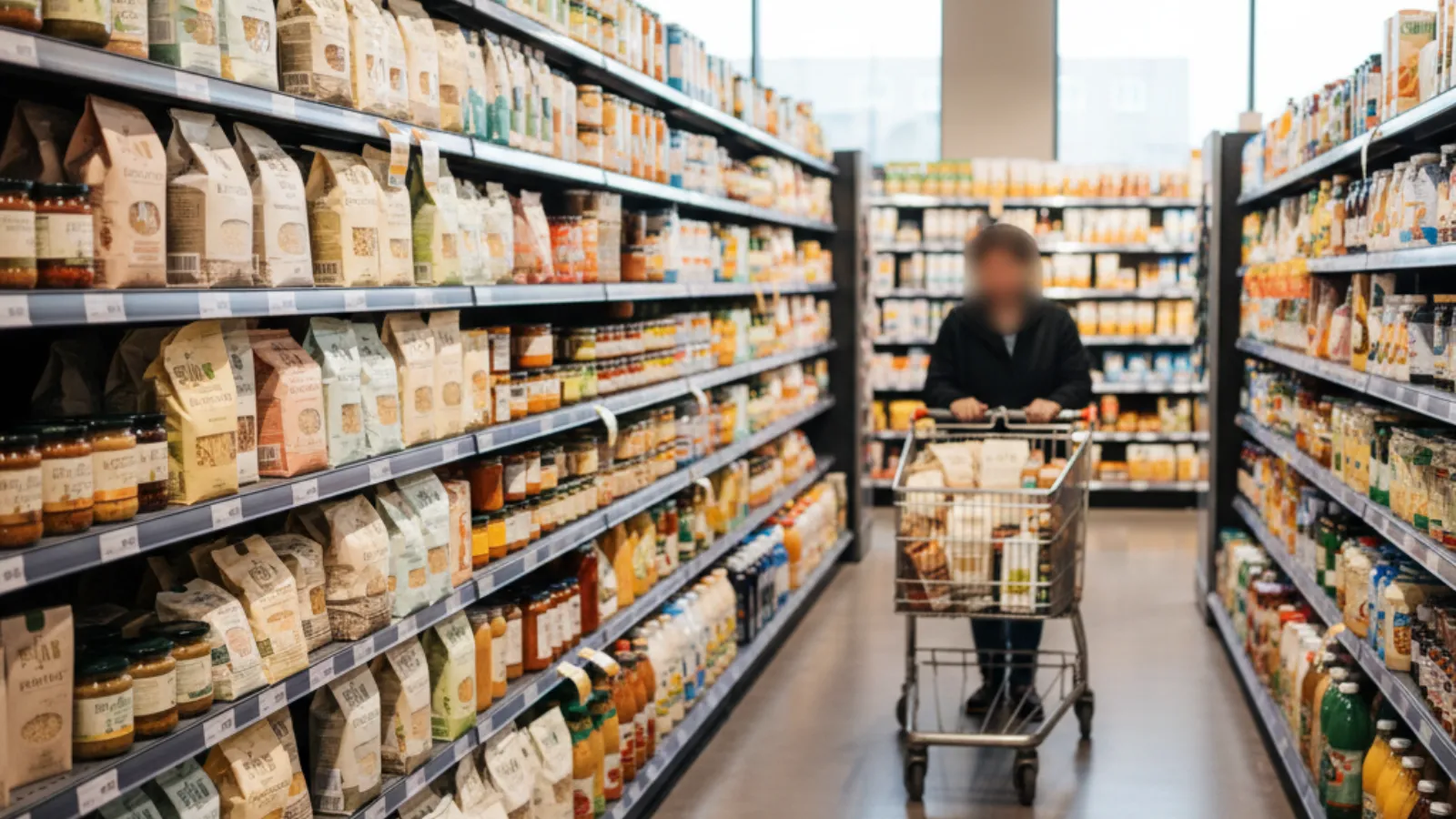
For years, branded food executives dismissed private label as a recession-era trade-down. Circana's April 2026 data makes that argument structurally indefensible.
Private label has crossed 50% unit share across Europe's six largest grocery markets — France, Germany, Italy, the Netherlands, Spain, and the UK — the highest level on record, and the first time the milestone has been confirmed simultaneously across the continent's entire Big Six bloc. In Spain, private label now commands 59% of units. The Netherlands sits at 56%. The UK and Germany have reached 52%. Even France, historically one of branded food's strongest markets in Europe, has reached 46%.
The 50% Line
This is not a flash point. It is a decade-long structural shift arriving at its logical conclusion. Private label in Europe grew at nearly three times the rate of national brands across 2025. And Circana's March 2026 report on the US market shows the same dynamic unfolding across the Atlantic: US store brand CPG sales have reached $330 billion, representing a 24% unit share and a 23% dollar share — figures that would have been inconceivable a decade ago.
The data also reveals an important distinction between dollar and unit share. National brands retain a slightly higher dollar share than their unit share suggests, because branded products continue to command a price premium at shelf. But that premium is narrowing. In categories where private label now holds majority unit share, the premium is no longer generating volume stability — it is masking a slow-moving loss of consumer franchise.
The Innovation Trap
The traditional branded defence — heavier promotional spend — is becoming its own liability. Circana's European data shows that 34% of all branded unit sales across Europe's biggest grocery markets are now sold on promotion. For private label, that figure is 14%. Branded manufacturers are spending more to hold less ground, compressing margins while training consumers to wait for discounts rather than pay full price.
The more dangerous shift is that private label is no longer competing on price alone. Major US grocers are aggressively scaling their own-label portfolios into branded territory on health claims, functionality, and product quality. Kroger's Simple Truth expansion now includes protein-forward cereals with 14 grams of protein and 6 grams of fibre per serving. Walmart is revamping nearly 10,000 Great Value products across 100-plus categories — for the first time in seven years. In the UK and Germany, retailer own-label ranges now include gut health products, adaptogen drinks, and high-protein snack formats that launched alongside, or ahead of, their national brand equivalents.
Gen Z is accelerating this trajectory. Circana's 2026 US data identifies younger consumers as a primary driver of private label momentum, with store brands increasingly treated as identity-aligned choices rather than budget compromises. When store brands begin winning on self-expression, branded CPG faces an existential positioning problem — not just a pricing one.
Branded Food's Narrowing Options
The operators best positioned to withstand private label pressure are those with genuine category dominance — not broad portfolios of mid-tier brands competing on shelf adjacency. Mondelez's concentrated position in biscuits and chocolate gives it defensible premium differentiation. Coca-Cola's Zero Sugar platform commands category leadership in a space where private label has made minimal inroads. Nestlé's premium coffee brands occupy a tier where retailer own-label cannot credibly play.
The operators most exposed are those with large portfolios of undifferentiated products in everyday grocery categories: condiments, soups, frozen meals, basic dairy, and commodity snacks. These are the aisles where private label's share gains have been fastest and most durable. Kraft Heinz's $600 million brand reinvestment — the so-called "Restoration" strategy announced under CEO Carlos Abrams-Rivera — faces its first real test. Q1 2026 results, due May 6, will be the first hard signal on whether that reinvestment is generating volume recovery or simply holding revenue at higher promotional cost.
The Structural Prognosis
Circana's 2026 outlook projects continued private label acceleration in Europe as inflation continues to compress branded pricing headroom. In the US, growth is expected to moderate but remain above national brand rates through at least 2027. The more consequential shift is strategic: private label is no longer a margin hedge for retailers — it is their primary innovation vehicle, with dedicated R&D, consumer research, and launch pipelines that rival what branded manufacturers were doing five years ago.
For branded food operators and their investors, the path forward is portfolio surgery. Divest or harvest the undifferentiated SKUs. Concentrate investment behind the brands with genuine market leadership, category-defining innovation, or defensible premium positioning. The companies that wait for the consumer to return to branded loyalty will find that the structural conditions for that return no longer exist.

Global Aseptic Packaging Market Report 2026
148.4bn litres and 344bn packs in 2025. Aseptic volumes across dairy, dairy alternatives, beverages and food in 39 markets — 2025 actuals and forecasts to 2030. Buy online and receive it within 24 hours.
More information
Global Cheese Database 2026
Production, imports, exports and consumption for 39 cheese types across 48 countries, with actuals through 2025 and forecasts to 2030. Join the waitlist for early access, pre-launch pricing and a free sample country chapter.
Get early accessStrategic Insights
📊 Analytics & Strategic Insight
Private Label at 50%: The Moment Branded Food Lost the Benefit of the Doubt
The decision most in this industry are avoiding:
👉 Branded food executives are protecting promotional spend rather than cutting undifferentiated SKUs. The 34%-versus-14% promotional intensity gap between branded and private label is not a short-term tactical imbalance — it is evidence that brands have traded structural equity for short-term volume, and the trajectory is now locked in.
👉 Most large branded operators have not updated their portfolio architecture to reflect that private label now wins on health claims, not just price. When Kroger's Simple Truth protein cereal benchmarks against a Kellogg's equivalent on fibre and protein per serve — and often wins on both — branded food loses its last non-price differentiator in the everyday grocery segment.
👉 PE diligence on branded food acquisitions is systematically underpricing private label risk. Deal models that project branded volume stabilisation in EU-facing everyday grocery categories without adjusting for 50%+ private label unit share in the target markets are building on structurally incorrect assumptions.
Here's the full context:
→ 2016–2020: Private label in Europe held a steady 35–38% unit share, largely confined to commodity categories. Branded operators retained firm positions in premium tiers, ready meals, and branded snacks.
→ 2021–2023: Inflation-driven consumer trade-down accelerated private label penetration across every grocery category. The UK, Germany, and Spain saw the sharpest shifts, driven by Aldi and Lidl shelf expansion and aggressive own-label product upgrades.
→ 2024: Circana confirmed private label innovation was outpacing national brands in new product launches across dairy, snacks, and beverages in multiple European markets — signalling the shift from price competition to platform competition.
→ March 2026: Circana's US report confirmed $330 billion in US private label CPG sales — 24% unit share, 23% dollar share — with private label growing at 3.3% versus 1.1% for national brands across 2025.
→ Most recent (April 2026): Circana confirmed 50% unit share simultaneously across Europe's Big Six. Spain leads at 59%; Netherlands at 56%; UK and Germany at 52%; France at 46%; Italy at 36%. All six markets now above or approaching the historic threshold.
What this means for food and beverage operators and investors:
✅ Brand portfolio rationalisation is now a defensive imperative, not a growth strategy. Operators with large SKU counts in everyday grocery categories facing 50%+ private label unit share should be modelling asset disposals, not further brand reinvestment. The top-line may stabilise. The margin will not.
✅ Branded operators in premium beverage, functional food, and health-positioned categories retain structural protection — for now. Circana's data shows private label has made minimal inroads in energy drinks, premium RTD coffee, and functional nutrition. These are the M&A targets and brand investment areas that warrant full-price acquisition multiples in 2026.
✅ Grocery retailers are the silent winners in the branded food margin crisis. As private label margins outperform national brands on shelf, retailers are building manufacturing capabilities, innovation pipelines, and consumer data advantages that make the power dynamic structurally permanent. Operators entering new retail partnerships in 2026 should negotiate from that reality.
3 moves you can make this week:
1️⃣ Run a private label exposure audit on your European SKU portfolio. For every category where private label holds more than 40% unit share in your target markets, model what happens to your branded margin if share drops a further 5 points over 24 months. That output is your disposal shortlist.
2️⃣ Map your brand's functional differentiation against the top 3 retailer own-label equivalents in each core category. If your product cannot win on protein per serve, fibre content, ingredient list clarity, or format innovation — promotional spend will not save it. This is a portfolio question, not a marketing one.
3️⃣ If you are conducting M&A diligence on a branded food asset with significant UK, German, or Spanish exposure, revise your volume recovery assumptions. In markets where private label commands 52–59% of units, the burden of proof on branded volume recovery is materially higher than historical precedent — and most models have not been updated to reflect it.
Take the Next Step
💧 Also covering the water dispense market?
Water dispense is one of the fastest-growing segments in food and beverage. Operator data, revenue benchmarks, and market intelligence across 32 countries.
→ Explore water dispense insights
Zenith Consulting
Submit your food & beverage project enquiry.
Share your requirements. If there is a strong fit, we’ll come back with an indicative investment range, project timeline and recommended strategic approach.
Reviewed by Zenith Consulting’s senior food & beverage strategy team.
Related analyses
- Market & Category Growth
UK Cheese Supplies Fall 6,900 Tonnes As Exports Hit A Q2 Record: Cheddar Milk Use Down 14 Million Litres
AHDB put UK available cheese supplies down 6,900 tonnes in the second quarter of 2026, while exports rose 8,000 tonnes to an all-time quarterly high. Defra figures show milk into Cheddar down 14.1 million litres in August alone.
Read analysis → - M&A, Investment & Valuation
Parmigiano Reggiano Takes On Australian Parmesan: The EU Trade Deal Protected 53 Cheese Names And Left Parmesan Out
The Parmigiano Reggiano Consortium has opened a three-year campaign in Australia, where cheese output runs at 455,000 tonnes a year. Australia agreed to protect 53 EU cheese names, and parmesan is not one of them.
Read analysis → - M&A, Investment & Valuation
Parmigiano Reggiano Takes On Australian Parmesan: The EU Trade Deal Protected 53 Cheese Names And Left Parmesan Out
The Parmigiano Reggiano Consortium has opened a three-year campaign in Australia, where cheese output runs at 455,000 tonnes a year. Australia agreed to protect 53 EU cheese names, and parmesan is not one of them.
Read analysis →
Share it with your peers
Pass this analysis to colleagues who track the food and beverage market.
Zenith Market Intel
Need a specific food or beverage market report?
Tell us which category, region or question would be useful for your team.
Sister Publication
Also follow our Water Dispense Market Intelligence
Category analyses, operator briefings, and investor signals across the global water dispense market.