Tyson Foods Is Losing Half a Billion on Beef — and That's Exactly the Plan
Tyson Foods raised its full-year profit forecast in May 2026 while projecting a beef loss of up to $500 million. It is not failing — it is deliberately shrinking the one business that cannot make money right now.
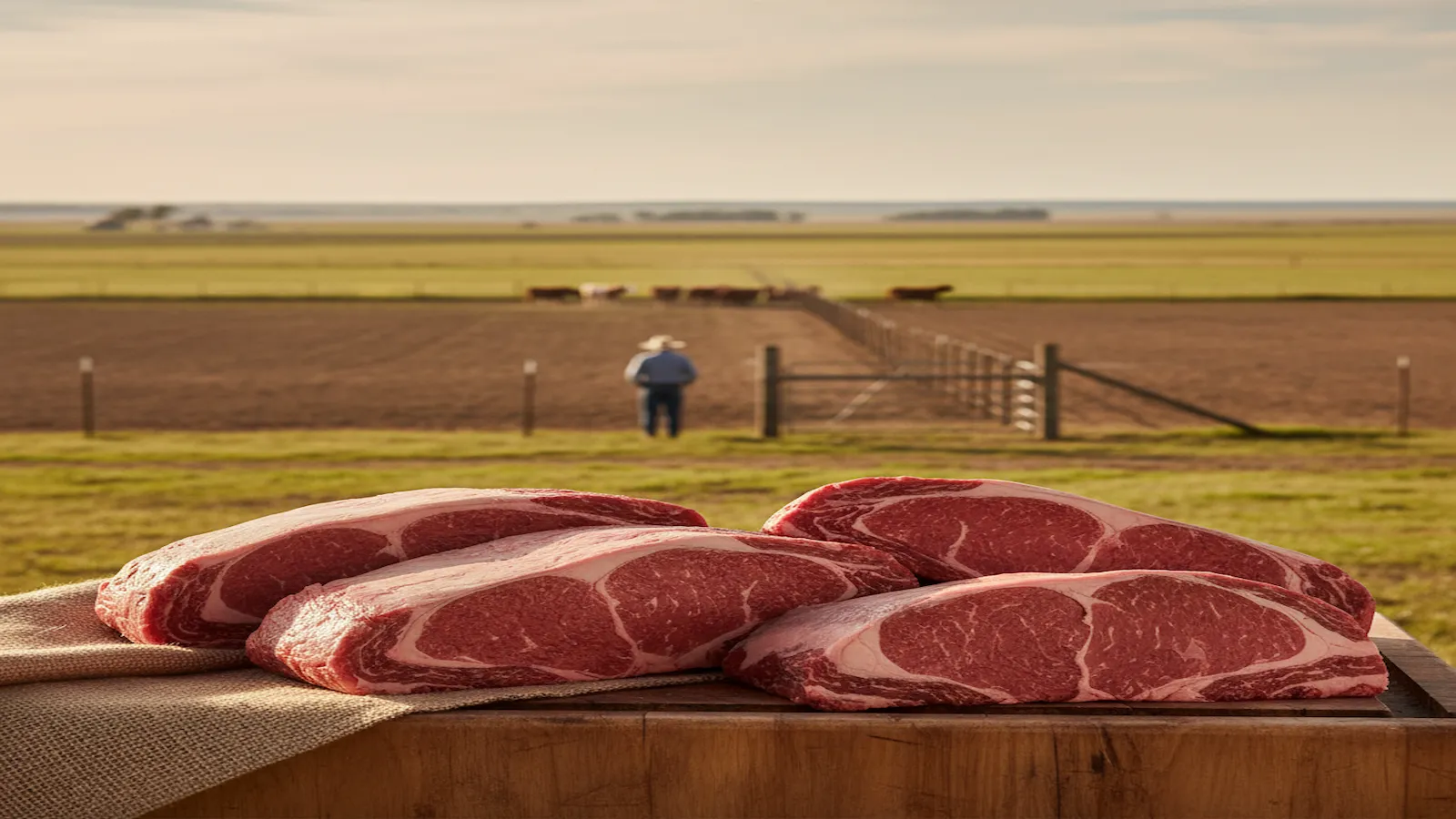
There is one number in Tyson Foods' 2026 guidance that stops most people cold. The company expects its beef segment to lose between $350 million and $500 million this year — and it just raised its full-year profit forecast anyway.
This is not a company in trouble. It is a company making a deliberate bet. The future of American protein, Tyson has decided, does not belong to beef. Not right now. Not until the cattle herd recovers from what the USDA confirms is its smallest size since 1951.
The Cattle Crisis Behind the Numbers
The US cattle herd stood at 86.2 million head in January 2026. That is the lowest count since the Eisenhower era. The cause is well understood. Years of severe drought across Texas, Oklahoma, and the Southern Plains forced ranchers to sell their breeding cows rather than feed animals they could not water. When breeding cows go to slaughter, the herd cannot rebuild quickly. A replacement heifer takes two years to reach breeding age. A calf needs another 18 to 24 months to reach slaughter weight.
This is a structural shortage, not a bad season. The USDA projects domestic beef production will drop another 2 percent in 2026 alone.
For beef processors, the economics are brutal. When cattle supply falls, the cost of buying live animals rises. When those costs rise faster than retail prices can follow, the processing margin goes negative. Tyson's beef division lost $319 million in the first quarter of fiscal 2026 — despite beef sales growing 8 percent to $5.77 billion. The company was selling more beef than ever. It was also losing more money than ever.
Three Segments, Three Very Different Stories
Tyson's Q2 FY2026 results, released in May 2026, show where the real business is. Net sales of $13.65 billion were up 4.4 percent year on year. Chicken delivered $505 million in operating income at an 11.8 percent margin. Prepared Foods added $348 million at 13.9 percent. Both are strong, consistent, and growing.
Beef delivered negative margin. And Tyson's response was not to fight for market share — it was to deliberately shrink its footprint.
In January 2026, Tyson closed its Lexington, Nebraska beef plant. That removed around 5,000 head of daily processing capacity and 3,200 jobs. It also scaled back its Amarillo, Texas facility to a single shift. Management was direct about why. The goal was to "right size our Beef operations with a smaller and more efficient footprint, higher capacity utilisation and stronger alignment with the long-term outlook for the US cattle herd."
This is not a cost-cutting story. It is a deliberate bet on a different protein future. Tyson is trading beef capacity — a commodity business tied to a shrinking input — for a higher share of earnings from chicken and prepared foods. Those two businesses control more of the value chain and generate structurally better margins.
What Happens to the Competitors Left Behind
When the largest beef processor in the US walks away from capacity, someone has to absorb the pressure. JBS, Cargill, and National Beef are still competing in a market where cattle supply keeps falling. Tyson's exit from Lexington took volume out of the market, which could support margins for whoever stays — but only if those companies can source enough cattle at prices that still leave room for profit.
When Tyson steps back from a category, the companies that stay inherit its problems. The cattle shortage is not fixed by Tyson closing plants. It just means the remaining processors fight harder for fewer animals at higher prices.
The Logic Behind the Raised Guidance
Tyson guided to $2.2 billion to $2.4 billion in adjusted full-year operating income for fiscal 2026. That is a raised range, not a reduced one. It rests on Chicken delivering $1.9 billion to $2.05 billion, Prepared Foods contributing $1.25 billion to $1.35 billion, and Beef staying within a managed loss.
The cattle herd will eventually recover. When it does, the question is whether the companies that held beef capacity will have better economics than Tyson — or whether they will have spent three years burning margin for no strategic return. Tyson is betting on the latter. The 74-year cattle herd low is not a crisis for Tyson. It is a competitive filter — and Tyson has chosen to pass through it leaner than everyone else.
Global Aseptic Packaging Market Report 2026
148.4bn litres and 344bn packs in 2025. Aseptic volumes across dairy, dairy alternatives, beverages and food in 39 markets — 2025 actuals and forecasts to 2030. Buy online and receive it within 24 hours.
More information
Global Cheese Database 2026
Production, imports, exports and consumption for 39 cheese types across 48 countries, with actuals through 2025 and forecasts to 2030. Join the waitlist for early access, pre-launch pricing and a free sample country chapter.
Get early accessStrategic Insights
📊 Analytics & Strategic Insight
The Beef Supply Crunch Is a Category Restructuring Event — Not a Commodity Cycle
The decision most in this industry are avoiding:
👉 Most food executives are treating the beef shortage as temporary. The cattle herd rebuilding cycle typically takes five to seven years from peak liquidation. The herd hit a 74-year low in January 2026. Anyone planning protein sourcing or manufacturing investment around a near-term beef recovery is working from a faulty assumption.
👉 Chicken is not the backup plan — it is the structural winner in protein for the rest of this decade. Chicken supply chains reset in weeks. Beef supply chains reset in years. Operators and manufacturers who have not shifted procurement toward poultry are already falling behind.
👉 Beef processing capacity exits are hard to reverse. Tyson's Lexington closure removed 5,000 head per day from the US market. The capex, workforce, and approvals needed to reopen a plant are substantial. This capacity is gone for years — not months.
Here's the full context:
→ 2010–2022: Prolonged drought across the US Southern Plains drives repeated cycles of herd liquidation. Breeding cow numbers fall below replacement rate in multiple consecutive years.
→ January 2025: USDA cattle inventory report confirms the US herd has hit its lowest level in decades. Multi-year supply constraint is now locked in.
→ Q1 FY2026 (Oct–Dec 2025): Tyson reports a $319 million beef operating loss despite beef revenue up 8 percent. The cost of buying live cattle outpaces retail pricing ability.
→ January 2026: Tyson closes Lexington, Nebraska beef plant (5,000 head/day, 3,200 jobs). Amarillo, Texas is scaled to a single shift. USDA confirms herd at 86.2 million head — lowest since 1951.
→ May 2026: Tyson Q2 FY2026 results show Chicken at 11.8 percent operating margin ($505M), Prepared Foods at 13.9 percent ($348M). Full-year guidance raised to $2.2–$2.4 billion, absorbing a projected beef loss of $350M–$500M.
What this means for food and beverage operators and investors:
✅ Foodservice operators should lock in chicken supply agreements now. As beef costs stay high through at least 2027, consumers and operators will keep shifting toward chicken and alternative proteins. Operators with diversified protein sourcing are protected. Those relying on beef-heavy menus face rising input costs with limited ability to pass them on.
✅ Retail buyers should plan for sustained beef price inflation. USDA projects a further 2 percent drop in domestic beef production in 2026. Private label beef does not help — the raw material cost is the same regardless of brand. Category managers need to rethink the protein aisle now, not after the next commodity shock.
✅ PE and strategic investors in protein should stress-test cattle cycle timing in any beef-adjacent deal. Model a minimum 2027 timeframe for meaningful herd recovery and 2028–2029 for normalised packer margins. Any deal priced on pre-2025 beef economics is likely overvalued on the processing side.
3 moves you can make this week:
1️⃣ Run a protein dependency audit across your inputs or menu. Map what share of your cost base is beef-exposed vs. poultry-exposed. If beef is above 40 percent of protein spend, model what sustained cattle cost pressure through 2028 does to your margin — then decide whether to act.
2️⃣ Build chicken supply relationships before you need them. The companies winning in this environment have committed poultry supply at fixed or formula pricing. If you are buying on the spot market, you are competing with Tyson, Perdue, and Pilgrim's Pride for the same birds. Start conversations with integrators now.
3️⃣ Track the USDA cattle reports each quarter. The key signals are the July 2026 cattle-on-feed report and the January 2027 inventory. A meaningful rise in breeding cow placements would be the first real evidence the cycle is turning. Until then, plan for sustained beef cost pressure — not a quick fix.
Take the Next Step
💧 Tracking the food and beverage operator market?
Water dispense is one of the fastest-growing operator segments in food and beverage. Revenue benchmarks, operator data, and market intelligence across 32 countries — covering hotels, workplaces, foodservice, and retail.
→ Explore water dispense insights
Zenith Consulting
Submit your food & beverage project enquiry.
Share your requirements. If there is a strong fit, we’ll come back with an indicative investment range, project timeline and recommended strategic approach.
Reviewed by Zenith Consulting’s senior food & beverage strategy team.
Related analyses
- Corporate Strategy & Portfolio
Oji Liquid Pak's USD 110 Million Vietnam Aseptic Carton Plant Adds 8 Billion Packs To A Region Already At 62 Billion
Oji Liquid Pak broke ground on a USD 110 million aseptic carton material plant in Dong Nai, rated at up to 8 billion packs a year from 2028. Zenith puts Vietnam at 10,358.7 million aseptic packs in 2025, and South East Asia already holds about 62 billion packs of documented converting capacity.
Read analysis → - Corporate Strategy & Portfolio
Spain Swaps HDPE Milk Bottles For Aseptic PET: 170 Million Litres Left And Only Three Aseptic PET Dairy Lines
Spanish UHT milk in large HDPE bottles fell from 307 million litres in 2020 to 170 million in 2025, and Zenith's model takes it to 88.5 million by 2030. Aseptic PET is taking the volume, and only three aseptic PET dairy lines have been documented in the country.
Read analysis → - Corporate Strategy & Portfolio
US Parmesan Output Jumps 25.9% While Cheddar Slips: Italian Cheese Takes Four In Five Pounds Of Growth
USDA figures published on 5 October show US Parmesan output up 25.9% in August while cheddar fell 0.9%. Italian types have supplied nearly four in every five pounds of US cheese growth so far in 2026.
Read analysis →
Share it with your peers
Pass this analysis to colleagues who track the food and beverage market.
Zenith Market Intel
Need a specific food or beverage market report?
Tell us which category, region or question would be useful for your team.
Sister Publication
Also follow our Water Dispense Market Intelligence
Category analyses, operator briefings, and investor signals across the global water dispense market.