The $42.7 Billion Flavor Bet: Why Investors Are Unconvinced by the Unilever-McCormick Megamerger
McCormick's $42.7 billion acquisition of Unilever's Foods division — home to Hellmann's, Knorr, and Frank's RedHot — sent shares of both companies falling the day it was announced, an almost unheard-of double-negative reaction to a transformational deal. Fresh investor and employee backlash this week signals the market is not yet convinced that "flavor focus" is a coherent strategic thesis rather than a well-branded exit for both parties.
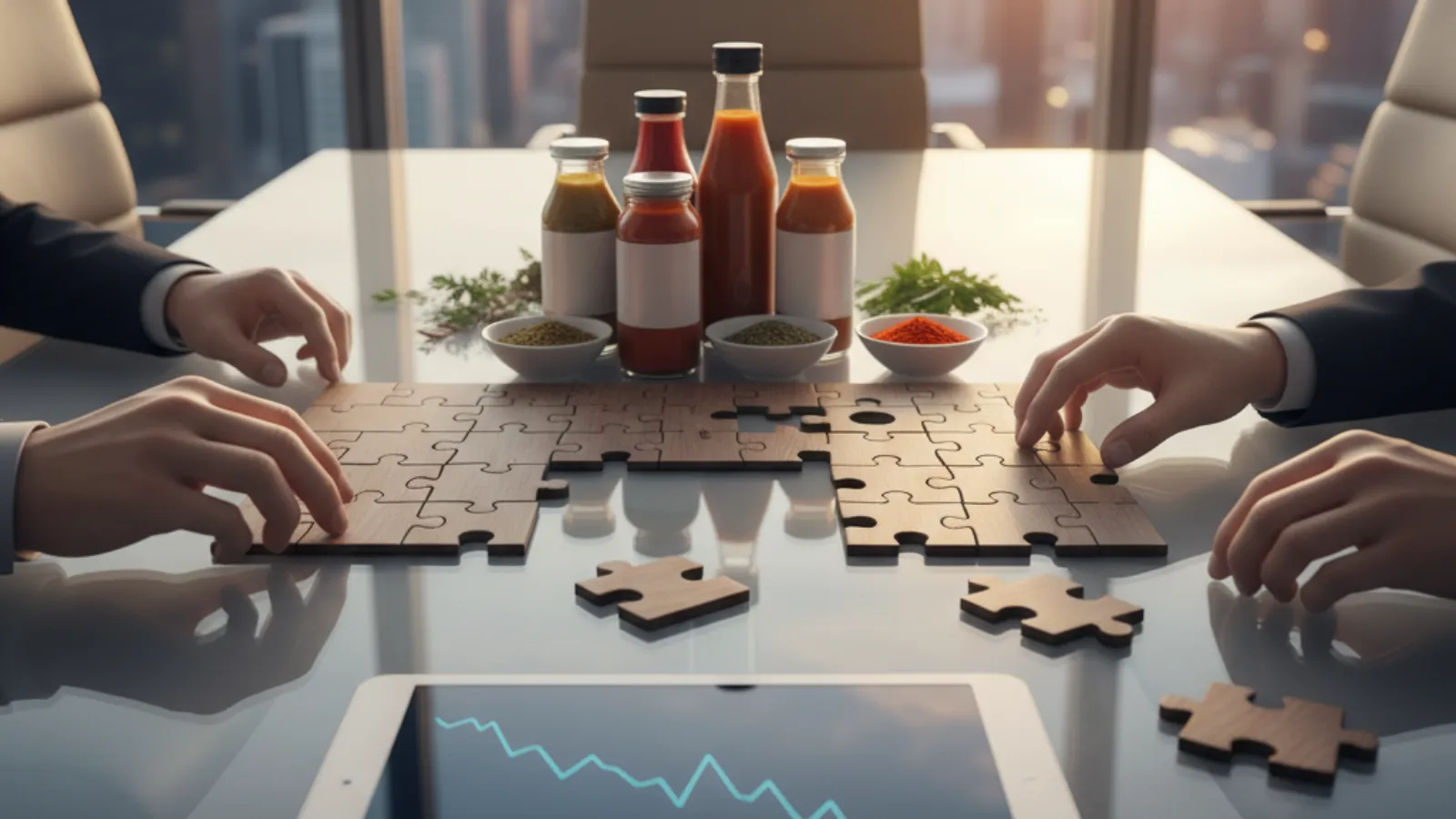
When a $42.7 billion deal is announced and both companies' shares fall, the market is telling you something. On March 31, 2026, McCormick & Company confirmed it would acquire the core food business of Unilever — taking on Hellmann's, Knorr, Frank's RedHot, and dozens of other brands in one of the largest food M&A transactions in a generation. Unilever's shares dropped 7%, wiping £5.3 billion off its market capitalisation. McCormick fell 5–6%. That is not the reception either board was planning for.
What the Deal Actually Is
The transaction is structured as a Reverse Morris Trust to maximise tax efficiency. It values Unilever Foods at approximately $42.7 billion in enterprise value. McCormick assumes around $9 billion in debt and issues new shares; Unilever shareholders receive 55% of the combined company, McCormick's existing shareholders hold 35%, and Unilever the company retains a 9% stake. Unilever receives $15.7 billion in upfront cash proceeds — earmarked to reduce leverage to approximately 2.0x net debt to EBITDA and fund €6 billion in share buybacks through 2029.
The combined entity is built around two portfolio pillars: McCormick's spices, seasonings, and hot sauce brands (Old Bay, Frank's RedHot, French's) and Unilever's condiment and flavouring businesses (Hellmann's, Knorr). Roughly 70% of Unilever Foods' sales derive from just two brands — Hellmann's and Knorr — which hold genuine category leadership in their respective segments. The deal is expected to generate $300 million in annual cost synergies and close by mid-2027, pending McCormick shareholder approval and regulatory clearance in the UK, EU, and United States.
Why Investors Are Sceptical
The market reaction points to four specific concerns. First, the deal's structural complexity. A Reverse Morris Trust introduces shareholder approval hurdles, tax conditions, and regulatory sequencing across multiple jurisdictions simultaneously. McCormick shareholders are being asked to vote to approve a transaction that materially dilutes their ownership stake — a difficult proposition when the investment thesis is not immediately legible.
Second, the timeline. A mid-2027 close is 15 months away. In that window, interest rates, category dynamics, and consumer sentiment can all shift materially. Both companies are asking shareholders to hold through significant uncertainty for a deal that may require brand divestitures to clear antitrust review — further compressing valuation certainty.
Third, the strategic narrative is contested. McCormick is framing the combined entity as a "preeminent global flavor-focused company." But analysts and investors have pushed back: Hellmann's is a condiment brand, not a flavour brand, and packaging Knorr stock cubes alongside Old Bay seasoning as a unified platform thesis is a narrative convenience rather than a structural category logic. The deal brings two large portfolios together — but portfolio breadth is precisely what capital markets have been penalising in food and beverage for the past two years.
Fourth, the employee relations dimension has created legal exposure. The Unilever European Works Council was formally notified on the day the announcement was made, after the strategic decision had already been finalised. European employee representatives expressed "serious concerns" and described the process as a breach of meaningful consultation — raising the possibility of legal challenge in Europe and compounding integration risk for a deal already running on a tight regulatory calendar.
The Regulatory Gauntlet
The combined entity will hold category-leading positions in mayonnaise, hot sauce, cooking bases, and packet seasonings across most major Western markets. Regulators in London, Brussels, and Washington will examine whether concentration in these categories creates barriers to entry or reduces consumer choice. Specific brand or geographic divestitures cannot be ruled out. Any required disposal in condiments or ambient flavouring is, by definition, a forced-seller pricing event — and an entry point for a faster-moving acquirer.
What This Signals for the Broader Industry
The Unilever-McCormick transaction is the logical conclusion of Unilever's decade-long strategic pivot away from food. Having sold its spreads business to KKR in 2018, announced the separation of its ice cream division (Ben & Jerry's, Magnum, Wall's) in 2024, and now offloading its core foods business, Unilever is explicitly repositioning as a personal care and beauty company. That is a defensible strategic choice. But the speed, structure, and market reaction suggest Unilever prioritised tax efficiency and deal certainty over maximising exit proceeds — and that McCormick is paying a price that reflects the seller's urgency as much as the assets' standalone value.
For the wider food and beverage industry, this deal asks a question that will define the next valuation cycle: is "flavor" a durable category platform, or is the McCormick combination a conglomerate play dressed in sharper language? The answer will determine whether the combined entity eventually commands a premium multiple or trades as another diversified food company in a market systematically re-rating diversification downward. Operators in condiments, ambient sauces, and branded food ingredients should watch regulatory outcomes closely — the right divestiture, at the right price, rarely announces itself twice.

Global Aseptic Packaging Market Report 2026
148.4bn litres and 344bn packs in 2025. Aseptic volumes across dairy, dairy alternatives, beverages and food in 39 markets — 2025 actuals and forecasts to 2030. Buy online and receive it within 24 hours.
More information
Global Cheese Database 2026
Production, imports, exports and consumption for 39 cheese types across 48 countries, with actuals through 2025 and forecasts to 2030. Join the waitlist for early access, pre-launch pricing and a free sample country chapter.
Get early accessStrategic Insights
📊 Analytics & Strategic Insight
The Unilever-McCormick deal is the largest food exit of the decade — and the market's cold reaction signals that "flavor focus" has not yet earned the strategic premium it is claiming
The decision most in this industry are avoiding:
👉 Most food executives are treating the Unilever-McCormick deal as an outlier megamerger when it is actually the clearest data point yet that Unilever's "simplify and focus" strategy has become a structured exit dressed in strategic language. The deal's speed, the tax-driven Reverse Morris Trust structure, and the below-expectation market reaction all point to a seller motivated by urgency — not by leverage. That matters enormously when modelling what comparable assets will fetch in the next round of Big Food disposals.
👉 The $300 million synergy target on a $42.7 billion deal represents less than 1% of transaction value — an unusually modest ambition for a transformational merger. For context, Mars's $36 billion acquisition of Kellanova in 2024 was underpinned by a strategic conviction about snacking scale that required no synergy disclosure to justify the multiple. McCormick's guidance implies an integration play, not a transformation — and markets are pricing the difference.
👉 The employee consultation failure in Europe is not a soft issue — it is a hard legal risk with real timeline consequences. European Works Council challenges have delayed and restructured deals before. A legal dispute in Europe could push the close beyond mid-2027, alter the deal's tax structure, or force board-level concessions. Most market participants are not modelling this in their base case.
Here's the full context:
→ 2018: Unilever sells its spreads business — including Flora, Rama, and Country Crock — to KKR for €6.8 billion. First major signal that Unilever Food is a disposal in progress.
→ 2024: Unilever announces the separation of its ice cream division (Ben & Jerry's, Magnum, Wall's) as a standalone listed company. 7,500 jobs cut in the same restructuring programme.
→ October 2024: Mars completes its $36 billion acquisition of Kellanova — the largest food deal since Kraft Heinz's creation, and the deal that reset expectations for what Big Food consolidation looks like when the buyer has conviction.
→ March 31, 2026: McCormick announces $42.7 billion acquisition of Unilever Foods via Reverse Morris Trust. Both companies' shares fall sharply on the day — Unilever -7%, McCormick -5%.
→ April 22, 2026: Investor and employee backlash deepens. European Works Council raises formal concerns about late consultation. Analysts publicly question the coherence of the "flavor-focused" platform narrative.
What this means for food and beverage operators and investors:
✅ Unilever's sequential divestiture of its food assets — spreads, ice cream, and now core foods — creates a visible template for any large FMCG operator still running food alongside faster-growing personal care or beauty categories. The question is no longer whether to exit food; it is whether to structure that exit as a sale, a spin, or a JV — and how to avoid Unilever's valuation outcome.
✅ Hellmann's and Knorr are genuinely strong brands with high household penetration and defensible category positions. The fact that they are changing hands at a price that disappointed markets does not reflect brand weakness — it reflects seller urgency. Acquirers should study the gap between stated deal value and market reaction as a forward indicator of similar divestiture opportunities in category-adjacent assets.
✅ For operators in condiments, ambient sauces, and branded cooking ingredients, regulatory review in three jurisdictions makes brand-level divestitures a real probability. Building a monitoring brief on the antitrust process now — before investment bank fees price in the competition — is the correct move. Forced-seller pricing events in category-leading brands are rare and time-limited.
3 moves you can make this week:
1️⃣ Map the full Unilever Foods brand portfolio beyond Hellmann's and Knorr. The 30% of revenues outside those two brands includes assets that the combined McCormick entity may classify as non-core — and regulators may force further disposals. Identify which of those assets would fit your platform before the M&A process reaches them.
2️⃣ Review your category exposure to ambient condiments and seasonings before the deal closes. If the McCormick-Unilever combination clears antitrust without major remedies, the entity will hold dominant positions across mayo, hot sauce, stock cubes, and packet seasonings in most major markets. Model the pricing and shelf dynamic this creates before it becomes structural.
3️⃣ Track the European Works Council consultation process actively. A successful legal challenge in Europe could delay or restructure the transaction. That timeline risk is not fully priced into current market expectations — understanding it gives you optionality that most participants are currently ignoring.
Take the Next Step
💧 Also covering the water dispense market?
Water dispense is one of the fastest-growing segments in food and beverage. Operator data, revenue benchmarks, and market intelligence across 32 countries.
→ Explore water dispense insights
♻️ Looking for a high-growth investment in sustainable beverage technology?
An iF Design Award-winning, IoT-enabled product line solving the single-use plastic crisis from the inside — designed for the home and B2B market. Strong structural tailwinds as plastic regulations tighten across Europe.
→ Request the investor deck: info@zenithglobalcommercial.com
Zenith Consulting
Submit your food & beverage project enquiry.
Share your requirements. If there is a strong fit, we’ll come back with an indicative investment range, project timeline and recommended strategic approach.
Reviewed by Zenith Consulting’s senior food & beverage strategy team.
Related analyses
- M&A, Investment & Valuation
Parmigiano Reggiano Takes On Australian Parmesan: The EU Trade Deal Protected 53 Cheese Names And Left Parmesan Out
The Parmigiano Reggiano Consortium has opened a three-year campaign in Australia, where cheese output runs at 455,000 tonnes a year. Australia agreed to protect 53 EU cheese names, and parmesan is not one of them.
Read analysis → - M&A, Investment & Valuation
Parmigiano Reggiano Takes On Australian Parmesan: The EU Trade Deal Protected 53 Cheese Names And Left Parmesan Out
The Parmigiano Reggiano Consortium has opened a three-year campaign in Australia, where cheese output runs at 455,000 tonnes a year. Australia agreed to protect 53 EU cheese names, and parmesan is not one of them.
Read analysis → - M&A, Investment & Valuation
Müller Closes Sachsenmilch Semi-Hard Cheese Dairy At Leppersdorf: Mozzarella And Acid Curd Lines Stay
Müller will close the semi-hard cheese dairy at Sachsenmilch Leppersdorf on 31 December 2026, with about 160 staff affected. Mozzarella and acid curd cheese carry on at a site that takes 1.7 billion kg of milk a year.
Read analysis →
Share it with your peers
Pass this analysis to colleagues who track the food and beverage market.
Zenith Market Intel
Need a specific food or beverage market report?
Tell us which category, region or question would be useful for your team.
Sister Publication
Also follow our Water Dispense Market Intelligence
Category analyses, operator briefings, and investor signals across the global water dispense market.