Beyond Meat's $58M Quarter Marks the End of Plant-Based Meat: Why Beyond Immerse Is a Category Exit, Not a Brand Refresh
Beyond Meat's Q1 2026 revenue collapsed to $58.2 million — its lowest quarter since 2019 — as volumes fell 19.5% and the company prepared to ship its first functional protein drink through one of the largest non-alcoholic distributors in New York. The Beyond Immerse launch is being positioned as a pivot. It is closer to a category exit.
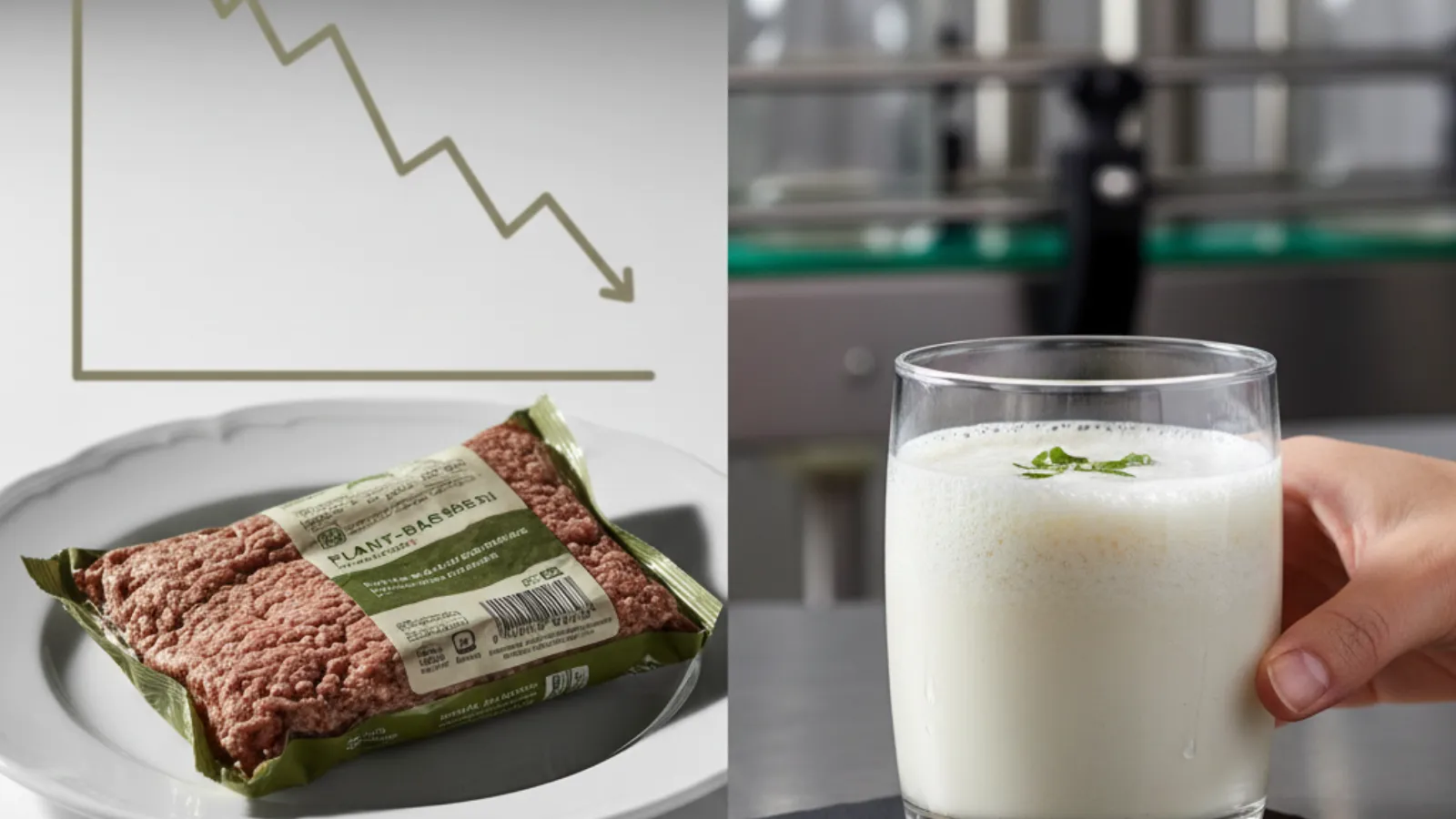
Beyond Meat is no longer trying to save plant-based meat. It is trying to leave it.
The Q1 2026 results released on May 6 told the story the company's January rebrand to "Beyond — The Plant Protein Company" had already hinted at. Net revenue collapsed to $58.2 million, the lowest quarterly figure since 2019, with volumes down 19.5% year-on-year and foodservice revenue down 29.7% to just $6.6 million. Market cap sits at roughly $263 million against a 2019 peak above $13 billion. A Nasdaq delisting notice is active, with a deadline of August 31 to recover the $1 share price for ten consecutive trading days.
And yet the most strategically important paragraph of the earnings release was not the revenue line. It was the announcement that Beyond Immerse — the company's new functional protein drink — will launch this summer in New York through Big Geyser, the largest non-alcoholic beverage distributor in the state, with access to more than 26,000 outlets. That distribution agreement, signed with a soft-drinks specialist rather than a refrigerated-meat broker, is the real product release.
The numbers behind the pivot
U.S. retail plant-based food sales reached $7.9 billion in 2025, but unit sales fell 3% and dollar sales fell 2%, according to SPINS data published by the Good Food Institute. The plant-based meat sub-category is where the bleeding is concentrated: refrigerated plant-based burgers dropped 26% year-on-year, and the average refrigerated alt-meat item count per store fell to 9.7 in April 2025 — down 10.3% in twelve months and roughly 31% since early 2021. Retailers are not waiting for the category to recover. They are reclaiming shelf space.
Beyond Meat's own numbers track that retreat. Net revenue per pound rose 5.4% in Q1 2026, which sounds like pricing power but is in fact the residue of distribution cuts: when the lowest-velocity SKUs are removed first, average price per pound rises while volume falls. Gross margin recovered to 3.4% from minus 10.1% a year earlier — an improvement that is real, but happens against a revenue base that has shrunk by more than 60% from peak. Cost discipline is restoring the unit economics of a product category that consumers are exiting.
What Beyond Immerse is actually trying to do
Beyond Immerse is a plant-protein beverage in three initial flavours — Peach Mango, Lemon Lime, Orange Tangerine — offered in 10g protein/60-calorie and 20g protein/100-calorie variants, with added tapioca fibre, antioxidants and electrolytes. The product was first announced in January 2026 and tested through the Beyond Test Kitchen direct channel. Four further flavours were added in February. It is being positioned as a drink designed for GLP-1 users — a market estimated to include more than 12 million adults in the U.S. by mid-2026 — at the intersection of protein, fibre, vitamin and electrolyte drinks.
This is not a brand extension. Plant-based burgers and protein beverages share almost no shelf, almost no buyer, almost no merchandising adjacency, and almost no consumption occasion. Beyond Immerse is going into the cooler next to BodyArmor, Celsius, poppi, Liquid I.V. and Premier Protein. The competitive set is no longer Impossible Foods. It is PepsiCo, Coca-Cola, Keurig Dr Pepper and the Celsius–Alani Nu portfolio.
The functional beverage gold rush — and the brutal competition
The category Beyond is entering is the most heavily capitalised arena in U.S. consumer goods. PepsiCo closed its $1.95 billion acquisition of poppi and launched Pepsi Prebiotic Cola off the same platform. Celsius acquired Alani Nu for $1.8 billion. Coca-Cola owns BodyArmor, Topo Chico Hard and Fairlife and is restaging Powerade. Monster Beverage is expanding international energy and Reign performance. Suntory, Keurig Dr Pepper and Red Bull are all increasing functional shelf investment. Beyond Meat enters this competitive set with a market cap below 1.5% of the value of poppi alone.
The Big Geyser distribution deal is the right move but the wrong scale. Big Geyser sells what its retailers want, and what they want from a struggling brand is fast turn. The Beyond Immerse launch needs velocity in the first 90 days or it loses cooler space to a Celsius reset. Beyond does not have the marketing budget for a national push, the venture profile to attract a strategic minority investor at non-distressed terms, or the time to wait for a slow build.
What this means for the rest of plant-based — and Big Food's wellness pivot
The category lesson for executives and investors is direct: plant-based meat was a moment, not a category. Functional beverages may be a category — but they are also the most capital-intensive battlefield in CPG. The brands that win it have hundreds of millions in shelf-investment firepower or a strategic parent willing to lose money on velocity for two years. Beyond has neither.
For Big Food, the read-through is more useful. Beyond's pivot validates the underlying thesis that drove PepsiCo to buy poppi, Coca-Cola to deepen its BodyArmor and Fairlife portfolios, and Danone to acquire Huel — that the protein-and-functional beverage corridor is where the next decade of incremental volume is being captured. It also validates the inverse thesis: plant-based meat does not become Big Food's next category. It becomes Big Food's cautionary tale. Mondelez, Nestlé, Kraft Heinz and Unilever now have a public case study in what happens when consumer interest peaks five years before manufacturing capacity does.
Beyond Immerse may sell well in New York this summer. That will not change the fact that Beyond Meat's 2026 strategic problem is no longer plant-based meat. It is whether the company has enough quarters left on the Nasdaq to prove a functional beverage can carry a brand that the meat business cannot.

Global Aseptic Packaging Market Report 2026
148.4bn litres and 344bn packs in 2025. Aseptic volumes across dairy, dairy alternatives, beverages and food in 39 markets — 2025 actuals and forecasts to 2030. Buy online and receive it within 24 hours.
More information
Global Cheese Database 2026
Production, imports, exports and consumption for 39 cheese types across 48 countries, with actuals through 2025 and forecasts to 2030. Join the waitlist for early access, pre-launch pricing and a free sample country chapter.
Get early accessStrategic Insights
📊 Analytics & Strategic Insight
Plant-based meat was never a category — it was a moment, and Beyond Meat's pivot to functional beverages is the public closing bell
The decision most in this industry are avoiding:
👉 Stop treating plant-based meat as a strategic option for new product development. The Beyond Meat Q1 2026 numbers, the SPINS shelf-count data, and the broader 26% refrigerated burger decline are not a downturn — they are a structural exit by U.S. consumers. Allocating R&D, marketing or capex to plant-based meat in 2026 is allocating to the previous decade's thesis.
👉 Recognise that "functional beverage" is now a saturated category, not an emerging one. Beyond is entering a cooler already populated by Celsius, poppi, BodyArmor, Liquid I.V., Premier Protein and PepsiCo's Pepsi Prebiotic Cola — all backed by strategic parents with shelf-investment budgets larger than Beyond's entire market cap. Entry without distribution scale or strategic backing is a margin-destroying exercise.
👉 The category that wins the next five years is GLP-1-adjacent nutrition, not plant-based protein per se. Beyond Immerse is being marketed at GLP-1 users — a population now estimated above 12 million U.S. adults. The strategically defensible position is protein-plus-fibre-plus-micronutrient beverages and snacks formulated for appetite-suppressed consumers, regardless of whether the protein is plant or whey.
Here's the full context:
→ 2009: Beyond Meat founded by Ethan Brown; plant-based meat becomes a venture-funded category over the following decade.
→ May 2019: Beyond Meat IPO at $25 per share; peak market cap above $13 billion within months, validating plant-based meat as the next Big Food category.
→ 2022-2024: U.S. retail plant-based meat sales decline; refrigerated plant-based burger sub-category falls 26% by 2025 SPINS data; average refrigerated alt-meat SKUs per store drop ~31% from 2021 peak.
→ January 15, 2026: Beyond Meat announces Beyond Immerse functional protein drink — three flavours, 10g/20g protein variants — exclusively through Beyond Test Kitchen direct channel; signals a category pivot.
→ Most recent (May 6, 2026): Q1 2026 results — revenue $58.2M (-15.3% YoY, -19.5% volume); Big Geyser distribution agreement covering 26,000 NY metro outlets confirmed for summer 2026 Beyond Immerse launch; Nasdaq delisting deadline August 31, 2026.
What this means for food and beverage operators and investors:
✅ Plant-based meat exposure is now a balance-sheet risk for retailers, not just brands. Refrigerated meat alternatives have been losing ~10% of SKU count per year. Retailers carrying significant private-label plant-based exposure should expect inventory write-downs and category re-merchandising before end of 2026. Operators should rebid that shelf space toward GLP-1-adjacent and functional-protein formats.
✅ The next round of strategic M&A in functional beverages will price defensibly only if backed by distribution leverage. Standalone functional brands without a Big Food parent are running into the same scale wall Beyond is hitting. Strategic buyers (PepsiCo, Coca-Cola, Keurig Dr Pepper, Suntory) will continue paying double-digit revenue multiples for traction; financial buyers will see 2026 entry points discounted by 30-50% vs. 2024 peaks.
✅ Big Food's wellness pivot is now validated by Beyond's exit. PepsiCo's poppi, Coca-Cola's BodyArmor/Fairlife, Danone's Huel, Celsius/Alani Nu — each transaction looks better post-Beyond Q1 than before. Strategic buyers should accelerate the timing of remaining functional/wellness acquisitions before competitive parents do.
3 moves you can make this week:
1️⃣ Audit your plant-based meat exposure across the portfolio, retail accounts and capex pipeline. Any SKU, line or facility built for plant-based meat over the past five years should be revalued under the new SPINS shelf-decline trajectory. Mark down inventory, defer or cancel related capex, and reallocate to functional protein or GLP-1-adjacent formats.
2️⃣ Map the functional protein and GLP-1-adjacent beverage cooler in your top three retail accounts. Count facings for Celsius, poppi, BodyArmor, Liquid I.V., Premier Protein and Pepsi Prebiotic Cola. The competitive density determines whether your own functional launch is viable as a standalone or only as a JV/licence with a Big Food distribution partner.
3️⃣ Set a calendar trigger for Beyond Meat's Nasdaq deadline (August 31, 2026) and Q2 2026 earnings (early August). If Beyond is delisted or reports a second consecutive double-digit volume decline, expect a strategic transaction — distressed sale, take-private, or asset partition between the meat business and Beyond Immerse — within ninety days. Functional-beverage IP and the Big Geyser distribution agreement could be the most valuable assets to acquire.
Take the Next Step
♻️ Looking for a high-growth investment in sustainable beverage technology?
An iF Design Award-winning, IoT-enabled product line solving the single-use plastic crisis from the inside — designed for the home and B2B market. Strong structural tailwinds as plastic regulations tighten across Europe.
→ Request the investor deck: info@zenithglobalcommercial.com
Zenith Consulting
Submit your food & beverage project enquiry.
Share your requirements. If there is a strong fit, we’ll come back with an indicative investment range, project timeline and recommended strategic approach.
Reviewed by Zenith Consulting’s senior food & beverage strategy team.
Related analyses
- Health, Nutrition & Functional
Dreher Adds A 12,000 Carton An Hour Elopak Aseptic Line Into A German Juice Market Down To 1,915 Million Litres
Dreher Group has started filling its own aseptic cartons at Stockach on an Elopak E-PS120AH running up to 12,000 cartons an hour. It joins a German market where Zenith's own data shows aseptic volume falling 2.6% a year and juices and nectars down to 1,915 million litres.
Read analysis → - Health, Nutrition & Functional
SIG Targets 85% Paper In Aseptic Cartons: Aluminium-Free Still Has Enormous Room To Scale
SIG says it is working towards 85% paper content in its aseptic cartons, with polymer and fibre barriers doing the work aluminium used to do. Set against the 344 billion aseptic packs filled worldwide in 2025, the aluminium-free carton is still a rounding error.
Read analysis → - Health, Nutrition & Functional
Saputo Creates A Dairy Ingredients Division: Cheese Plants Are Now Judged On Their Whey
Saputo has split dairy ingredients into its own division under Steve Douglas. US cheese output rose 2.1% in July while whey protein concentrate output fell 2.3%.
Read analysis →
Share it with your peers
Pass this analysis to colleagues who track the food and beverage market.
Zenith Market Intel
Need a specific food or beverage market report?
Tell us which category, region or question would be useful for your team.
Sister Publication
Also follow our Water Dispense Market Intelligence
Category analyses, operator briefings, and investor signals across the global water dispense market.