Arla Puts 28.3 Million Euros Back Into Falkenberg Cottage Cheese Ten Months After Adding 1,500 Tonnes
Arla has committed 28.3 million euros to cottage cheese making at Falkenberg in Sweden, ten months after a SEK 70 million step there added 1,500 tonnes a year. In Australia, facing growth above 40%, the co-op bought a cheese plant instead.
I had this filed as another high-protein spend. Then I checked the date of the last one.
Arla goes back to the same Swedish plant
Arla Foods committed 28.3 million euros to cottage cheese making at Falkenberg in Sweden on 1 October 2026. The money buys a new cheese tank, a packing line, more floor space and upgraded kit. The work lands gradually through 2028. A further 35 million euros goes to skyr at Upahl in Germany. That site lifts output by about 30% from the second half of 2028. The two together come to just over 63 million euros.
Ten months between two cheques
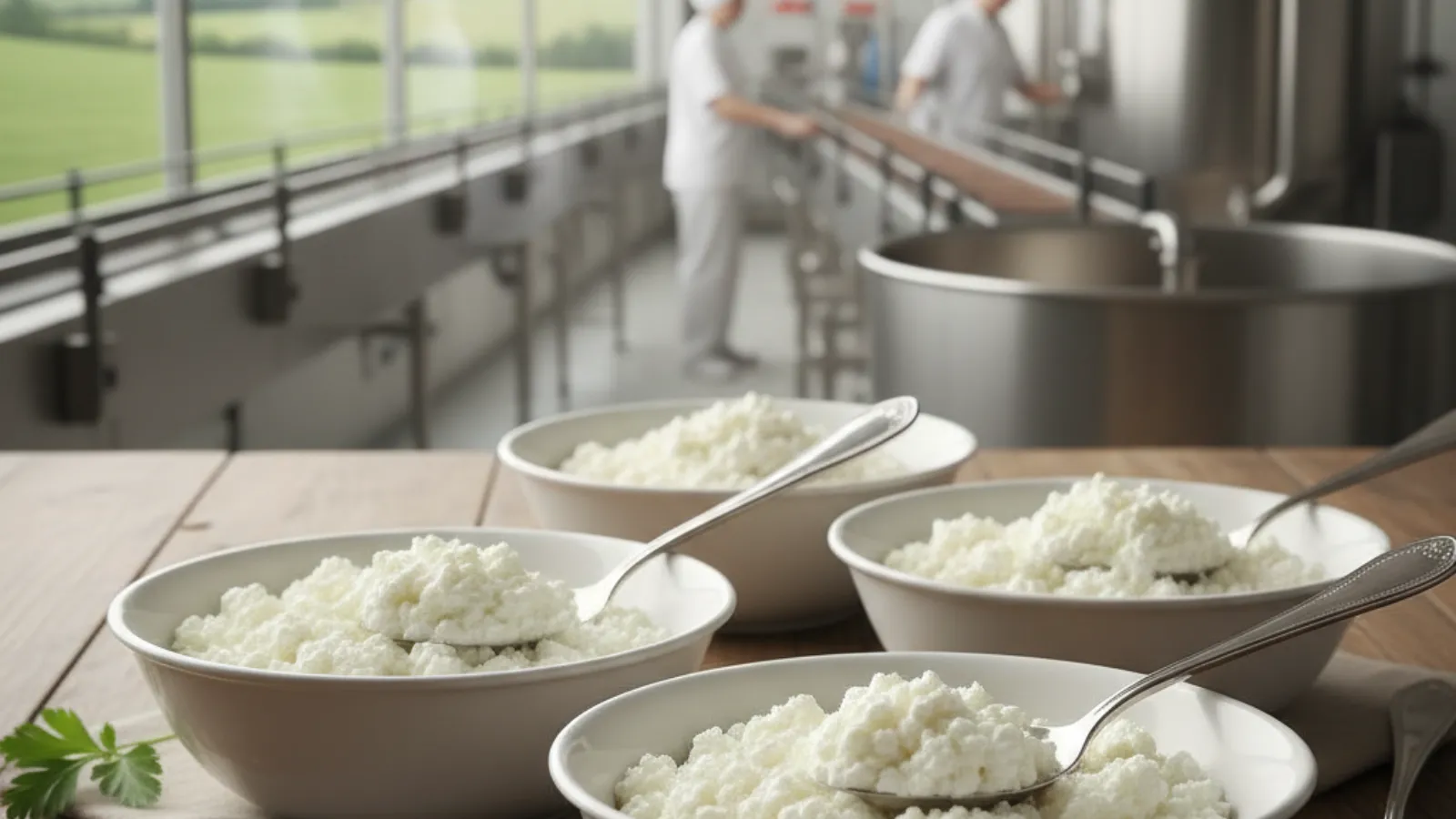
Falkenberg had money in December 2025. Arla put SEK 70 million into the site then, to add 1,500 tonnes of Keso cottage cheese a year. That capacity was due on line in the last quarter of 2026. The plant was tracking about 27,000 tonnes for 2025, some 17% up on the year before. It takes in around 130 million kilos of milk a year. So the 1,500-tonne step was worth roughly 5% of its output. Arla has come back inside a year with a far larger sum.
Where the 25% rise actually sits
Arla reports cottage cheese volumes up 25% across its markets over three years. Skyr is up more than 33% on the same basis. The country split is the useful part. Arla's own figures put growth at 37% in Denmark and 37% in Britain. The Netherlands is on 38% and Sweden on 13%. Falkenberg mainly serves Sweden and Denmark. So the plant taking the money sits in the slowest of those four markets. It ships into one of the fastest.
Others are moving on the same shelf. In Britain, All Things sold a million pots in four months. It is doubling output at Yester Farm Dairies by the end of 2026. In the United States, L Catterton backed Good Culture in a deal that put the brand above 500 million dollars.
In Australia Arla bought the plant instead
The co-op handled the same category differently on the other side of the world. In May 2026 Arla Foods Mayer Australia agreed to buy Brancourts. The family firm at Hexham in New South Wales dates from 1895. Brancourts makes cottage cheese, sour cream and sweetened condensed milk. Arla said Australian cottage cheese volumes were growing more than 40% a year. Lillie Li Valeur, executive vice president of Arla International, called Australia "a highly attractive market". No tonnage and no price were given.
What a 2028 start date costs
Building and buying are not the same purchase. The Falkenberg work starts paying in 2028, so Arla carries two more years of demand on the vats it has. Brancourts was making cottage cheese on the day the deal was signed. This category added a quarter of its volume in three years. The build route hands the near term to whoever already owns a vat. Arla made that trade twice in one year. Each time it went the other way.
What this means for the market
Cottage cheese has moved from a tired shelf line to a capacity matter in several countries at once. The capacity is going in one plant at a time, at groups that already own fresh dairy sites. A new brand therefore competes for vat time rather than for shelf space alone. That is a different entry cost. Three things decide whether one of these markets is worth entering. How much cottage cheese the country already makes. Whether any of that making can be bought. And how much of the growth is left by the time a new line is running.
For cheese makers and buyers, one commercial test now sits above the rest. How much of this cheese does a country make today, and how fast is that tonnage moving? Our Global Cheese Database 2026 counts cottage and quark among its 39 cheese types. It gives production, trade and consumption in tonnes for 48 countries, with 2025 actuals and forecasts to 2030. The waitlist carries a free sample country chapter.
Global Aseptic Packaging Market Report 2026
148.4bn litres and 344bn packs in 2025. Aseptic volumes across dairy, dairy alternatives, beverages and food in 39 markets — 2025 actuals and forecasts to 2030. Buy online and receive it within 24 hours.
More information
Global Cheese Database 2026
Production, imports, exports and consumption for 39 cheese types across 48 countries, with actuals through 2025 and forecasts to 2030. Join the waitlist for early access, pre-launch pricing and a free sample country chapter.
Get early accessStrategic Insights
📊 Analytics & Strategic Insight
Cottage cheese is now a capacity market, and the vats are already owned
The decision most in this industry are avoiding:
👉 The growth rate is the easy part. Almost every cottage cheese figure published this year is a demand figure. Very few name the tonnage behind it.
👉 A fresh cheese line is a milk allocation choice. Falkenberg takes about 130 million kilos of milk a year. Every tonne of cottage cheese is milk that did not become cheddar, butter or powder.
👉 Build timing decides who collects the growth. A 2028 start date is a decision to sell nothing extra in 2027.
Here's the full context:
→ 2023: Arla begins a 51 million euro programme on skyr sites in Denmark, Germany and Sweden.
→ December 2025: Arla puts SEK 70 million into Falkenberg. The money adds 1,500 tonnes of Keso a year, due in late 2026.
→ January 2026: L Catterton backs Good Culture in America. The deal puts the cottage cheese brand above 500 million dollars.
→ May 2026: Arla Foods Mayer Australia agrees to buy Brancourts of Hexham, New South Wales. Australian volumes are growing above 40% a year.
→ Most recent: Arla commits 28.3 million euros more to Falkenberg. The work lands gradually through 2028.
What this means for cheese producers, traders and buyers:
✅ Fresh cheese capacity gets bought rather than built when growth runs this fast. Arla did both inside one year, and the bought plant delivered first.
✅ The milk balance moves with the category. A site handing vat time to cottage cheese takes that time from something else.
✅ Country growth rates split hard inside one category. Denmark and the Netherlands are running close to three times Sweden on Arla's own numbers.
What this means for market decisions:
1️⃣ Market appeal has shifted to the fresh end of the cheese shelf. The tonnage is small and the growth rate is high.
2️⃣ Position favours whoever owns a fresh dairy site today. Arla and the big co-ops can switch a vat over. A new brand cannot.
3️⃣ An entrant should price the wait. Count the country's cottage cheese tonnage. Then ask what a two-year build costs in lost volume.
The Zenith view:
Arla's spending shows that one group sees enough demand to fund two plants. It does not show that any single country has the tonnage to carry a new line on its own. What decides that case is how much of this cheese a market already makes, and who makes it.
The data behind this story
🧀 Global Cheese Database 2026
Production, imports, exports and consumption for 39 cheese types across 48 countries, in tonnes, with actuals to 2025 and forecasts to 2030. The 2026 edition is being built market by market. Waitlist members get the pre-launch price and a free sample country chapter.
→ Join the waitlist
Evaluating a cottage cheese or fresh cheese market? Zenith helps food and beverage companies assess market size, growth, competitors, pricing and route to market before they invest.
→ Discuss your market
Zenith Consulting
Submit your food & beverage project enquiry.
Share your requirements. If there is a strong fit, we’ll come back with an indicative investment range, project timeline and recommended strategic approach.
Reviewed by Zenith Consulting’s senior food & beverage strategy team.
Related analyses
- M&A, Investment & Valuation
Parmigiano Reggiano Takes On Australian Parmesan: The EU Trade Deal Protected 53 Cheese Names And Left Parmesan Out
The Parmigiano Reggiano Consortium has opened a three-year campaign in Australia, where cheese output runs at 455,000 tonnes a year. Australia agreed to protect 53 EU cheese names, and parmesan is not one of them.
Read analysis → - M&A, Investment & Valuation
Parmigiano Reggiano Takes On Australian Parmesan: The EU Trade Deal Protected 53 Cheese Names And Left Parmesan Out
The Parmigiano Reggiano Consortium has opened a three-year campaign in Australia, where cheese output runs at 455,000 tonnes a year. Australia agreed to protect 53 EU cheese names, and parmesan is not one of them.
Read analysis → - M&A, Investment & Valuation
Müller Closes Sachsenmilch Semi-Hard Cheese Dairy At Leppersdorf: Mozzarella And Acid Curd Lines Stay
Müller will close the semi-hard cheese dairy at Sachsenmilch Leppersdorf on 31 December 2026, with about 160 staff affected. Mozzarella and acid curd cheese carry on at a site that takes 1.7 billion kg of milk a year.
Read analysis →
Share it with your peers
Pass this analysis to colleagues who track the food and beverage market.
Zenith Market Intel
Need a specific food or beverage market report?
Tell us which category, region or question would be useful for your team.
Sister Publication
Also follow our Water Dispense Market Intelligence
Category analyses, operator briefings, and investor signals across the global water dispense market.