Müller Closes Sachsenmilch Semi-Hard Cheese Dairy At Leppersdorf: Mozzarella And Acid Curd Lines Stay
Müller will close the semi-hard cheese dairy at Sachsenmilch Leppersdorf on 31 December 2026, with about 160 staff affected. Mozzarella and acid curd cheese carry on at a site that takes 1.7 billion kg of milk a year.
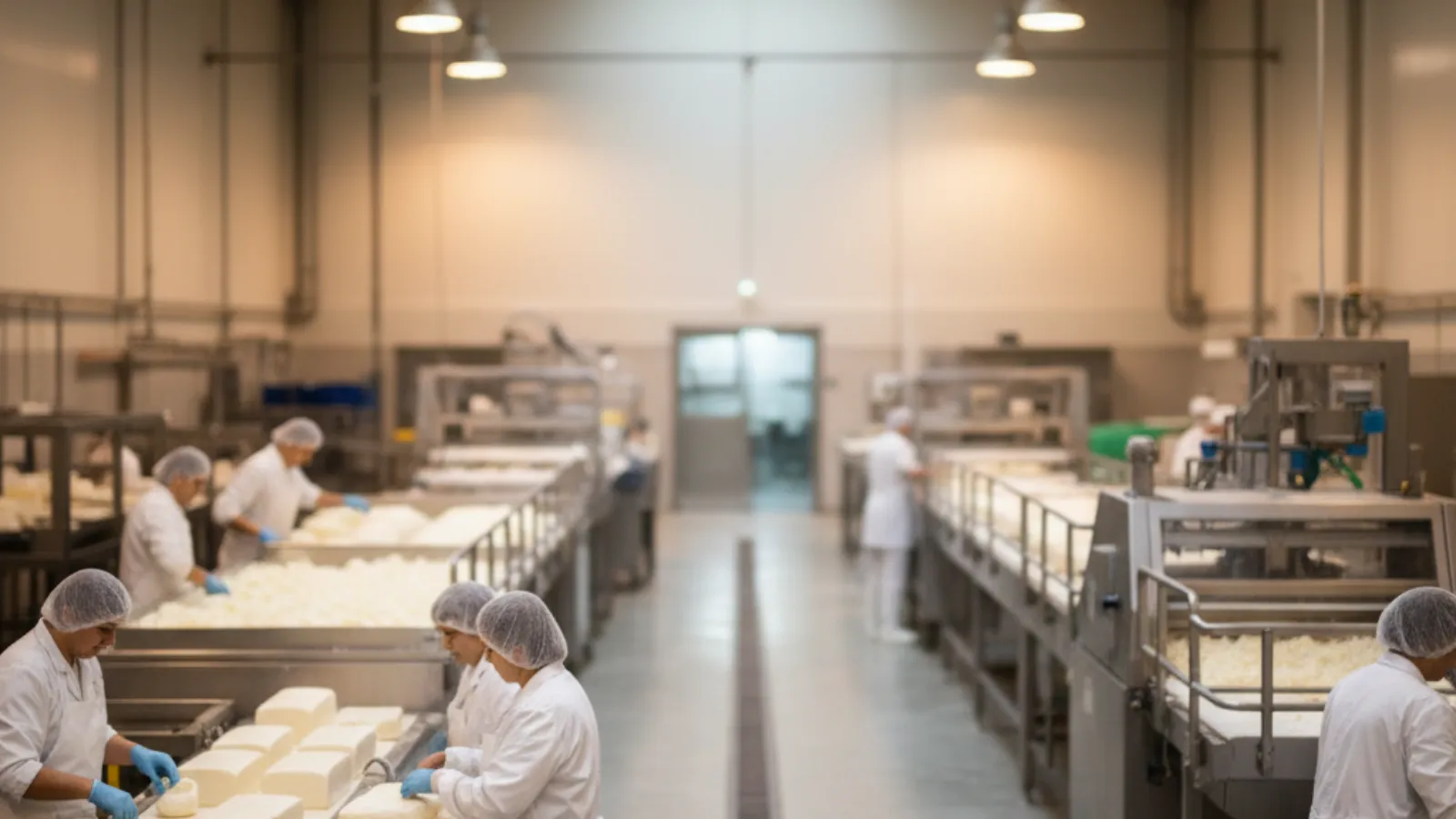
I had this filed as a small plant closure. Then I read the German type split. Hard, semi-hard and soft cheese has added 72,000 tonnes since 2010, while pasta filata added 204,000.
What Müller is closing
Unternehmensgruppe Theo Müller is shutting the semi-hard cheese dairy at Sachsenmilch in Leppersdorf, Saxony. Müller will close the semi-hard cheese dairy at Sachsenmilch Leppersdorf on 31 December 2026. About 160 people work in that part of the site. The packing and office areas tied to it go as well. The group gave two reasons. Eating habits have changed and the kit is old. A rebuilt line would need heavy spending. Müller says it looked at every other option first. The news broke on 6 and 7 October through German trade media and the dpa wire. It came with a second closure. The Homann sauce plant at Rogätz in Saxony-Anhalt will stop production by the end of September 2027. About 160 more jobs go with it. Taken together the two sites account for roughly 320 roles.
What stays at Leppersdorf
The site is not closing. Mozzarella and acid curd cheese carry on at Leppersdorf. So do butter, yoghurt and the whey plants that feed infant nutrition. The site employs about 3,000 people in all. It takes in around 1.7 billion kg of milk a year, and almost all of it is handled on site. About half of that milk goes to the cheese dairies. That is close to 850 million kg. So this is a cut inside a very large cheese operation rather than an exit from cheese.
The German type table explains the choice
National output figures make the decision look ordinary. The Milchindustrie-Verband puts German hard, semi-hard and soft cheese at 1.18 million tonnes in 2025. The 2020 figure was 1.16 million. That is five years of almost no movement. Fresh cheese went the other way, reaching 860,000 tonnes from 835,000. Pasta filata, the mozzarella family, stood at 450,000 tonnes against 246,000 in 2010. Processed cheese held at 210,000 tonnes. Semi-hard is the flat part of a growing table. Gouda, Edam, Maasdam, Fontal and Kashkaval were all made at Leppersdorf. Those are the types a German shopper buys pre-sliced in a pack.
The milk stays in the market
Milk suppliers were the first question asked in Saxony. Milk freed by the closure can be sold to other buyers. The site also keeps its remaining cheese lines running. Frank Siebert, who leads the works council, said no jobs need to go. Staff are being moved to other areas at Leppersdorf. A shift to shorter working patterns has created vacancies elsewhere on site. Employees should know their position by the end of October.
Own label moves to a licence
The brand side is being handled by contract. Landliebe sliced cheese will be made by another dairy under licence. Müller has not named the partner. That is the pattern worth watching. A group can leave the vats and keep the shelf. Licensed and own-label work move cheese volume from one maker to another, and the national total never moves. Someone else now fills those slots.
The same split shows up outside Germany. Dutch and Polish plants run large Gouda and Edam programmes aimed at the same buyers. Hard Italian types and pasta filata have taken the growth in several large markets. Each family carries its own milk price, its own buyers and its own shelf life.
What this means for the market
A country total is the wrong unit for this call. Germany makes more cheese than any other state in the European Union. Its semi-hard family has been flat for five years. Position in the market has moved with the type. Makers geared to Gouda and Edam blocks are bidding for a pool that is not growing. Mozzarella and fresh cheese plants are not. An entrant should price the cheese type before it prices the country. Ask which family holds the growth. Then ask who already owns the vats and the shelf space in it. The licence deal is the part to track. A maker that picks up branded sliced cheese volume starts 2027 with a filled plant. The build cost is zero. That is a cheaper route into German semi-hard cheese than a new vat. It never shows in a production table.
The closure itself is clear. The bigger question is how much semi-hard capacity Europe still holds, and how fast it is being reallocated. Our Global Cheese Database 2026 splits each market into 39 cheese types. The four families are hard and semi-hard, fresh, mould ripened and processed. It carries output, imports, exports and demand in tonnes for 48 countries, with 2025 actuals and forecasts to 2030. The waitlist carries a free sample country chapter.

Global Aseptic Packaging Market Report 2026
148.4bn litres and 344bn packs in 2025. Aseptic volumes across dairy, dairy alternatives, beverages and food in 39 markets — 2025 actuals and forecasts to 2030. Buy online and receive it within 24 hours.
More information
Global Cheese Database 2026
Production, imports, exports and consumption for 39 cheese types across 48 countries, with actuals through 2025 and forecasts to 2030. Join the waitlist for early access, pre-launch pricing and a free sample country chapter.
Get early accessStrategic Insights
📊 Analytics & Strategic Insight
Germany's largest cheese site is leaving the flattest cheese family
The decision most in this industry are avoiding:
👉 The site is cutting one cheese family rather than its milk intake. Leppersdorf keeps mozzarella, acid curd and whey. The milk behind the closed vats gets reallocated.
👉 Old kit is doing as much work here as demand. Müller named both reasons. A line that needs rebuilding sets its own deadline.
👉 The shelf space does not disappear with the vats. Landliebe sliced cheese moves to a licensed maker. Someone gains volume without building anything.
Here's the full context:
→ 1996: Cheese production starts at Leppersdorf under Müller ownership.
→ 2008: The natural ripening store is expanded as semi-hard output grows.
→ 2011: A whey refining plant opens on the site, at about 70 million euros.
→ 2024: A grating line is commissioned, aimed at pasta filata and hard cheese demand.
→ Most recent: Müller will close the semi-hard cheese dairy on 31 December 2026. About 160 staff are affected.
What this means for cheese producers, traders and buyers:
✅ German semi-hard supply is being rearranged rather than cut. One site leaves the family. The milk behind it stays available to other buyers.
✅ Buyers of Gouda and Edam should re-check their second source. A licensed maker has to carry the Landliebe volume from January. Spare German semi-hard capacity is worth counting now.
✅ Mozzarella and fresh cheese hold the German growth. Pasta filata has risen from 246,000 tonnes in 2010 to 450,000. Fresh cheese reached 860,000 tonnes in 2025.
What this means for market decisions:
1️⃣ Market appeal has moved to the fresh and pasta filata families. The semi-hard table has been flat for five years.
2️⃣ A German semi-hard plant has just lost a large competitor. Whoever wins the Landliebe licence gains volume with no build. Everyone else gains a little room.
3️⃣ An entrant should count semi-hard vats across Europe before choosing Germany. Dutch and Polish plants serve the same buyers. Test where spare capacity already sits.
The Zenith view:
A closed cheese dairy proves that one group found semi-hard cheese unprofitable at one site. It does not prove that German semi-hard demand is falling. One question decides an investment here. Which of the 39 cheese types holds the growth, and who already owns the vats in it.
The data behind this story
🧀 Global Cheese Database 2026
Production, imports, exports and consumption for 39 cheese types across 48 countries, in tonnes, with actuals to 2025 and forecasts to 2030. The 2026 edition is being built market by market. Waitlist members get the pre-launch price and a free sample country chapter.
→ Join the waitlist
Evaluating a cheese market or a cheese type? Zenith helps food and beverage companies assess market size, growth, competitors, pricing and route to market before they invest.
→ Discuss your market
Zenith Consulting
Submit your food & beverage project enquiry.
Share your requirements. If there is a strong fit, we’ll come back with an indicative investment range, project timeline and recommended strategic approach.
Reviewed by Zenith Consulting’s senior food & beverage strategy team.
Related analyses
- M&A, Investment & Valuation
Parmigiano Reggiano Takes On Australian Parmesan: The EU Trade Deal Protected 53 Cheese Names And Left Parmesan Out
The Parmigiano Reggiano Consortium has opened a three-year campaign in Australia, where cheese output runs at 455,000 tonnes a year. Australia agreed to protect 53 EU cheese names, and parmesan is not one of them.
Read analysis → - M&A, Investment & Valuation
Parmigiano Reggiano Takes On Australian Parmesan: The EU Trade Deal Protected 53 Cheese Names And Left Parmesan Out
The Parmigiano Reggiano Consortium has opened a three-year campaign in Australia, where cheese output runs at 455,000 tonnes a year. Australia agreed to protect 53 EU cheese names, and parmesan is not one of them.
Read analysis → - M&A, Investment & Valuation
Arla Puts 28.3 Million Euros Back Into Falkenberg Cottage Cheese Ten Months After Adding 1,500 Tonnes
Arla has committed 28.3 million euros to cottage cheese making at Falkenberg in Sweden, ten months after a SEK 70 million step there added 1,500 tonnes a year. In Australia, facing growth above 40%, the co-op bought a cheese plant instead.
Read analysis →
Share it with your peers
Pass this analysis to colleagues who track the food and beverage market.
Zenith Market Intel
Need a specific food or beverage market report?
Tell us which category, region or question would be useful for your team.
Sister Publication
Also follow our Water Dispense Market Intelligence
Category analyses, operator briefings, and investor signals across the global water dispense market.