England, Quebec and Poland Just Age-Gated Energy Drinks. Monster, Red Bull and Celsius All Sit Above the Line
Six European countries and a Canadian province now restrict energy drink sales to minors, and England joins them in April 2027 with a 150mg per litre threshold that catches almost every major brand. Here is what age-gating does to channel economics, and why the tea and coffee carve-out is the most important line in the law.
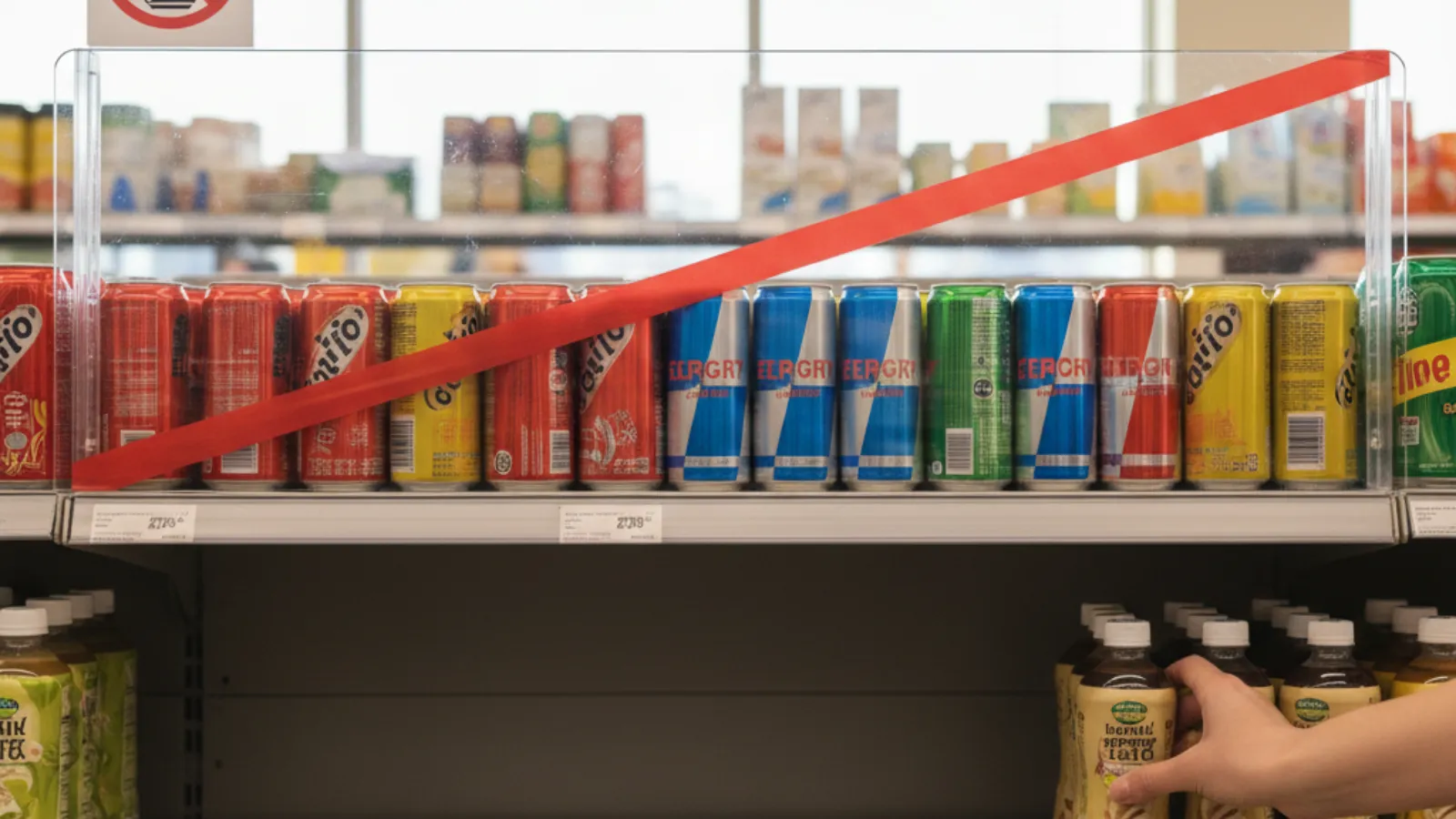
Monster Beverage had its best ever first quarter in Europe, the Middle East and Africa this year. Sales in the region rose 52.4% to US$568.2m, while the wider energy category there grew about 10.5%. In the same few months, three governments moved to make part of that shopper base illegal to sell to. England confirmed a ban. Quebec passed one. Poland already has one running.
What England has signed up to
On 16 July 2026 the UK government confirmed that from April 2027, shops in England cannot sell high-caffeine energy drinks to anyone under 16. The rule covers any drink other than tea or coffee with more than 150mg of caffeine per litre. It applies in shops, in vending machines and online. Business to business sales are out of scope. Retailers carry the duty to check, councils enforce it, and fines run up to £2,500.
The government says about 100,000 children in England drink high-caffeine energy drinks every day. The consultation behind the decision ran from September to November 2025 and drew 1,095 responses. The threshold matters more than the age limit. At 150mg per litre, a standard Red Bull (80mg in 250ml, so 320mg per litre) is caught. So is Monster (160mg in 500ml, again 320mg per litre). Celsius and Prime sit near 560mg per litre. Almost nothing in the modern energy aisle sits under the line.
The map is filling in fast
Quebec adopted Bill 9 on 10 June 2026 with 103 members voting for it. It bars sales to under-16s, and it goes further than England. It bans online sales and vending machine sales of energy drinks outright, unless a later regulation allows them back. Retailer penalties reach C$62,500 and can double for repeat offences. Poland's under-18 ban took effect on 1 January 2026. Lithuania has had one since 2014 and Latvia since 2016, with Romania, Hungary and Bulgaria following. Six European countries and a Canadian province now age-gate this category, and the largest market in Europe joins them in 2027.
Brussels has no plan for an EU-wide rule, so the map stays patchy. That is harder to plan around than one hard rule, because every market writes its own definition, its own age limit and its own channel carve-outs.
The carve-out that decides the next five years
Read the England rule again: more than 150mg per litre, other than tea or coffee. Quebec wrote the same exemption. A can of cold brew with the same caffeine as a Monster can still be sold to a 14 year old. That is a legal gap wide enough to build a portfolio through. Ready-to-drink coffee, tea-based energy, matcha and guarana blends sold as tea all sit outside a rule aimed at the can beside them. Every large drinks group already owns coffee and tea assets. Very few have modelled what happens if their growth engine gets age-gated market by market while the exempt shelf next to it keeps selling.
The shelf reacts before the shopper does
An age check is a friction cost at the till. It slows the queue, it needs staff training, and it pushes small independents to stock less of a product that now carries legal risk. Quebec removes two whole routes to market in one line of law. The volume lost from under-16s is smaller than the shelf lost to retailers who decide the category is more trouble than it earns. UK supermarkets already ask for ID on these drinks voluntarily, so the shelf effect started well before the law did.
The marketing bill comes next
Regulators are now looking at how the category recruits. In June 2026 the Texas attorney general opened an investigation into Celsius and Alani Nu over youth marketing, following the death of a teenager. India's food safety regulator issued misbranding notices in early July to brands calling themselves energy drinks. The US FDA has put caffeine labelling on its 2026 guidance agenda. Age-gating rarely arrives alone. It tends to bring marketing limits, then labelling rules, then tax. Alcohol and tobacco walked that path, and anyone who watched sugar taxes spread knows the running order.
What to do with this
The category is still growing hard and the near-term numbers will keep looking good. Deutsche Bank still cut Monster to Hold on 20 July, four days after the England announcement. The risk sits further out. A brand that recruits at 14 and converts at 20 loses six years of habit building in every market that gates it. The groups that win the next five years will build an exempt or lower-caffeine ladder now, while the money from the current boom is still there to fund it. Buyers should price age-gating risk into any energy asset that comes to market this year. Operators should check which of their products sit above 150mg per litre and what a second range under the line would cost to build.

Global Aseptic Packaging Market Report 2026
148.4bn litres and 344bn packs in 2025. Aseptic volumes across dairy, dairy alternatives, beverages and food in 39 markets — 2025 actuals and forecasts to 2030. Buy online and receive it within 24 hours.
More information
Global Cheese Database 2026
Production, imports, exports and consumption for 39 cheese types across 48 countries, with actuals through 2025 and forecasts to 2030. Join the waitlist for early access, pre-launch pricing and a free sample country chapter.
Get early accessStrategic Insights
📊 Analytics & Strategic Insight
Age-gating is a channel problem before it is a volume problem
The decision most in this industry are avoiding:
👉 The lost under-16 volume is the small number. The bigger number is the shelf space a retailer quietly gives back when a product needs an ID check, staff training and a fine risk. That loss hits every shopper, at every age, in that store.
👉 The 150mg per litre line is a product brief that nobody wants to accept. Reformulating below it is possible and cheap. Almost no one will do it, because the caffeine is the promise the brand is built on. That is a strategy choice being made by default.
👉 The tea and coffee exemption hands the category's next decade to companies that already own coffee. Same caffeine, same shelf, no age check. The groups with a ready-to-drink coffee platform have an on-ramp for young drinkers that pure-play energy brands will not have.
Here's the full context:
→ 2014: Lithuania became the first EU country to ban energy drink sales to under-18s. Latvia followed in 2016, then Romania, Hungary and Bulgaria.
→ 2018: Major UK supermarkets began asking for ID on drinks above 150mg of caffeine per litre, years ahead of any law.
→ 2025: England consulted from 3 September to 26 November and received 1,095 responses. The EU decided against an EU-wide rule and kept its high-caffeine warning label.
→ 2026: Poland's under-18 ban took effect on 1 January. Quebec adopted Bill 9 on 10 June, adding outright bans on online and vending sales, with penalties up to C$62,500.
→ Most recent: On 16 July 2026 England confirmed an under-16 ban from April 2027 with fines up to £2,500. Deutsche Bank cut Monster Beverage to Hold four days later.
What this means for food and beverage operators and investors:
✅ Age-gating risk has moved from the risk register into the valuation. Any energy or high-caffeine asset trading this year should be priced with a haircut on markets that have gated it or are likely to within three years.
✅ Channel mix is the first thing to model. Quebec shows a government can delete online and vending in one clause. If those routes carry meaningful volume for you, that is a revenue line with a legal off switch.
✅ Recruitment age is a real asset that is being quietly written down. Brands built on teenage habit formation lose their cheapest customer acquisition in every gated market. Work out what it costs to acquire that drinker at 18 instead of 14.
3 moves you can make this week:
1️⃣ Run the 150mg per litre test across your range. List every product above the line, by market and by channel, and put revenue against each one. Most teams have never seen this number on a single page.
2️⃣ Price one compliant alternative. Cost a lower-caffeine or tea-based version of your best seller: formulation, packaging, margin. Have the option ready before the rule reaches your third market.
3️⃣ Ask your top ten retail customers what they plan to do. Retailers decide range before governments finish legislating. Their answer tells you the real timeline, which is usually a year earlier than the statute says.
Take the Next Step
💬 You don't need a written brief.
Tell us what you are weighing up, and we will come back with the likely project scope, recommended direction and cost range.
→ Tell us what you're planning
Zenith Consulting
Submit your food & beverage project enquiry.
Share your requirements. If there is a strong fit, we’ll come back with an indicative investment range, project timeline and recommended strategic approach.
Reviewed by Zenith Consulting’s senior food & beverage strategy team.
Related analyses
- M&A, Investment & Valuation
EEX Hands Its Dairy Market To CME: Europe Makes 10.8 Million Tonnes Of Cheese And Cannot Hedge Any Of It
CME Group will take over the European Energy Exchange dairy business before the end of 2027, including the weekly cheese indexes for cheddar curd, mild cheddar, young gouda and mozzarella. Europe makes 10.8 million tonnes of cheese a year and still has no cheese futures contract behind it.
Read analysis → - M&A, Investment & Valuation
Chobani's $1.2bn Allentown Plant Would Take A Third Of Pennsylvania's Milk: Keurig Dr Pepper Sold The Building For $125m
Keurig Dr Pepper is selling its Chobani stake for $800m and its Allentown plant for $125m to cut debt before its 2027 split. Chobani will spend $1.2bn on the site, which at full run would draw more than three billion pounds of Pennsylvania milk a year, close to a third of the whole state's output.
Read analysis → - M&A, Investment & Valuation
USDA's Ranchers First Puts 20% Of US Beef Processing In Play: The Purchase Order Matters More Than The Loan
USDA says nearly 20% of US beef processing will come free as the herd grows, and it is offering backed loans to fill it. The cheaper win sits in the buying line, because a purchase order fills a plant and a loan only builds one.
Read analysis →
Share it with your peers
Pass this analysis to colleagues who track the food and beverage market.
Zenith Market Intel
Need a specific food or beverage market report?
Tell us which category, region or question would be useful for your team.
Sister Publication
Also follow our Water Dispense Market Intelligence
Category analyses, operator briefings, and investor signals across the global water dispense market.