General Mills' $2.1 Billion Gamble: Why the Cheerios Maker Is Shrinking on Purpose Before Its June 24 Earnings
General Mills heads into its Q4 FY2026 report on June 24 facing a third straight year of falling sales. The decline is not an accident. It is the plan.
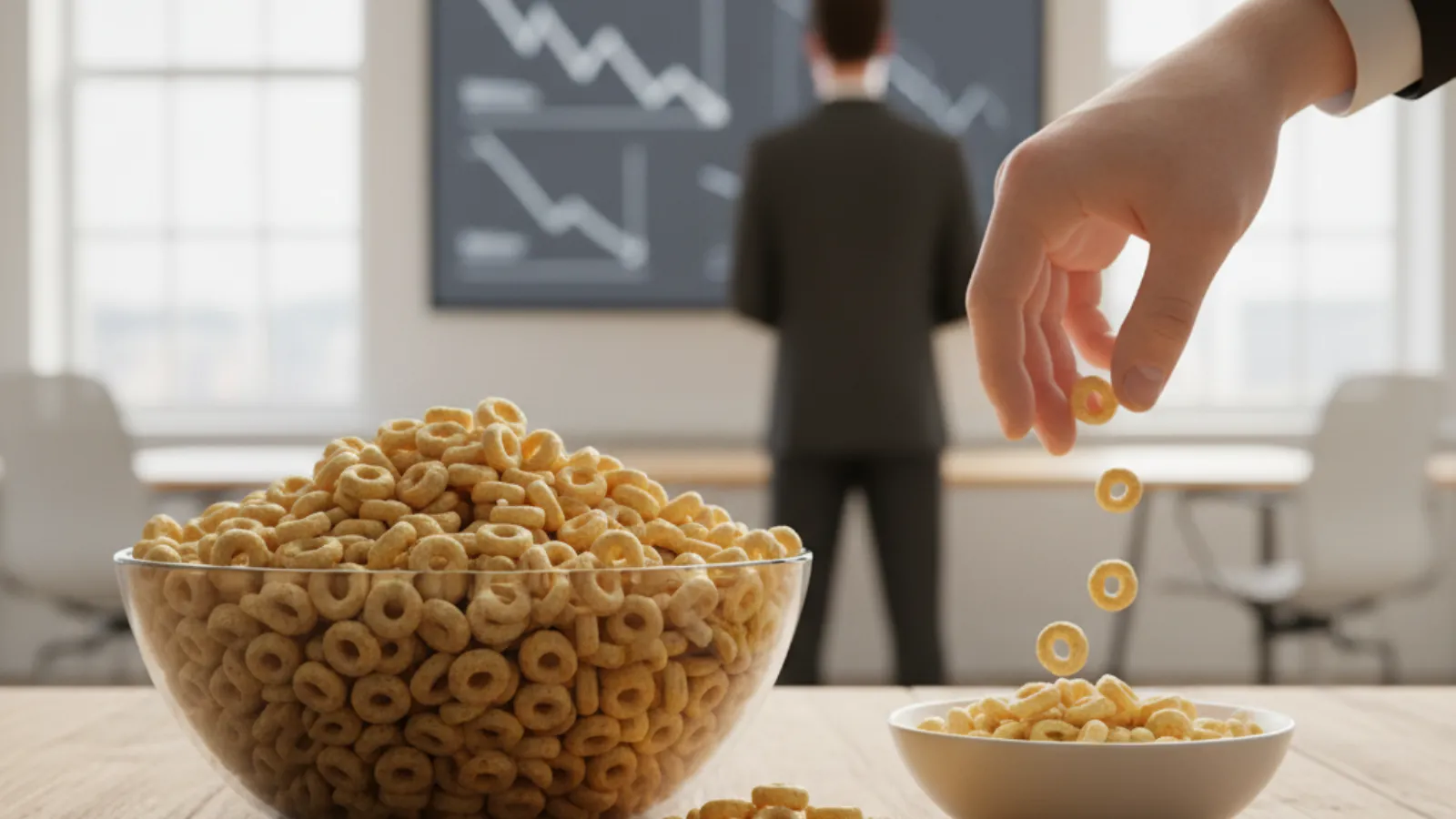
Here is a number that should stop any food investor cold. General Mills is on track for its third year in a row of falling organic sales. Most CEOs would be fired for that. Jeff Harmening planned it.
The $2.1 billion subtraction
The maker of Cheerios, Pillsbury, and Blue Buffalo reports fourth-quarter fiscal 2026 results on June 24. The headline numbers will look ugly. Organic sales are guided to fall 1.5% to 2% for the full year. Adjusted profit is set to drop 16% to 20%. But the ugliness is the point. This is a company tearing itself down to build something leaner.
Last June, General Mills sold its North American yogurt business for $2.1 billion. The U.S. arm went to French dairy giant Lactalis. The Canadian arm went to Sodiaal. Gone with it were Yoplait, Go-Gurt, Oui, and two factories.
That business added roughly $1.2 billion to fiscal 2025 sales. Selling it punched a hole in the top line on purpose. The yogurt unit was big, but it was slow and low-margin. General Mills chose smaller and faster over bigger and tired.
The cash is not sitting idle. Management is using the proceeds for share buybacks and to cut debt. The divestitures, plus a smaller pet acquisition, will shave about 5 points off adjusted operating profit growth this year. That is a steep near-term price for a cleaner portfolio.
Betting the future on dogs and cats
While yogurt left, pet food stayed front and center. Blue Buffalo is the growth engine General Mills paid $8 billion for in 2018. Now the company is pushing it into fresh, refrigerated pet food with its Love Made Fresh line.
The bet is not clean yet. The Blue Buffalo Wilderness dog line slowed from late fiscal 2025 into early fiscal 2026. Pet was supposed to be the easy win, and right now it is a work in progress. Investors will want proof on June 24 that the fresh launch is gaining real shelf space, not just spending money.
Reinvestment now, payoff later
Harmening calls the strategy bold. He told investors General Mills entered fiscal 2026 ready to spend hard to make its brands more "remarkable." That means lower prices, more marketing, and better products. All of it costs money today and lifts sales only later.
The company already warned this would hurt. It said the first three quarters would show falling sales and profit even as volume and market share improved. That gap between volume and dollars is the whole story. General Mills is moving more product but charging less for it, by choice.
The fourth quarter is built to look better. A 53rd week, easier comparisons, and a retailer inventory swing should all flatter the numbers. Management has promised a meaningful step-up. If that step-up does not show, the reinvestment thesis takes a serious hit.
Why the market is not convinced
In February, General Mills cut its full-year outlook. Organic sales went from roughly flat to down 1.5% to 2%. That marks a third consecutive year of decline for one of America's most iconic food names. Investors were not impressed by talk of future improvement.
The trust gap is the real issue. General Mills is asking the market to believe in a payoff that keeps moving further out. Every quarter of falling sales burns patience. The June 24 report is the first chance to show the spending is finally working.
The bigger lesson reaches across all of Big Food. Slow-growth giants are learning they cannot price their way to growth forever. The new playbook is to sell the tired brands, buy or build the fast ones, and spend to defend share. General Mills is running that play in public. Whether it pays off will shape how every packaged-food board thinks about reinvestment for the rest of the decade.
Global Aseptic Packaging Market Report 2026
148.4bn litres and 344bn packs in 2025. Aseptic volumes across dairy, dairy alternatives, beverages and food in 39 markets — 2025 actuals and forecasts to 2030. Buy online and receive it within 24 hours.
More information
Global Cheese Database 2026
Production, imports, exports and consumption for 39 cheese types across 48 countries, with actuals through 2025 and forecasts to 2030. Join the waitlist for early access, pre-launch pricing and a free sample country chapter.
Get early accessStrategic Insights
📊 Analytics & Strategic Insight
Shrinking to Grow: The Reinvestment Reset Reshaping Big Food
The decision most in this industry are avoiding:
👉 Cutting revenue on purpose is the hardest call a CEO can make. Most packaged-food leaders defend the top line at all costs. General Mills sold $1.2 billion in annual sales to escape a low-margin trap. That takes nerve few boards have.
👉 Volume up, dollars down is a feature, not a failure. The market punishes falling sales even when units and share rise. Smart operators read the volume line first, because that is where real demand lives.
👉 Pet food is not the guaranteed win everyone assumes. Blue Buffalo slowed in dog feeding just as fresh pet heats up. Premium pet is now a fight, not a free ride.
Here's the full context:
→ 2018: General Mills buys Blue Buffalo for $8 billion to enter premium pet food.
→ June 2025: General Mills sells its North American yogurt business to Lactalis and Sodiaal for $2.1 billion.
→ Mid 2025: Company enters fiscal 2026 with a plan to reinvest heavily and accept short-term sales and profit declines.
→ February 2026: General Mills cuts full-year guidance to organic sales down 1.5% to 2% and adjusted profit down 16% to 20%.
→ Most recent: General Mills reports Q4 FY2026 results on June 24, the first real test of whether the reinvestment reset is working.
What this means for food and beverage operators and investors:
✅ Portfolio pruning is the new default. Selling slow brands to fund fast ones is now standard Big Food strategy. Expect more divestitures of legacy categories like yogurt, canned goods, and basic dairy.
✅ Watch volume and share, not just headline sales. The companies winning quietly are growing units while their reported dollars dip. That gap closes when pricing normalizes.
✅ Premium pet food is consolidating into a real battle. Fresh and refrigerated pet is the next front. Operators in dairy and cold chain should study it as an adjacency.
3 moves you can make this week:
1️⃣ Audit your own slow-growth brands. Identify the units dragging your margin and ask honestly whether they belong in someone else's portfolio.
2️⃣ Separate volume from value in your reporting. Build a dashboard that shows unit demand apart from pricing so you can see real momentum.
3️⃣ Map the fresh pet and premium adjacency. If you have cold-chain or dairy capability, scope where you could play before the category fully consolidates.
Take the Next Step
💧 Also covering the water dispense market?
Water dispense is one of the fastest-growing segments in food and beverage. Operator data, revenue benchmarks, and market intelligence across 32 countries.
→ Explore water dispense insights
Zenith Consulting
Submit your food & beverage project enquiry.
Share your requirements. If there is a strong fit, we’ll come back with an indicative investment range, project timeline and recommended strategic approach.
Reviewed by Zenith Consulting’s senior food & beverage strategy team.
Related analyses
- Corporate Strategy & Portfolio
Krones Opens Its Largest Plant Outside Germany In China: An Aseptic Laboratory Lands As Local Line Builders Take The Orders
Krones has opened a second plant at Taicang, giving it 74,000 square metres of buildings and its largest site outside Germany. It arrives in a market where Zenith puts aseptic drinks at 17,950 million litres and local line builders hold more than 30 aseptic lines on order.
Read analysis → - Corporate Strategy & Portfolio
US Cheese Exports Rise 9% To 59,007 Tonnes: Mexico And The Americas Supplied All Of August's Growth
US cheese exports reached 59,007 tonnes in August, up 9% on a year earlier. Mexico, South America and Central America added more than the whole net gain while South Korea fell 12%.
Read analysis → - Corporate Strategy & Portfolio
Greatview Faces Hong Kong Delisting: The Aseptic Carton Maker Sold 11.7 Billion Packs Against 30 To 34 Billion Of Chinese Capacity
Greatview Aseptic Packaging has asked for a review of the Hong Kong exchange decision to cancel its listing. The carton maker sold 11.7 billion packs in 2025 against Chinese plants Zenith rates at roughly 30 to 34 billion.
Read analysis →
Share it with your peers
Pass this analysis to colleagues who track the food and beverage market.
Zenith Market Intel
Need a specific food or beverage market report?
Tell us which category, region or question would be useful for your team.
Sister Publication
Also follow our Water Dispense Market Intelligence
Category analyses, operator briefings, and investor signals across the global water dispense market.