PepsiCo Just Put 41 Driverless Trucks on US Roads. The Real Story Is the Cost Curve, Not the Tech
PepsiCo is now the first major food and drink giant to run driverless trucks at real scale, hauling Doritos and soda across three states. The bigger signal: Big Food has found a way to grow without hiring, just as a driver shortage and a new visa rule squeeze the labour pool.
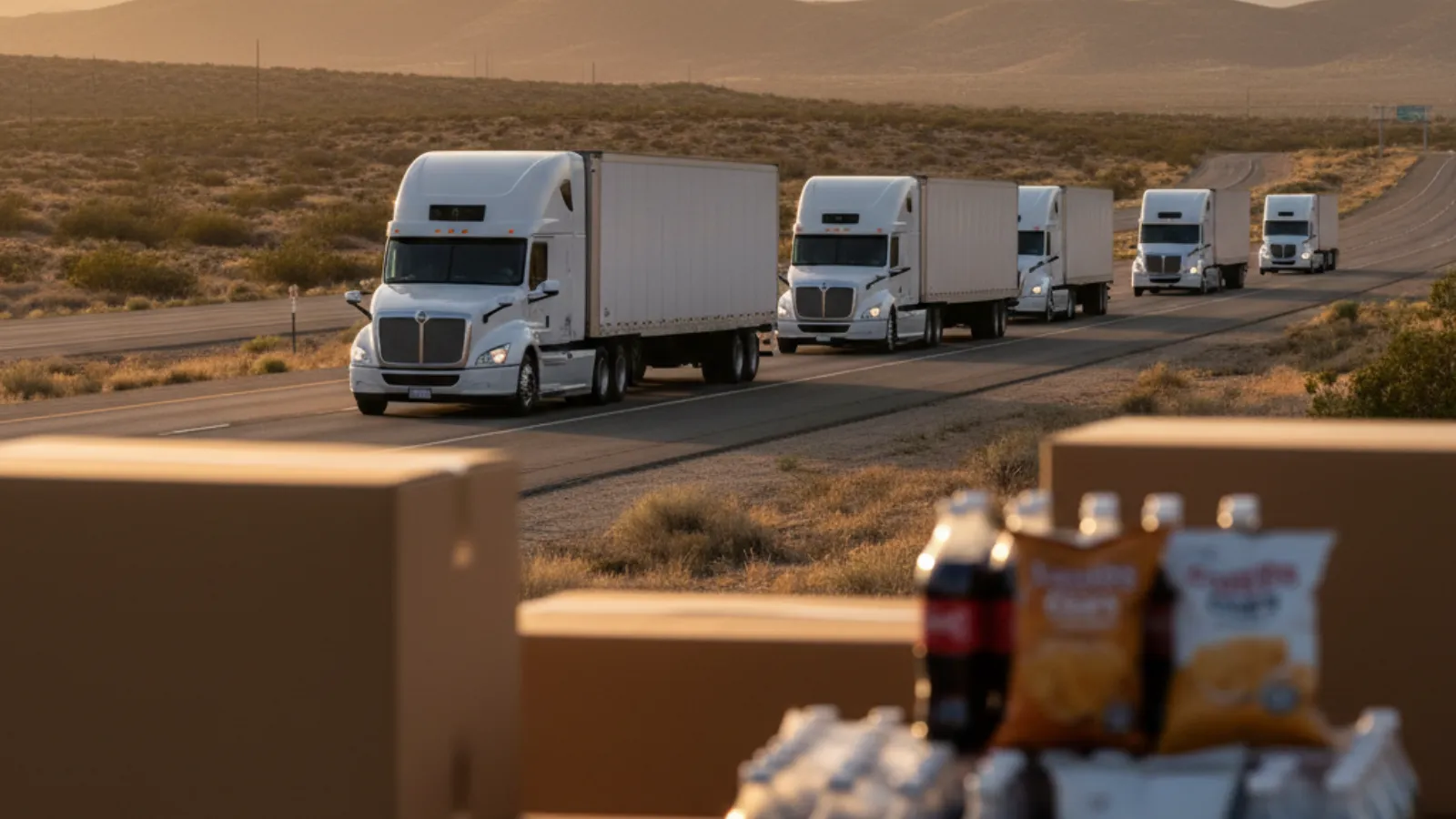
A 26,000-pound truck full of Doritos is driving itself to Walmart. No one is behind the wheel.
On June 8, 2026, PepsiCo and its partner Gatik confirmed they are running the largest commercial driverless freight fleet in the United States. PepsiCo is now the first major consumer goods company to move its everyday products with no human drivers, at real commercial scale. The headlines went to the robot trucks. The story that matters to executives is quieter: this is how Big Food plans to grow without adding people.
The deal in plain numbers
PepsiCo has 41 autonomous trucks in live service today. The fleet is split across three states: 35 in Arizona, five in Texas, and one in Arkansas. The trucks carry Frito-Lay snacks and drinks between plants, distribution centres, and stores like Walmart and Dollar General.
These are not test runs on a closed track. The trucks have hauled real freight on public roads since driverless operation began in June 2025. PepsiCo says the fleet has hit a 99% on-time rate and has had no public-road accidents in that time. Gatik, the company that builds the systems, has booked more than $600 million in contracted revenue.
One line from PepsiCo says it all. Jim Farrell, a senior supply chain VP, told the Wall Street Journal: "One of the things that we can do is be able to grow the business without having to add as many employees."
Why now: the labour math broke
The timing is not an accident. The US trucking sector is short of drivers, and the gap is getting worse. The American Trucking Associations puts the current shortfall near 60,000 drivers and says the industry must hire about 1.2 million new drivers over the next decade just to keep pace.
The squeeze is also a cost problem. Truckload spot rates ran about 27% above the prior year in early May 2026. When drivers are scarce, carriers charge more, and food companies pay the bill at the end of the line. A new federal rule that took effect on March 16, 2026 tightens who can hold a commercial licence, a change some in the industry warn could pull tens of thousands more drivers off the road.
So what? PepsiCo is not chasing a shiny toy. It is buying a hedge against a labour market that keeps getting tighter and more expensive.
The middle mile is the smart target
Gatik did not aim at glamorous long-haul routes or robotaxis. It went after the "middle mile" — the short, repeated trips that link factories, warehouses, and stores. These runs are boring, predictable, and done many times a day. That is exactly what a self-driving system handles best.
The genius is in the route choice, not just the sensors. A truck that drives the same 200-mile loop ten times learns it cold. PepsiCo runs thousands of these short trips, so even small savings per run add up fast across the network. The same logic could reshape where companies place warehouses and how often they restock shelves.
The pushback is real
Not everyone is cheering. The Teamsters union has attacked driverless trucking, arguing it puts profit ahead of workers and road safety. Truck driving is one of the largest jobs in America, so any hint of automation draws fire from labour groups and lawmakers.
PepsiCo says it will retrain some staff to monitor fleets and unload product, and Gatik argues new jobs will appear in maintenance and remote operations. Whether those roles replace the ones at risk is still an open question. Safety is the other worry: the tech has not yet faced every kind of weather, traffic, and road that human drivers handle every day.
What it means for buyers and operators
For food and drink leaders, this is a preview, not a one-off. If PepsiCo proves the model pays, rivals will copy it, and logistics cost will become a place where the biggest players pull ahead. Scale plus automation lets the giants lower their cost to serve in a way smaller brands cannot match.
For investors, watch the operating margin, not the novelty. The win is not "robot trucks" — it is freight cost that stops rising while volume grows. For everyone else in the supply chain, the message from PepsiCo is blunt: the plan is to grow the business without growing the headcount, and the trucks are just the start.
Global Aseptic Packaging Market Report 2026
148.4bn litres and 344bn packs in 2025. Aseptic volumes across dairy, dairy alternatives, beverages and food in 39 markets — 2025 actuals and forecasts to 2030. Buy online and receive it within 24 hours.
More information
Global Cheese Database 2026
Production, imports, exports and consumption for 39 cheese types across 48 countries, with actuals through 2025 and forecasts to 2030. Join the waitlist for early access, pre-launch pricing and a free sample country chapter.
Get early accessStrategic Insights
📊 Analytics & Strategic Insight
The robot trucks are a headline. The real move is Big Food decoupling growth from hiring.
The decision most in this industry are avoiding:
👉 Stop treating logistics as a fixed cost you cannot touch. Most operators accept rising freight rates as weather. PepsiCo just proved the line can be bent — and the firms that move first will own the cost advantage.
👉 Automate the boring routes, not the flashy ones. Everyone watches long-haul and robotaxis. The money is in the dull, repeated middle-mile trips that nobody writes headlines about.
👉 Say the quiet part out loud. The goal is growing volume without growing headcount. Boards that won't name that openly will plan for the wrong future.
Here's the full context:
→ 2024–2025: Driver shortages, inflation and high freight rates push food makers to automate inside plants and warehouses first.
→ June 2025: PepsiCo and Gatik begin running fully driverless trucks on public roads, moving real freight.
→ March 16, 2026: A new federal rule tightens commercial licence eligibility, threatening to shrink the driver pool further.
→ Early May 2026: Truckload spot rates sit about 27% above the prior year, squeezing food and drink margins.
→ Most recent: June 8, 2026 — PepsiCo and Gatik confirm 41 driverless trucks live across Arizona, Texas and Arkansas, the largest commercial driverless freight deployment in the US.
What this means for food and beverage operators and investors:
✅ Logistics is becoming a competitive moat. Scale plus automation lets the largest players cut cost-to-serve in ways smaller brands cannot copy quickly.
✅ The labour squeeze is structural. An ageing driver base, high turnover and tighter licence rules mean the pressure that justified this won't ease soon.
✅ Judge it on margin, not novelty. The real test is whether freight cost stays flat while volume rises — that is the number investors should track.
3 moves you can make this week:
1️⃣ Audit your middle mile. List your most repeated short-haul lanes and rank them by volume — those are the first candidates for automation or fixed-rate contracts.
2️⃣ Model a no-headcount-growth scenario. Stress-test your plan for volume growth with flat labour, and find where the cost actually sits.
3️⃣ Lock freight rate exposure now. With spot rates well above last year, review contract cover before the next driver-supply shock hits.
Take the Next Step
📞 Need help with market entry, market research, or water source valuation?
Book a free 30-minute consultation with Akos Petri — strategic guidance across European and US markets, operator landscapes, and commercial positioning.
→ Book your free call
Zenith Consulting
Submit your food & beverage project enquiry.
Share your requirements. If there is a strong fit, we’ll come back with an indicative investment range, project timeline and recommended strategic approach.
Reviewed by Zenith Consulting’s senior food & beverage strategy team.
Related analyses
- Innovation & Technology
US Cottage Cheese Curd Hits 514 Million Pounds: AMPI Hands A Cheddar Plant Over And The Sweet Whey Goes With It
US cottage cheese curd output reached 514.3 million pounds in 2025, up 14.7%, while all other cheese grew 4.0%. AMPI is switching its Blair cheddar plant to cottage cheese and Westby has just cut the ribbon on a 50% capacity lift.
Read analysis → - Market & Category Growth
US Cheese Warning Labels Move Closer: Bongards Adds 180 Million Pounds Of Process Cheese Anyway
A US Senate committee has advanced a bill that would put a front-of-pack warning on whole milk, all cheese and most yogurt. Bongards is still spending $135 million on 180 million pounds more process cheese, and the channel split explains why.
Read analysis → - Market & Category Growth
Tetra Pak Takes Tetra Recart Into Chinese Dessert Soups: World Aseptic Food Is Stuck At 8.3 Billion Litres
Tetra Pak and Shanghai Meilin have put two ready-to-eat dessert soups into Tetra Recart, a carton that is sterilised after filling rather than aseptically filled. Zenith's Global Aseptic Packaging Market Report 2026 puts world aseptic food at 8,286 million litres in 2025, 5.6% of world aseptic volume, and flat to 2030.
Read analysis →
Share it with your peers
Pass this analysis to colleagues who track the food and beverage market.
Zenith Market Intel
Need a specific food or beverage market report?
Tell us which category, region or question would be useful for your team.
Sister Publication
Also follow our Water Dispense Market Intelligence
Category analyses, operator briefings, and investor signals across the global water dispense market.