Utz and Campbell's Face Avocado Oil Lawsuits as 89% of Samples Fail a Purity Test
A UC Davis study found 48 of 54 samples sold as made with avocado oil did not match the real oil, and class actions have now landed on Utz Brands and Campbell's. For food and drink operators the lesson is short: a claim you cannot test is a cost you have not booked.
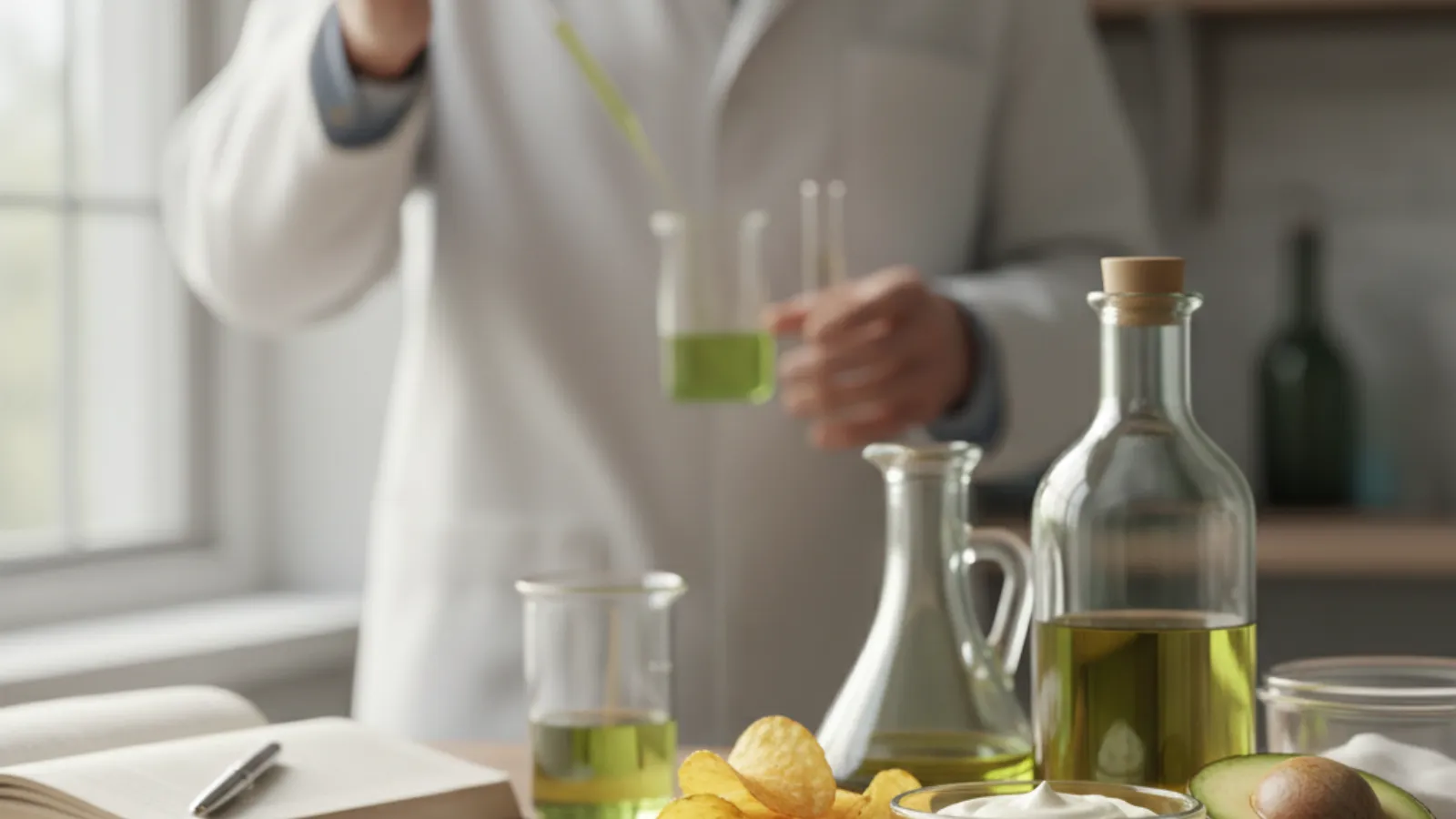
I think most recipe plans have a hole in them. They list the better inputs to buy. They never list which of those inputs a buyer can test on arrival. A team at UC Davis checked 54 samples of food sold as made with avocado oil. Forty-eight failed.
Two class actions have followed. On 13 August a New York federal court received Schultz v. Utz Brands. On 18 August a California federal court received Heiland v. The Campbell's Company. Both are claims and neither has been tested in court. Utz has not commented, and Campbell's declined to.
What the tests found
The study ran in Applied Food Research. The team pulled the oil back out of 74 shop-bought foods. Chips, mayonnaise and salad dressings were all in the set. They then read the fatty acids and sterols. Those work like a fingerprint for each oil.
Fifty-four of the samples came from 27 products that listed avocado oil as the only oil. Of those, 48 did not match the real thing. Chips failed at 93%. Mayonnaise failed at 71%. Every salad dressing failed. Of 20 products that listed olive oil alone, one failed.
That last line is the one to read twice. Olive oil has had 40 years of scandal, testing and rules. It now mostly passes. The newer oil has none of that, and it mostly fails.
The price gap is doing the work
Bulk refined avocado oil runs about $3 to $7 a kilo. The extra virgin grade runs $7 to $12. Palm and soy have sat nearer $1.10 to $1.30. So the swap can pay someone six times over.
The study does not say brand owners swapped anything. A maker can buy in good faith and still take a watered-down drum. The watering down can happen well up the chain, at a mill or a trader. But a gap that wide tells you where the pressure sits.
The bill lands on the brand
Here is the part that should worry a board. The lawsuits name the brand owner, and not the oil seller. Marketing wrote the claim on the front of the bag. Buying inherited the risk behind it.
Both brands matter to their owners. Boulder Canyon is one of the four names Utz calls its core. Utz lifted net sales 1.4% to $371.8m in the second quarter, with price up 3.6% and volume down 2.2%. The firm has also agreed a take-private deal at $14.25 a share.
Campbell's sits in the other spot. Snack sales fell 4% to $940m in its third quarter, from $982m a year before. Kettle Brand is one of the names meant to fix that. A court fight over what is in the fryer is the last thing either owner wants.
What a buyer should do now
The pull towards this oil is real and it is here to stay. Lay's now fries a kettle line in it. Fresh Del Monte bought most of Uganda's Avolio in March 2025 and is scaling it to 140 tonnes of fruit a day. It put the world market near $1.2bn, growing 8% to 10% a year.
So the fix is a test rather than a promise. Buy the claim you can prove. If a brand wants a shopper to pay more for what goes in the fryer, a picture of the fruit will not carry it. The winners here will be the groups that can hand a retailer a lab result for every drum.
For buyers of snack assets this is a new line in the check list. Ask which claims on the pack have a test behind them. In a deal, an untested claim on a growing brand is a live cost. Utz is being taken private with one of those claims in court.
Global Aseptic Packaging Market Report 2026
148.4bn litres and 344bn packs in 2025. Aseptic volumes across dairy, dairy alternatives, beverages and food in 39 markets — 2025 actuals and forecasts to 2030. Buy online and receive it within 24 hours.
More information
Global Cheese Database 2026
Production, imports, exports and consumption for 39 cheese types across 48 countries, with actuals through 2025 and forecasts to 2030. Join the waitlist for early access, pre-launch pricing and a free sample country chapter.
Get early accessStrategic Insights
📊 Analytics & Strategic Insight
The claim you cannot test
The decision most in this industry are avoiding:
👉 Your recipe plan is only as good as your test list. Most plans name the input to buy. Very few name the check that proves it turned up.
👉 A wide price gap is a fraud signal on its own. When a swap pays six times over and no rule book exists, someone will make the swap.
👉 You cannot buy trust from a seller who has none to give. A drum can be watered down two steps above your fryer. Your name is still the one on the bag.
Here's the full context:
→ 2021 to 2024: Shoppers start reading oil names on packs. Small brands build whole ranges on one pricey oil.
→ March 2025: Fresh Del Monte buys most of Uganda's Avolio. It puts the world market near $1.2bn.
→ 2025 to 2026: Lay's puts the oil in a kettle line. The claim goes mainstream in the crisp aisle.
→ July 2026: UC Davis reports that 48 of 54 samples do not match. Chips fail at 93%. Every dressing fails.
→ Most recent: Utz is sued on 13 August. Campbell's is sued on 18 August. Both are claims and neither has been tested.
What this means for food and beverage operators and investors:
✅ The label is a cost line. Every claim you cannot test is a bill you have not booked.
✅ Cheap swaps travel upstream. Your risk can sit in a mill you have never visited.
✅ Deals now need a claim check. A growing brand with an open case is worth less on the day.
3 moves you can make this week:
1️⃣ List every pack claim you sell. Mark the ones with a lab test behind them.
2️⃣ Price the gap on your top three inputs. Where a swap pays three times over, test each load.
3️⃣ Put testing in the contract. Make the seller carry the cost of a retest and a recall.
Take the Next Step
🎯 This is the thinking we bring to client projects.
If today's topic touches a decision on your desk this quarter, start the conversation before the window closes.
→ Start the conversation
Zenith Consulting
Submit your food & beverage project enquiry.
Share your requirements. If there is a strong fit, we’ll come back with an indicative investment range, project timeline and recommended strategic approach.
Reviewed by Zenith Consulting’s senior food & beverage strategy team.
Related analyses
- M&A, Investment & Valuation
Parmigiano Reggiano Takes On Australian Parmesan: The EU Trade Deal Protected 53 Cheese Names And Left Parmesan Out
The Parmigiano Reggiano Consortium has opened a three-year campaign in Australia, where cheese output runs at 455,000 tonnes a year. Australia agreed to protect 53 EU cheese names, and parmesan is not one of them.
Read analysis → - M&A, Investment & Valuation
Parmigiano Reggiano Takes On Australian Parmesan: The EU Trade Deal Protected 53 Cheese Names And Left Parmesan Out
The Parmigiano Reggiano Consortium has opened a three-year campaign in Australia, where cheese output runs at 455,000 tonnes a year. Australia agreed to protect 53 EU cheese names, and parmesan is not one of them.
Read analysis → - M&A, Investment & Valuation
Müller Closes Sachsenmilch Semi-Hard Cheese Dairy At Leppersdorf: Mozzarella And Acid Curd Lines Stay
Müller will close the semi-hard cheese dairy at Sachsenmilch Leppersdorf on 31 December 2026, with about 160 staff affected. Mozzarella and acid curd cheese carry on at a site that takes 1.7 billion kg of milk a year.
Read analysis →
Share it with your peers
Pass this analysis to colleagues who track the food and beverage market.
Zenith Market Intel
Need a specific food or beverage market report?
Tell us which category, region or question would be useful for your team.
Sister Publication
Also follow our Water Dispense Market Intelligence
Category analyses, operator briefings, and investor signals across the global water dispense market.