Allulose Lawsuits Hit Liquid Death, WK Kellogg And KIND: The FDA Green Light That Was Never A Defence
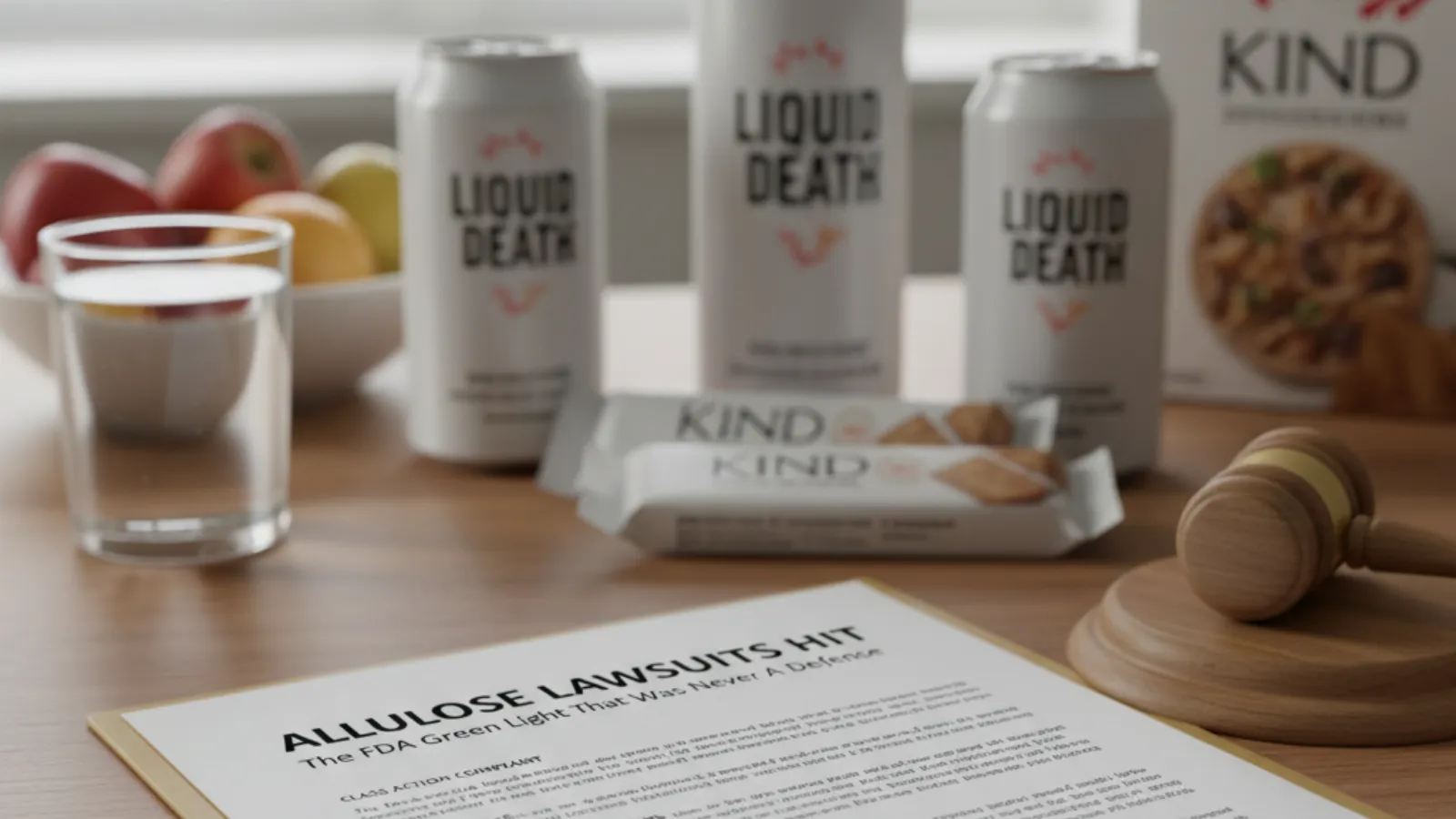
Five food and drinks brands were sued in one week over zero sugar claims on packs sweetened with allulose. The FDA said it would not act on the back panel, and it never changed the rule on the front.
I will say this plainly. A promise not to enforce a rule leaves the rule exactly where it was. Chobani's Zero Sugar yogurt carries about 4 grams of allulose a serving. The line for a sugar free claim is half a gram.
That gap is now a legal problem for a growing list of food and drinks brands.
What the court actually decided
The case is Franco v Chobani. Two shoppers, Jason and Abigail Franco, bought Chobani Zero Sugar yogurt at a Costco near Chicago. They sued in May 2023. They said the front of the pack was false, because each serving held about 4 grams of allulose.
A district court threw the case out in 2025. Its logic was simple. The FDA had told firms they could leave allulose off the Nutrition Facts panel. Federal rules therefore blocked the state claims.
On 27 July 2026 the Seventh Circuit reversed that. The FDA filed its own view with the court and sided with the shoppers. The rule counts every simple sugar as sugar, and allulose is one. So a food cannot be sold as sugar free with more than half a gram in it.
Five brands in one week
The lawyers moved fast. On 24 August a shopper sued Liquid Death over the 0g Sugar line on its Sparkling Energy cans. Those cans hold about 2 grams of allulose. The same day, WK Kellogg was sued over a Zero Added Sugar claim on Special K. The maker of David protein bars was sued on that date too.
On 28 August it was KIND, over a Zero Added Sugar claim on four of its bars. KIND has been owned by Mars since 2020. Liquid IV has been named as well. The complaints read like copies of each other, because they are.
The rule the FDA never touched
In 2020 the FDA gave the trade a pass. Firms could leave allulose out of the sugar lines on the back panel. It also let them count 0.4 calories a gram. That guidance covered the Nutrition Facts panel and nothing else.
It never touched the front of the pack, where the money is. The rule on a sugar free claim sat untouched the whole time. So the back of a pack can be right and the front of the same pack wrong.
Firms read a green light on one panel as cover for the other. Lawyers at Morrison Foerster now tell clients the plain version. A choice not to act is no shelter from a private suit.
The maths does not work
Here is the part that makes this hard to fix. Allulose is a bulk sweetener, so it goes into a recipe by the gram. It does the work of sugar by weight. That is why product teams like it.
Chobani used about 4 grams. Liquid Death used about 2. The line in the rule is half a gram. That is eight times over and four times over. Nobody lands on those numbers by a rounding slip.
The fix is a different sweetener, and that changes the taste and the feel in the mouth. Those are the two things allulose was bought for. A brand that swaps it out gives up the reason it paid more.
What sold the pack now proves the case
The Liquid Death complaint leans on a 2021 survey by the International Food Information Council. Only 15% of people asked had ever heard of allulose. The argument is that shoppers trust the front of the pack rather than the small print.
Read that a second time. The same low awareness is what made the front claim worth printing. A shopper who cannot name the sweetener sees Zero Sugar and pays more for it. The gap in knowledge that sold the pack is now the proof that it misled.
Where this goes next
The Chobani ruling binds federal courts in three states. Illinois, Indiana and Wisconsin. Yet the new cases were filed in California and New York. Lawyers are treating the ruling as a template rather than a limit.
Two of the new suits go further. They attack Zero Added Sugar, which sits under a separate part of the rule. The Chobani ruling did not settle that part at all. Plaintiffs are already pushing past the ground they won.
The FDA could write a new rule and end the fight. It has had six years since the 2020 guidance and has not done it. For anyone selling a pack with a sugar claim on the front, waiting on Washington is a poor plan. Count the grams. Check every front panel against the rule. Price the risk before a court prices it for you.

Global Aseptic Packaging Market Report 2026
148.4bn litres and 344bn packs in 2025. Aseptic volumes across dairy, dairy alternatives, beverages and food in 39 markets — 2025 actuals and forecasts to 2030. Buy online and receive it within 24 hours.
More information
Global Cheese Database 2026
Production, imports, exports and consumption for 39 cheese types across 48 countries, with actuals through 2025 and forecasts to 2030. Join the waitlist for early access, pre-launch pricing and a free sample country chapter.
Get early accessStrategic Insights
📊 Analytics & Strategic Insight
The front of the pack is a legal document, and most firms treat it as art
The decision most in this industry are avoiding:
👉 Guidance is not law. A regulator saying it will not act is a comfort letter. It leaves the rule where it was, and it binds no state court.
👉 The claim is the product. Firms did not buy allulose for taste alone. They bought the right to print Zero Sugar. That right is what is now in play.
👉 A recipe change is a legal event. Most firms sign off a new sweetener in the lab and the plant. The pack claim it unlocks rarely gets the same review.
Here's the full context:
→ 2020: The FDA says it will not act on firms leaving allulose off the sugar lines on the back panel.
→ 2023: Two shoppers sue Chobani over Zero Sugar yogurt holding about 4 grams of allulose.
→ 2025: A district court throws the case out. It reads the guidance as cover.
→ July 2026: The Seventh Circuit reverses. The FDA tells the court its own rule counts allulose as sugar.
→ Most recent: Five brands were sued in the last week of August. Liquid Death, WK Kellogg, KIND, David and Liquid IV were all named.
What this means for food and beverage operators and investors:
✅ Sugar cuts now carry a legal price. The board was sold a health win. Part of that win was a pack claim that may not hold.
✅ The risk runs across the whole range. Any pack, web page or shop listing with a sugar claim is in scope. Most firms cannot list them in a day.
✅ Own label carries it too. Shops copied the same claims onto their own packs. The buyer who asked for it holds the risk.
3 moves you can make this week:
1️⃣ List every pack with a sugar claim. Include the label, the web page, the shop listing and the ads. You cannot price a risk you have not counted.
2️⃣ Check the grams against the rule. Half a gram a serving is the line for sugar free. Zero added sugar sits under a separate line.
3️⃣ Ask what the claim is worth. If the claim goes, does the sweetener still pay for itself? That answer decides whether you fight or change the recipe.
Take the Next Step
🧭 Got a project in mind?
Send us your thoughts and project requirements and our consultants will build you a project plan.
→ Start a project enquiry
Zenith Consulting
Submit your food & beverage project enquiry.
Share your requirements. If there is a strong fit, we’ll come back with an indicative investment range, project timeline and recommended strategic approach.
Reviewed by Zenith Consulting’s senior food & beverage strategy team.
Related analyses
- Health, Nutrition & Functional
Sports And Energy Drinks Reach 39,180 Million Litres, And Aseptic Filling Has Almost None Of It
Sports and energy drinks are the fastest growing group on the world drinks shelf at 39,180 million litres in 2025, up 7.2% a year since 2020. Zenith's Global Aseptic Packaging Market Report 2026 books just 100 million litres of the United States total as aseptic.
Read analysis → - Health, Nutrition & Functional
Dreher Adds A 12,000 Carton An Hour Elopak Aseptic Line Into A German Juice Market Down To 1,915 Million Litres
Dreher Group has started filling its own aseptic cartons at Stockach on an Elopak E-PS120AH running up to 12,000 cartons an hour. It joins a German market where Zenith's own data shows aseptic volume falling 2.6% a year and juices and nectars down to 1,915 million litres.
Read analysis → - Corporate Strategy & Portfolio
FDA Clears Salt Substitutes In 41 Cheese Standards, And The Last Sodium Push Moved The Median Just 3%
The FDA has opened 41 cheese standards to salt substitutes, with the rule effective 14 December 2026. The cheese part can still be objected to until 12 November, and the last US sodium push moved the median by 3%.
Read analysis →
Share it with your peers
Pass this analysis to colleagues who track the food and beverage market.
Zenith Market Intel
Need a specific food or beverage market report?
Tell us which category, region or question would be useful for your team.
Sister Publication
Also follow our Water Dispense Market Intelligence
Category analyses, operator briefings, and investor signals across the global water dispense market.