Dreher Adds A 12,000 Carton An Hour Elopak Aseptic Line Into A German Juice Market Down To 1,915 Million Litres
Dreher Group has started filling its own aseptic cartons at Stockach on an Elopak E-PS120AH running up to 12,000 cartons an hour. It joins a German market where Zenith's own data shows aseptic volume falling 2.6% a year and juices and nectars down to 1,915 million litres.
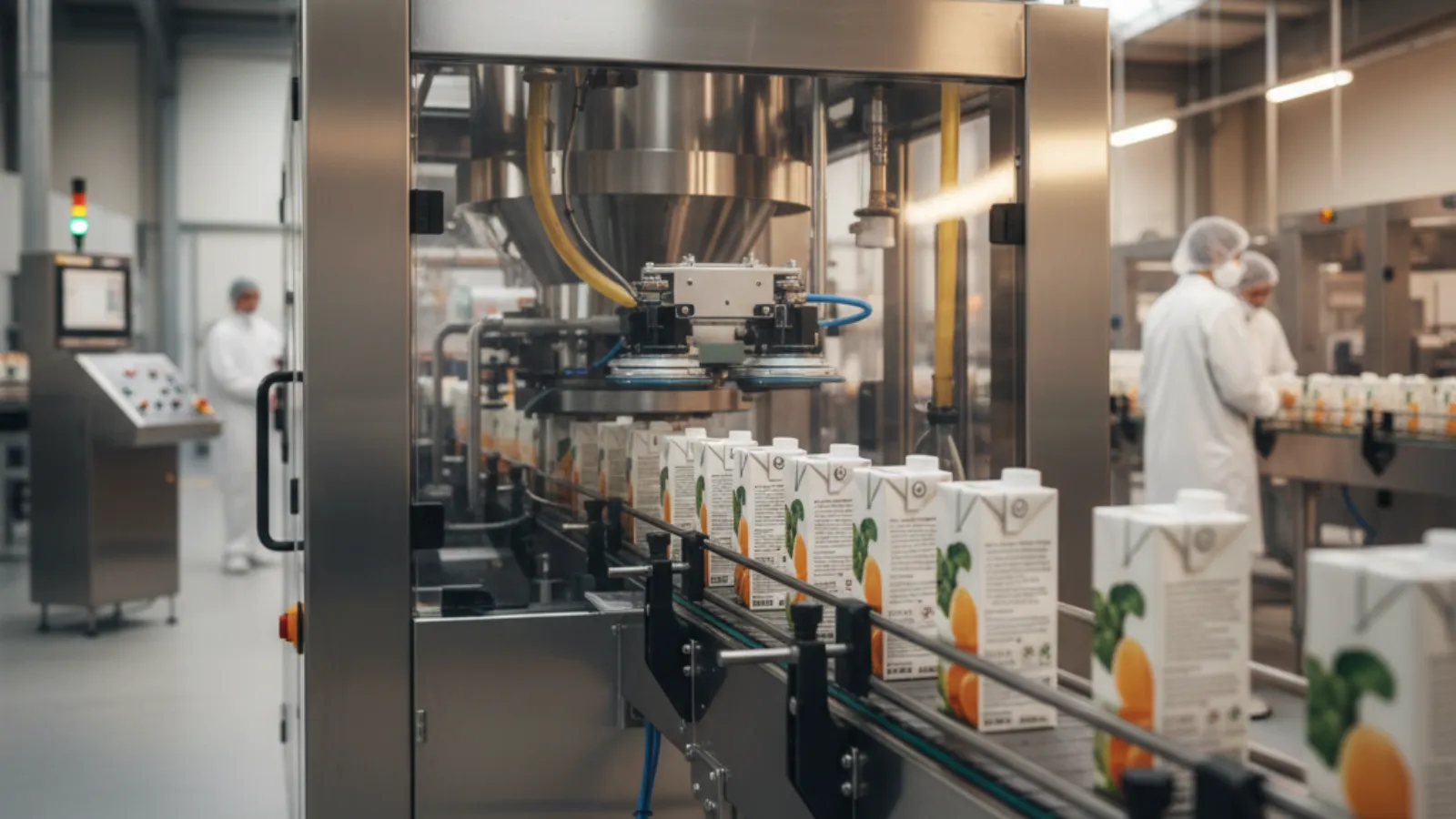
I would ask any juice board the same question. Do you own the filling line, or do you rent it? Dreher has answered it with an Elopak machine that runs up to 12,000 cartons an hour.
What Dreher has installed at Stockach
Dreher Group sits at Stockach on Lake Constance and has made fruit juice since 1924. The family firm sold juice bases, oat bases, concentrates and purees to other makers. Now it fills finished packs itself. The new line is an Elopak E-PS120AH and it runs up to 12,000 cartons an hour. Pack sizes run from 500 ml to 1,000 ml. It fills several Pure-Pak shapes from pre-printed blanks. Elopak supplied the machine and pulled the other suppliers together. Juice goes into the Pure-Pak Sense Aseptic carton. The site also runs the eSense version, which drops the aluminium layer for a polymer barrier. Dreher works two shifts and sold commercial output a week after start-up. The floor was laid out to take a second Elopak filler.
The German market that line fills into
Our Global Aseptic Packaging Market Report 2026 sizes what the machine is joining. German makers filled 6.6 billion litres aseptically in 2025, in 9.5 billion packs. The figure was 7,564 million litres in 2020. It has fallen 2.6% a year since then. The model takes it to 6,258 million litres by 2030. Cartons hold 60.3% of that volume and 53.1% of the packs. The average German aseptic pack holds 698 ml. That is among the largest in the study. Family cartons of H-Milch and juice carry most of it.
Juice is the category losing the litres
German juices and nectars came to 1,915 million litres in 2025, down 4.6% a year. Juice drinks hold another 1,170 million litres. Juice drinking has fallen from 31.5 litres a head in 2018 to 22.5 litres in 2025. That series is the fruit juice trade body's own. Two rising lines pull the other way. Ready-to-drink tea and coffee grows 5.0% a year and sports and energy drinks 11.6%. Together they added 340 million litres between 2020 and 2025. Juices and nectars lost 505 million over the same years.
Hot fill and preservatives are taking the shelf
German long-life drinks hold 4,100 million litres and stay flat to 2030. Aseptic filling is 2,758 million litres of that today. Its share of the shelf has slid from 79.7% in 2020 to 67.3%. The model puts it at 60.8% by 2030. Hot filling has gone the other way to 806 million litres. It grew 5.9% a year across the review period. Preservative filling reached 536 million litres and grew 13.7% a year. Family cartons of ambient drinks fall 4.1% a year to 783 million litres by 2030. So Dreher has bought into the part of the shelf that is shrinking fastest.
Why a juice group still buys its own filler
German ambient juice filling is a cold-aseptic PET business and the evidence is direct. riha WeserGold fills about 900 million litres a year and calls itself the leader in cold-aseptic PET. Eckes-Granini runs Krones dry-aseptic lines at Bad Fallingbostel. Valensina fills cold aseptic at Vechta. Gropper added Krones dry-aseptic capacity in 2018 and 2019. Co-packers fill more than half of German discounter juice volume. So a small number of sites set the pack and the technology for a large share of the shelf. Dreher sold juice bases into that system for years. Owning a filler moves the firm up the chain.
Oat drinks are the other reason to own a carton filler. German plant-based output rose from 190 million litres in 2020 to 290 million in 2025. The model takes it to 365 million by 2030. Dreher already sells oat bases, so filling them is a short step. The eSense carton matters here as well. It drops the aluminium layer, which helps where packaging rules reward simpler material.
What this means for the market
Germany is unattractive on volume and nobody should pretend otherwise. Aseptic litres fall 2.0% a year to 2030 on our model. Carton litres fall faster still. An entrant reading the national total would stay out. The money here sits somewhere else. Own-label juice and oat drinks need carton capacity that few German firms hold. More than half of discounter juice runs through co-packers. So filling capacity is the scarce asset rather than demand. The thing worth testing before any spend is the contract book. A 12,000 carton an hour line needs volume signed, and Germany has no spare growth to supply it.
For fillers and suppliers, the important question is now where carton capacity still earns a return in a falling market. Pack type and filling technology answer that market by market. Our Global Aseptic Packaging Market Report 2026 splits all 39 markets both ways. A free 40-page sample sits on the page.
Global Aseptic Packaging Market Report 2026
148.4bn litres and 344bn packs in 2025. Aseptic volumes across dairy, dairy alternatives, beverages and food in 39 markets — 2025 actuals and forecasts to 2030. Buy online and receive it within 24 hours.
More information
Global Cheese Database 2026
Production, imports, exports and consumption for 39 cheese types across 48 countries, with actuals through 2025 and forecasts to 2030. Join the waitlist for early access, pre-launch pricing and a free sample country chapter.
Get early accessStrategic Insights
📊 Analytics & Strategic Insight
Capacity is being added to the fastest shrinking part of the German shelf
The decision most in this industry are avoiding:
👉 A falling market can still be short of capacity. Most reading of a story like this pairs investment with growth. German carton filling is scarce while the litres keep falling.
👉 The pack choice here runs against the country. German ambient juice filling is a cold-aseptic PET business. Dreher went to carton anyway.
👉 Own-label volume decides this line rather than category demand. More than half of German discounter juice runs through co-packers. That book is what is worth counting.
Here's the full context:
→ 2018: Germans drink 31.5 litres of juice a head. Gropper adds Krones dry-aseptic capacity in the same window.
→ 2020: German aseptic volume peaks at 7,564 million litres. Aseptic holds 79.7% of the long-life drinks shelf.
→ 2022: The single-use deposit reaches juice and soft-drink PET bottles. Beverage cartons stay outside the system.
→ 2025: Juice drinking falls to 22.5 litres a head. The aseptic share of the shelf is down to 67.3%.
→ Most recent: Dreher starts its own aseptic carton line. It runs up to 12,000 cartons an hour.
What this means for aseptic fillers, converters and equipment suppliers:
✅ German carton filling is worth more than the volume trend suggests. Few own-label fillers hold it. The ones that do can price it.
✅ Equipment makers should sell ownership and replacement rather than growth. German litres fall 2.0% a year to 2030. The orders come from firms moving filling in-house.
✅ Aluminium-free board demand rises while carton litres fall. Dreher runs the eSense build on the same line. Material buyers should plan for both at once.
What this means for market decisions:
1️⃣ Germany looks poor on litres and tight on carton capacity. Those two facts point in opposite directions. Only one of them is priced today.
2️⃣ Elopak wins a German filling customer that held no aseptic line before. Tetra Pak and SIG convert board in Germany already. The machine order is where position moves.
3️⃣ An entrant should count own-label contracts before counting litres. Find which discounter volume is co-packed today. Then ask who fills it and on what pack.
The Zenith view:
A new line proves that someone wants German carton capacity. It does not prove that German carton volume has turned. Two things decide this case. Whether own-label juice stays in carton, and whether oat drinks grow fast enough to fill the gap.
The data behind this story
📦 Global Aseptic Packaging Market Report 2026
148.4 billion litres and 344 billion packs across 39 markets, split by category, pack type and pack size, with 2025 actuals and forecasts to 2030. A free 40-page sample is on the page.
→ Read the free sample
Evaluating Germany or another European aseptic market? Zenith helps food and beverage companies assess market size, growth, competitors, pricing and route to market before they invest.
→ Discuss your market
Zenith Consulting
Submit your food & beverage project enquiry.
Share your requirements. If there is a strong fit, we’ll come back with an indicative investment range, project timeline and recommended strategic approach.
Reviewed by Zenith Consulting’s senior food & beverage strategy team.
Related analyses
- Health, Nutrition & Functional
SIG Targets 85% Paper In Aseptic Cartons: Aluminium-Free Still Has Enormous Room To Scale
SIG says it is working towards 85% paper content in its aseptic cartons, with polymer and fibre barriers doing the work aluminium used to do. Set against the 344 billion aseptic packs filled worldwide in 2025, the aluminium-free carton is still a rounding error.
Read analysis → - Health, Nutrition & Functional
Saputo Creates A Dairy Ingredients Division: Cheese Plants Are Now Judged On Their Whey
Saputo has split dairy ingredients into its own division under Steve Douglas. US cheese output rose 2.1% in July while whey protein concentrate output fell 2.3%.
Read analysis → - Health, Nutrition & Functional
Fonterra Puts NZ$1 Billion Into Protein While New Zealand Ships 415,012 Tonnes Of Cheese
Fonterra committed NZ$1 billion to South Island protein plants on 24 September. New Zealand exported 415,012 tonnes of cheese in 2025, about 97% of everything it made, with China taking 30%.
Read analysis →
Share it with your peers
Pass this analysis to colleagues who track the food and beverage market.
Zenith Market Intel
Need a specific food or beverage market report?
Tell us which category, region or question would be useful for your team.
Sister Publication
Also follow our Water Dispense Market Intelligence
Category analyses, operator briefings, and investor signals across the global water dispense market.