SIG Targets 85% Paper In Aseptic Cartons: Aluminium-Free Still Has Enormous Room To Scale
SIG says it is working towards 85% paper content in its aseptic cartons, with polymer and fibre barriers doing the work aluminium used to do. Set against the 344 billion aseptic packs filled worldwide in 2025, the aluminium-free carton is still a rounding error.
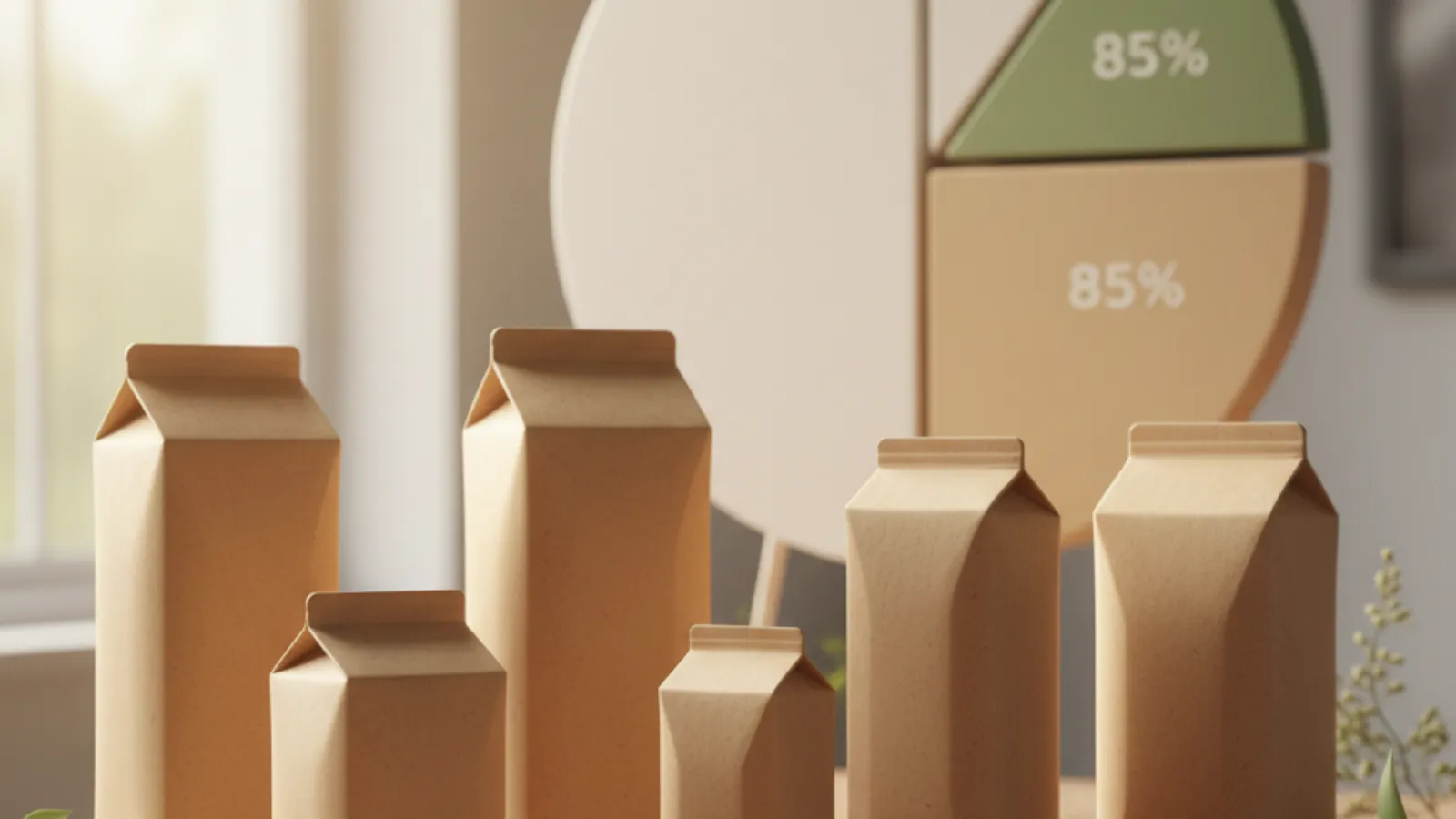
I will say this plainly. The aluminium-free aseptic carton is a supply question rather than a technology question. SIG now says it is working towards 85% paper content in the pack. It has sold more than 5 billion packs with no aluminium layer since 2010. Zenith's Global Aseptic Packaging Market Report 2026 counts 344 billion aseptic packs filled in 2025 alone.
What SIG said this week
SIG set out its material plans in an interview published on 30 September. Gavin Steiner, the group's chief technology officer, said the 85% paper objective had been met. The next target is at least 90% paper content by 2030. That later figure counts the closure. The 85% does not.
Steiner also pointed at the rules. He said regulation is shaping how the trade behaves and levelling the ground for everyone. Demand is strongest in dairy, plant drinks, protein drinks, sauces, desserts and nutrition packs. Pouch and bag-in-box filling are the formats gaining ground.
What comes out of the carton
A standard aseptic carton holds three main materials. Paper carries the structure and polymer keeps the liquid in. A thin aluminium foil blocks oxygen and light. SIG cut that to two main materials in its full barrier pack. Polymer layers now do the oxygen work. Light is handled by fibre direction and by colours that soak it up.
The carbon sums are what make this worth doing. SIG says aluminium is about 5% of a carton by weight. Aluminium carries roughly 25% of the carbon footprint of a full barrier pack. Taking it out cuts that footprint by up to 61% when forest-based polymers go in too.
The number that puts it in scale
Zenith's report puts world aseptic volume at 148.4 billion litres in 2025. Cartons carry 66.5% of that. The more than 5 billion alu-free packs sold since 2010 are roughly 1.5% of one year's world packs. That is my own sum off the two published figures.
The split by product shows where the volume sits. Cartons carry 91.8% of the world's UHT white milk, on Zenith's figures. That is 52.7 billion litres of milk packed in 2025. Juice and plant drinks need the tougher barrier. That version only reached multi-serve packs in 2025.
Why the filling line is the easy part
The material runs on filling machines that are already installed. SIG says the swap needs minor changes and little money. Small packs run at up to 24,000 an hour. Multi-serve packs run at up to 15,000 an hour. No new line is needed to make the switch.
That is the part most coverage misses. A format change that needs a new filler moves at the speed of machine spending. A material change that runs on the old filler moves at the speed of board supply. Those are very different clocks.
The last five points sit in the cap
Getting from 85% to 90% means solving the closure. SIG has worked with Pulpac since 2025 on a dry moulded fibre cap and base. The closure is the one part of the pack nobody has made from paper at scale. It is also the part a filling machine applies last.
Tetra Pak is moving the same way. It put EUR 60 million into a pilot plant at Lund in Sweden for paper-based barriers. Its own 1 litre paper barrier carton reached shelves with Sterilgarda in Italy. Two of the big carton houses now point at the same structure.
What this means for the market
Most packaging plans treat this as a brand choice. The sharper read is a material supply question. An entrant should ask who can supply alu-free board into its market, and at what volume. The category mix sets the timetable. A market whose aseptic cartons are mostly UHT milk converts earlier than one built on juice.
One supplier's material change rarely moves a world market on its own. What matters is whether the same switch shows up across countries and categories. Our Global Aseptic Packaging Market Report 2026 sizes carton volume across 39 markets by category and pack size. That is the base you need to see how far a material change can travel.
Global Aseptic Packaging Market Report 2026
148.4bn litres and 344bn packs in 2025. Aseptic volumes across dairy, dairy alternatives, beverages and food in 39 markets — 2025 actuals and forecasts to 2030. Buy online and receive it within 24 hours.
More information
Global Cheese Database 2026
Production, imports, exports and consumption for 39 cheese types across 48 countries, with actuals through 2025 and forecasts to 2030. Join the waitlist for early access, pre-launch pricing and a free sample country chapter.
Get early accessStrategic Insights
📊 Analytics & Strategic Insight
The material swap that needs no new filling line
The decision most in this industry are avoiding:
👉 The hard part is board supply rather than the barrier. The science is settled and already sold. Mills that can coat alu-free board at volume are the limit.
👉 A pack that runs on the installed filler changes the sums on conversion. With no new machine to buy, the switch becomes a buying decision.
👉 Fifteen years of alu-free packs equal about four days of world filling. That is the honest scale of the shift so far, on the two published totals.
Here's the full context:
→ 2010: SIG began selling aseptic cartons with no aluminium layer.
→ 2023: The alu-free full barrier pack went on sale in China.
→ 2024: SIG delivered its 3 billionth alu-free pack to European dairy.
→ 2025: The alu-free full barrier reached multi-serve cartons in May.
→ Most recent: SIG says the 85% paper target is met. The 90% goal needs the cap.
What this means for aseptic fillers, converters and equipment suppliers:
✅ Fillers can change material without buying a line. Minor work on an installed SIG machine holds 24,000 packs an hour.
✅ Converters face a board question rather than a machine question. Alu-free structures need coated board that few mills make at volume.
✅ Equipment makers lose a lever here. The pack changes and the filler does not, so the money moves to the material.
What this means for market decisions:
1️⃣ The reachable base is two thirds of the world market. Zenith puts cartons at 66.5% of 148.4 billion litres. That is what a material swap can touch.
2️⃣ SIG moves first and the board mills gain most. Tetra Pak is building the same route at Lund. Aluminium rollers lose a customer either way.
3️⃣ An entrant should test board supply in the target market. Ask which mill coats it, at what volume, and how long a switch takes to qualify.
The Zenith view:
This proves a supplier can take aluminium out and hold twelve months of shelf life. It does not prove the world's cartons will follow. What decides the case is how much alu-free board a market can buy.
The data behind this story
📦 Global Aseptic Packaging Market Report 2026
148.4 billion litres and 344 billion packs across 39 markets, split by category, pack type and pack size, with 2025 actuals and forecasts to 2030. A free 17-page sample is on the page.
→ Read the free sample
Evaluating an aseptic packaging market? Zenith helps food and beverage companies assess market size, growth, competitors, pricing and route to market before they invest.
→ Discuss your market
Zenith Consulting
Submit your food & beverage project enquiry.
Share your requirements. If there is a strong fit, we’ll come back with an indicative investment range, project timeline and recommended strategic approach.
Reviewed by Zenith Consulting’s senior food & beverage strategy team.
Related analyses
- Health, Nutrition & Functional
Dreher Adds A 12,000 Carton An Hour Elopak Aseptic Line Into A German Juice Market Down To 1,915 Million Litres
Dreher Group has started filling its own aseptic cartons at Stockach on an Elopak E-PS120AH running up to 12,000 cartons an hour. It joins a German market where Zenith's own data shows aseptic volume falling 2.6% a year and juices and nectars down to 1,915 million litres.
Read analysis → - Health, Nutrition & Functional
Saputo Creates A Dairy Ingredients Division: Cheese Plants Are Now Judged On Their Whey
Saputo has split dairy ingredients into its own division under Steve Douglas. US cheese output rose 2.1% in July while whey protein concentrate output fell 2.3%.
Read analysis → - Health, Nutrition & Functional
Fonterra Puts NZ$1 Billion Into Protein While New Zealand Ships 415,012 Tonnes Of Cheese
Fonterra committed NZ$1 billion to South Island protein plants on 24 September. New Zealand exported 415,012 tonnes of cheese in 2025, about 97% of everything it made, with China taking 30%.
Read analysis →
Share it with your peers
Pass this analysis to colleagues who track the food and beverage market.
Zenith Market Intel
Need a specific food or beverage market report?
Tell us which category, region or question would be useful for your team.
Sister Publication
Also follow our Water Dispense Market Intelligence
Category analyses, operator briefings, and investor signals across the global water dispense market.