Spain Swaps HDPE Milk Bottles For Aseptic PET: 170 Million Litres Left And Only Three Aseptic PET Dairy Lines
Spanish UHT milk in large HDPE bottles fell from 307 million litres in 2020 to 170 million in 2025, and Zenith's model takes it to 88.5 million by 2030. Aseptic PET is taking the volume, and only three aseptic PET dairy lines have been documented in the country.
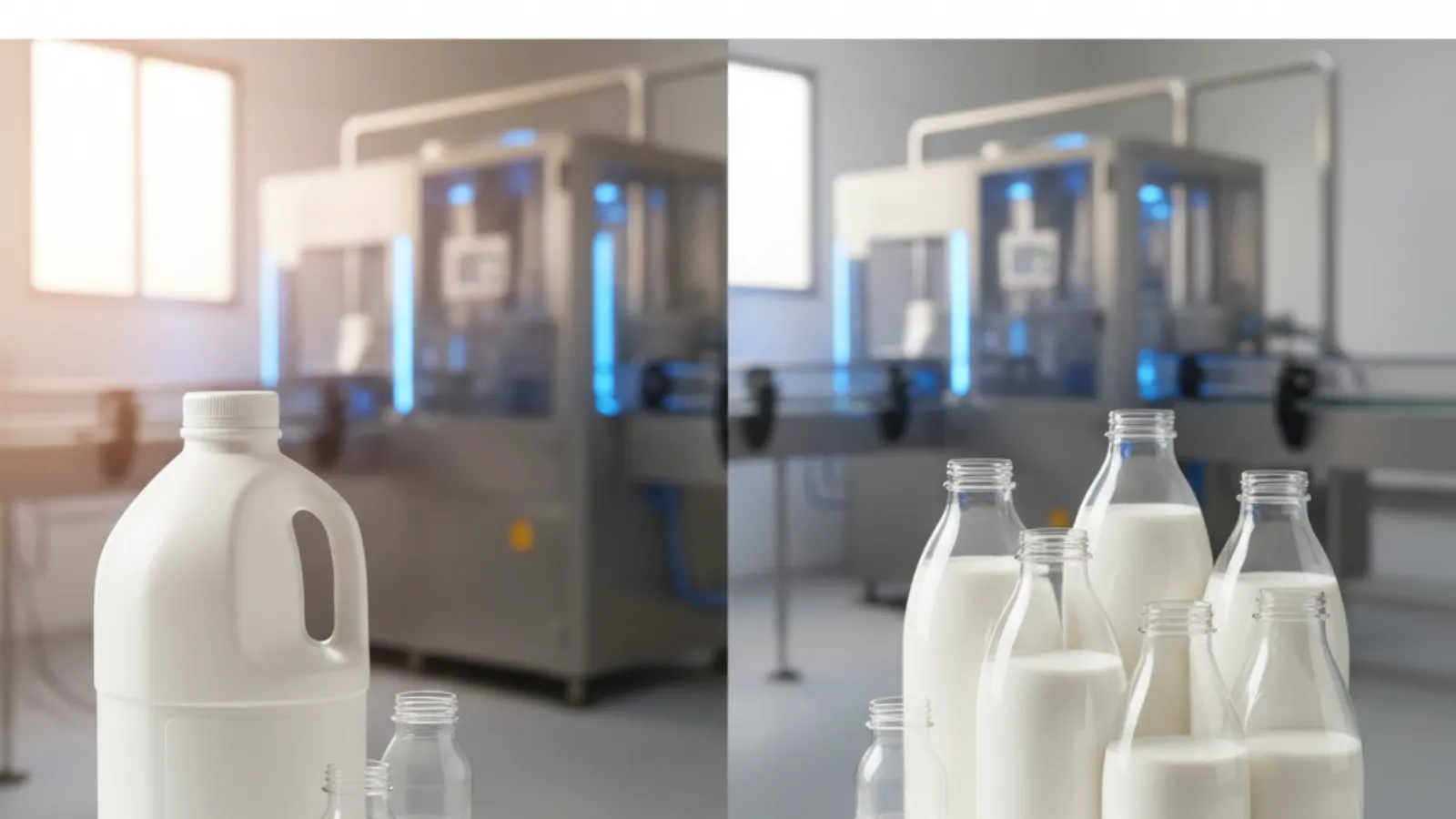
I keep seeing the same ending for the plastic milk bottle. It almost never loses to the carton. In Spain it has given up 137 million litres since 2020, and the aseptic PET bottle took the volume.
What the Spanish bottle numbers show
Zenith's Global Aseptic Packaging Market Report 2026 puts Spain at 5,173 million litres filled aseptically in 2025. The count was 7,144 million packs. That is an average pack of 724 ml. UHT white milk is the largest block at 3,085 million litres, or 59.6% of the total. Inside that block, large HDPE bottles fell from 307 million litres in 2020 to 170 million in 2025. The rate is 11.2% a year. The model takes the line down again to 88.5 million litres by 2030. Large aseptic PET bottles went the other way. They rose from 61.4 million litres in 2020 to 139 million in 2025. That is 17.7% a year. The model reaches 192 million litres by 2030.
Cartons gain while the bottle changes hands
The easy read is that Spanish shoppers are moving from plastic to card. The numbers say something else. Family cartons hold 87.5% of aseptic white milk litres in 2025, up from 86.7% in 2020. Add portion packs and cartons carry 89.5% of the category. Household panel work by the Spanish agriculture ministry points the same way. The carton took 88.4% of liquid milk volume in the year to November 2024. It reached 89.2% a year later. The plastic bottle held 10.4% and fell 8.8% in a year. So the carton is steady. The whole swap happens inside the bottle tier.
Three aseptic PET dairy lines, and no more
Spain's aseptic bottle business is small enough to name. Sidel installed an Aseptic Combi Predis at Andia Lacteos and Iparlat in 2020. It runs at 9,000 bottles an hour. A second unit went to the same group later. A complete aseptic PET line started at COVAP in Cordoba in 2021, at up to 13,200 bottles an hour. That line fills about 30 million bottles a year of 1.5 litre UHT milk. Three documented lines carry the whole switch out of HDPE. Every other Spanish dairy bottle is hot filled, preserved or blown from HDPE.
The same pattern sits in the world table
Spain is the sharp case, and it is not the only one. Cartons carry 91.8% of world aseptic UHT milk. Large HDPE bottles are down to 1,595 million litres. They fall 5.6% a year. The report takes that line to 1,363 million litres by 2030. Large PET in UHT milk grows 10.4% a year to 623 million litres. Small PET grows 16.7% a year to 78.2 million. HDPE across the whole aseptic market is 2,326 million litres out of 148,353 million. It is the smallest format with the steepest decline.
Who pays for the swap in Spain
Own label took about 60% of Spanish milk volume by 2023. The share was about 45% in 2019. Most of that move came in the two inflation years. CAPSA Food, with Central Lechera Asturiana, is the largest branded processor at 16.3% of milk volume. COVAP passed a thousand million euros of revenue on the back of its Mercadona and Hacendado supply. Own label sets the pack cost, so the pack has to be cheap to run. Spain has one liquid carton converting plant, Tetra Pak Envases at Arganda del Rey. A closures plant at Alcala de Guadaira has taken 51.6 million euros for tethered caps.
Spain is still a one litre brik market. The average aseptic white milk pack was 947 ml in 2025 against 944 ml in 2020. Family cartons are 82.8% of aseptic white milk packs. The upsizing has happened in the bottle instead.
What this means for the market
A falling category can still hold a growing pack. Spanish aseptic milk goes from 3,410 million litres in 2020 to 3,085 million in 2025, then 2,950 million by 2030. On that line alone a supplier would stay out. The pack mix tells a different story, because large PET is the only rising format in Spanish milk. Position in this market now follows the filler. Three groups own the growing format. Everyone else sells cartons or runs HDPE on borrowed time. An entrant should count installed aseptic PET dairy lines before it prices demand. Ask how much of the 192 million litre forecast already has a filler behind it. Then ask who would pay for the rest.
One market rarely moves a pack format on its own. What matters is whether the same swap is turning up in other countries. Our Global Aseptic Packaging Market Report 2026 splits all 39 markets by pack type and pack size. It carries HDPE, PET, carton, pouch and bag in box volumes in litres and in packs. Actuals run to 2025 and forecasts to 2030. A free 40 page sample sits on the page.
Global Aseptic Packaging Market Report 2026
148.4bn litres and 344bn packs in 2025. Aseptic volumes across dairy, dairy alternatives, beverages and food in 39 markets — 2025 actuals and forecasts to 2030. Buy online and receive it within 24 hours.
More information
Global Cheese Database 2026
Production, imports, exports and consumption for 39 cheese types across 48 countries, with actuals through 2025 and forecasts to 2030. Join the waitlist for early access, pre-launch pricing and a free sample country chapter.
Get early accessStrategic Insights
📊 Analytics & Strategic Insight
Spain's milk bottle is converting to aseptic PET while the carton holds its ground
The decision most in this industry are avoiding:
👉 The carton is barely in this fight. It holds 87.5% of aseptic white milk litres and gains share in the panel data. The whole move happens inside the bottle tier.
👉 Falling litres and a fast rising format sit side by side. Spanish aseptic milk drops 2.0% a year. Large PET inside it rises 17.7% a year.
👉 An HDPE exit is a filling decision before it is a shopper one. Blow moulding and aseptic PET need different kit and different validation. The bottler picks the date.
Here's the full context:
→ 2020: Spain fills 5,361 million litres aseptically. Large HDPE milk bottles hold 307 million litres of it.
→ 2020: Sidel installs an Aseptic Combi Predis at Andia Lacteos and Iparlat at 9,000 bottles an hour.
→ 2021: COVAP starts a complete aseptic PET line at Cordoba, at up to 13,200 bottles an hour.
→ 2023: Own label reaches about 60% of Spanish milk volume, from about 45% in 2019.
→ Most recent: Large HDPE milk bottles are down to 170 million litres. Zenith's model takes them to 88.5 million by 2030.
What this means for aseptic fillers, converters and equipment suppliers:
✅ Spain is a live aseptic PET dairy market with very few lines. Three installations carry 139 million litres today. The 2030 figure is 192 million.
✅ HDPE blow moulding in Spanish milk has a visible end date. The line halves again by 2030. Spare blowing and filling capacity comes free with it.
✅ Carton demand in Spanish milk is steady rather than slipping. Family cartons hold 87.5% of aseptic litres, and one converting plant serves the country.
What this means for market decisions:
1️⃣ Market appeal in Spain sits in the pack mix rather than the volume. Total aseptic litres fall 0.1% a year to 2030. Large PET rises 4.9% a year.
2️⃣ Three line owners hold the only growing milk pack. Andia Lacteos, Iparlat and COVAP fill it. Everyone else sells cartons or blows HDPE.
3️⃣ An entrant should count lines before it prices demand. Ask how much of the 192 million litre forecast already has a filler. Then ask who would build the rest.
The Zenith view:
A falling milk market does not prove that pack investment is wrong in Spain. It proves that the growth has moved inside the pack mix. One question decides the case here. How many aseptic PET dairy lines does Spain need by 2030, and who is going to own them.
The data behind this story
📦 Global Aseptic Packaging Market Report 2026
148.4 billion litres and 344 billion packs across 39 markets, split by category, pack type and pack size, with 2025 actuals and forecasts to 2030. A free 40-page sample is on the page.
→ Read the free sample
Evaluating a milk market or a pack format switch? Zenith helps food and beverage companies assess market size, growth, competitors, pricing and route to market before they invest.
→ Discuss your market
Zenith Consulting
Submit your food & beverage project enquiry.
Share your requirements. If there is a strong fit, we’ll come back with an indicative investment range, project timeline and recommended strategic approach.
Reviewed by Zenith Consulting’s senior food & beverage strategy team.
Related analyses
- Corporate Strategy & Portfolio
Oji Liquid Pak's USD 110 Million Vietnam Aseptic Carton Plant Adds 8 Billion Packs To A Region Already At 62 Billion
Oji Liquid Pak broke ground on a USD 110 million aseptic carton material plant in Dong Nai, rated at up to 8 billion packs a year from 2028. Zenith puts Vietnam at 10,358.7 million aseptic packs in 2025, and South East Asia already holds about 62 billion packs of documented converting capacity.
Read analysis → - Corporate Strategy & Portfolio
US Parmesan Output Jumps 25.9% While Cheddar Slips: Italian Cheese Takes Four In Five Pounds Of Growth
USDA figures published on 5 October show US Parmesan output up 25.9% in August while cheddar fell 0.9%. Italian types have supplied nearly four in every five pounds of US cheese growth so far in 2026.
Read analysis → - Corporate Strategy & Portfolio
China Lists All Five Cheese Tariff Codes For US Imports While EU Cheese Pays Up To 11.7%
China has put all five cheese tariff codes on its list of US goods for lower duty, published with the new US-China Board of Trade on 27 September. EU cheese entering the same market pays anti-subsidy duty of up to 11.7%, and New Zealand still holds 61% of the tonnage.
Read analysis →
Share it with your peers
Pass this analysis to colleagues who track the food and beverage market.
Zenith Market Intel
Need a specific food or beverage market report?
Tell us which category, region or question would be useful for your team.
Sister Publication
Also follow our Water Dispense Market Intelligence
Category analyses, operator briefings, and investor signals across the global water dispense market.