Cyclospora Outbreak Pulls $280m A Month From US Produce As 80 Acres And Revol Greens Cut Jobs
A Cyclospora outbreak tied to Taylor Farms iceberg lettuce has taken more than 6.5 million US homes out of the salad aisle and put about $280 million of monthly produce spend at risk. The money is not moving to canned or frozen, and two indoor growers with no link to the outbreak are cutting jobs.
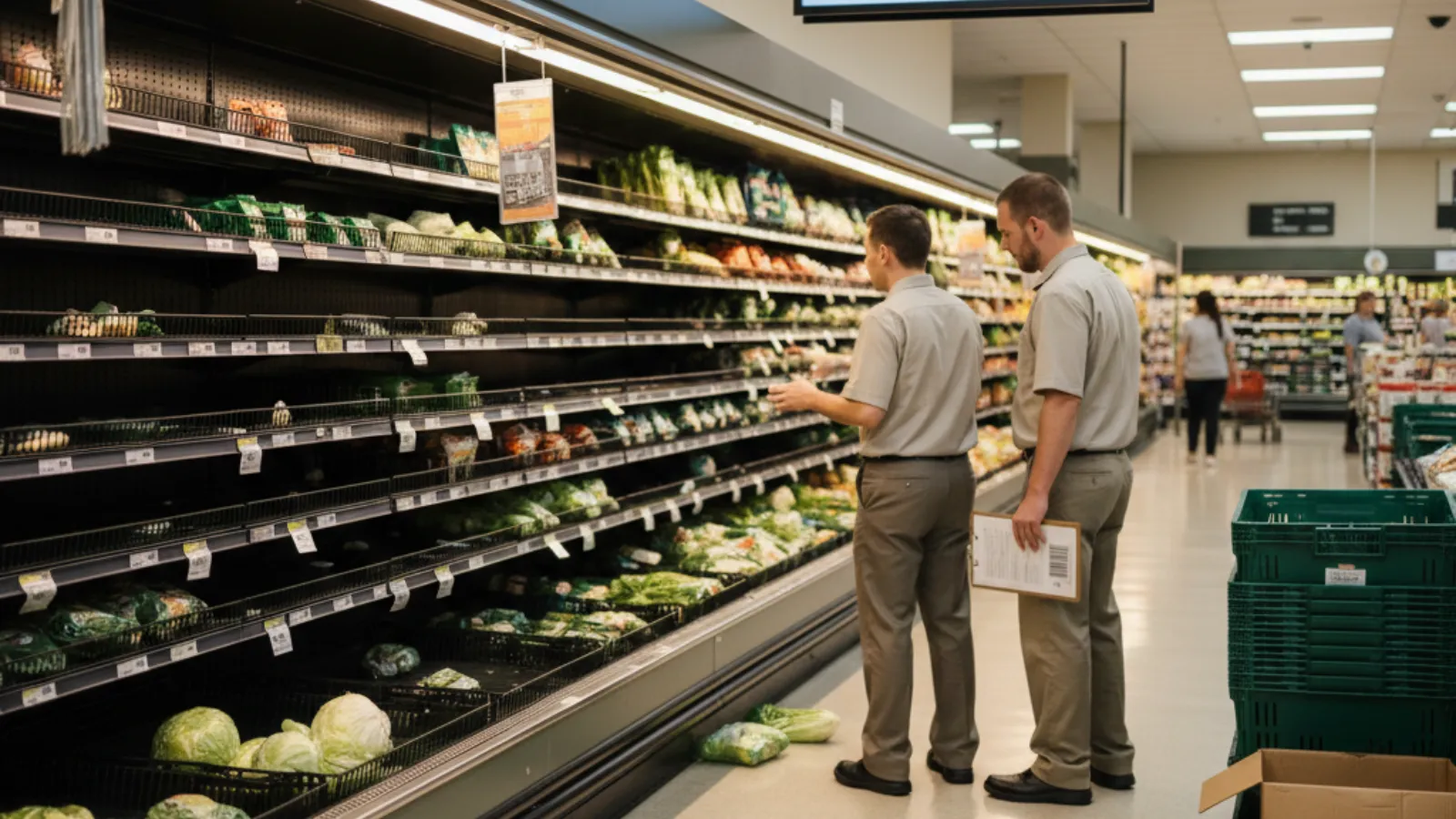
The one thing I keep asking food bosses is this. Who pays when the fault sits somewhere else? Two indoor lettuce farms had no link to this outbreak. One is cutting 166 jobs. The other has put 116 more on the line.
The CDC counts 11,458 cases in the US Cyclospora outbreak. It reports 495 people sent to a ward, two deaths and 20 states. The trigger was iceberg lettuce from Taylor Farms de Mexico. The damage at the till has spread much wider than that one supply line.
Shoppers left the aisle, and they left fast
Numerator put figures on it in data released on 19 August. More than 6.5 million US homes stopped buying salad mixes and kits in the month to 26 July. That is one month set against the month before it. Awareness of the outbreak now sits at 87% of produce shoppers.
More than a quarter of homes have stopped buying salads and fresh greens outright. One in ten have cut back what they spend there. Numerator puts about $280 million of monthly produce spend at risk for every month this runs.
The drop also tracks how close the cases are. In states with more than 200 reported cases, spend per home on salad mixes and kits fell 10.7%. Same month, same product, a steeper fall where the news felt local. The closer the cases, the harder the drop.
The swap to canned and frozen never happened
Here is the part the trade has missed. Nearly half of shoppers, 45%, said they had swapped fresh produce or planned to. The tills tell a different story. The share of homes buying canned veg rose 0.3 points. Frozen rose 0.1 points. Only canned saw more spend per home, up 3.2%.
The money did not move down the aisle. Most of it left the store. Any frozen or canned team that booked promo money against this scare got close to nothing back. A food safety event does not hand share to the aisle next door. It takes volume out of the basket.
The growers paying for a fault they did not make
80 Acres Farms will cut 166 jobs and close its San Antonio site, along with other US sites. Revol Greens may shut its Temple site in Texas, which puts 116 jobs on the line. It has set 4 October as the date it decides. Both grow lettuce indoors. Neither has any link to the field lettuce at the centre of this outbreak.
Both supplied H-E-B, which says its own produce section is holding up. Walmart pulled Taylor Farms iceberg lines from shelves in 15 states. No lab test has ever tied the bug to a bag of lettuce. The FDA named the source on tracing and case work. One early sample result was pulled back as a false alarm.
Trust in an aisle has no single owner
This is the bit boards keep getting wrong. A clean plant record protects your brand. It does not protect your aisle. Indoor growers sell on the promise that nothing touches open ground. That promise did not hold the volume when the news broke.
There is one number that should steady nerves. 82% of the shoppers who quit salad kits say they will buy them again once this is over. The loss looks like timing rather than a lasting shift. That changes what you should spend on now, and what you should hold back.
So the plan writes itself. Cash cover has to run the length of an outbreak you did not cause. Supply deals need a clause for a shelf pulled over someone else's recall. Price your safety spend against the whole aisle, because your own plant is only half the risk. The firms cutting jobs this month were the safest growers in the trade on paper. That is the lesson worth taking.

Global Aseptic Packaging Market Report 2026
148.4bn litres and 344bn packs in 2025. Aseptic volumes across dairy, dairy alternatives, beverages and food in 39 markets — 2025 actuals and forecasts to 2030. Buy online and receive it within 24 hours.
More information
Global Cheese Database 2026
Production, imports, exports and consumption for 39 cheese types across 48 countries, with actuals through 2025 and forecasts to 2030. Join the waitlist for early access, pre-launch pricing and a free sample country chapter.
Get early accessStrategic Insights
📊 Analytics & Strategic Insight
Why a scare in one aisle is a volume loss for the whole store
The decision most in this industry are avoiding:
👉 Your safety budget is set at the wrong level. Firms fund it to guard their own plant. This month the loss landed on farms with clean records.
👉 Nobody owns trust in an aisle, so nobody funds its defence. Trade bodies talk after the event. No one holds a pooled war chest for a scare they did not cause.
👉 The switch story is a myth, and buyers keep planning around it. Shoppers told the survey they would swap. The tills show that they mostly stayed away.
Here's the full context:
→ 14 July 2026: The CDC issues a health alert on the outbreak. Case counts start to climb fast.
→ 17 July 2026: Taylor Farms de Mexico recalls all iceberg lettuce grown in central Mexico. Walmart clears the lines in 15 states.
→ 20 July 2026: The FDA pulls back a sample result as a false alarm. It keeps Taylor Farms named on tracing work.
→ 14 August 2026: 80 Acres Farms confirms 166 job cuts and a San Antonio closure. Revol Greens sets 4 October for a call on Temple.
→ Most recent: The CDC put the count at 11,458 cases on 27 August. That is 495 ward cases, two deaths and 20 states.
What this means for food and beverage operators and investors:
✅ Model the aisle rather than your own plant. Your worst month can be set by a rival's field. Build that into the cash plan.
✅ Stop banking on switch gains. Canned and frozen picked up almost nothing here. Promo money aimed at a rival's crisis is money lost.
✅ Watch the 82%. A demand shock that reverses is a timing problem. Cut price now and you give away margin you never had to.
3 moves you can make this week:
1️⃣ Pull your last three scares and check the tills. See whether your volume moved to a rival or left the store. Plan the next one on that answer.
2️⃣ Read one supply contract for a shared-shelf clause. Ask what happens if a shop pulls your whole shelf over someone else's recall. Most contracts are silent on it.
3️⃣ Set a cash line for an outbreak you did not cause. Size it on eight to ten weeks of lost volume in your top aisle. Name the person who can release it.
Take the Next Step
💬 You don't need a written brief.
Tell us what you are weighing up, and we will come back with the likely project scope, recommended direction and cost range.
→ Tell us what you're planning
Zenith Consulting
Submit your food & beverage project enquiry.
Share your requirements. If there is a strong fit, we’ll come back with an indicative investment range, project timeline and recommended strategic approach.
Reviewed by Zenith Consulting’s senior food & beverage strategy team.
Related analyses
- Sustainability, Regulation & Risk
Raw Milk Cheese Warning Label Petition: Parmigiano Reggiano And Roquefort Cannot Be Pasteurised
A draft FDA petition would put a warning label on every raw milk cheese sold in America, imported cheese included. The US took in 251.3 million pounds of cheese in seven months, and the biggest Italian and French names cannot be pasteurised at all.
Read analysis → - Sustainability, Regulation & Risk
Aseptic Bags Face The EU Recycling Test: ABMA Starts A Three-Year Programme Ahead Of PPWR Requirements
Europe's industrial aseptic bag makers have started a three-year project to make the pack recyclable before the PPWR deadline on 1 January 2030. Zenith puts 4,670 million litres of the world's aseptic food in bag-in-box, and 810 million litres of West European aseptic volume rides in the same format.
Read analysis → - M&A, Investment & Valuation
Parmigiano Reggiano Takes On Australian Parmesan: The EU Trade Deal Protected 53 Cheese Names And Left Parmesan Out
The Parmigiano Reggiano Consortium has opened a three-year campaign in Australia, where cheese output runs at 455,000 tonnes a year. Australia agreed to protect 53 EU cheese names, and parmesan is not one of them.
Read analysis →
Share it with your peers
Pass this analysis to colleagues who track the food and beverage market.
Zenith Market Intel
Need a specific food or beverage market report?
Tell us which category, region or question would be useful for your team.
Sister Publication
Also follow our Water Dispense Market Intelligence
Category analyses, operator briefings, and investor signals across the global water dispense market.