$166bn in Tariff Refunds Is on a Clock, and 40% of Food Importer Claims Are Being Rejected
US customs is working through $166bn in tariff refunds after the Supreme Court struck the emergency duties down, but the filing window is only 80 days per shipment and close to 40% of early claims were rejected. Meanwhile a new round of forced labour duties on 59 trading partners comes with no refund route at all.
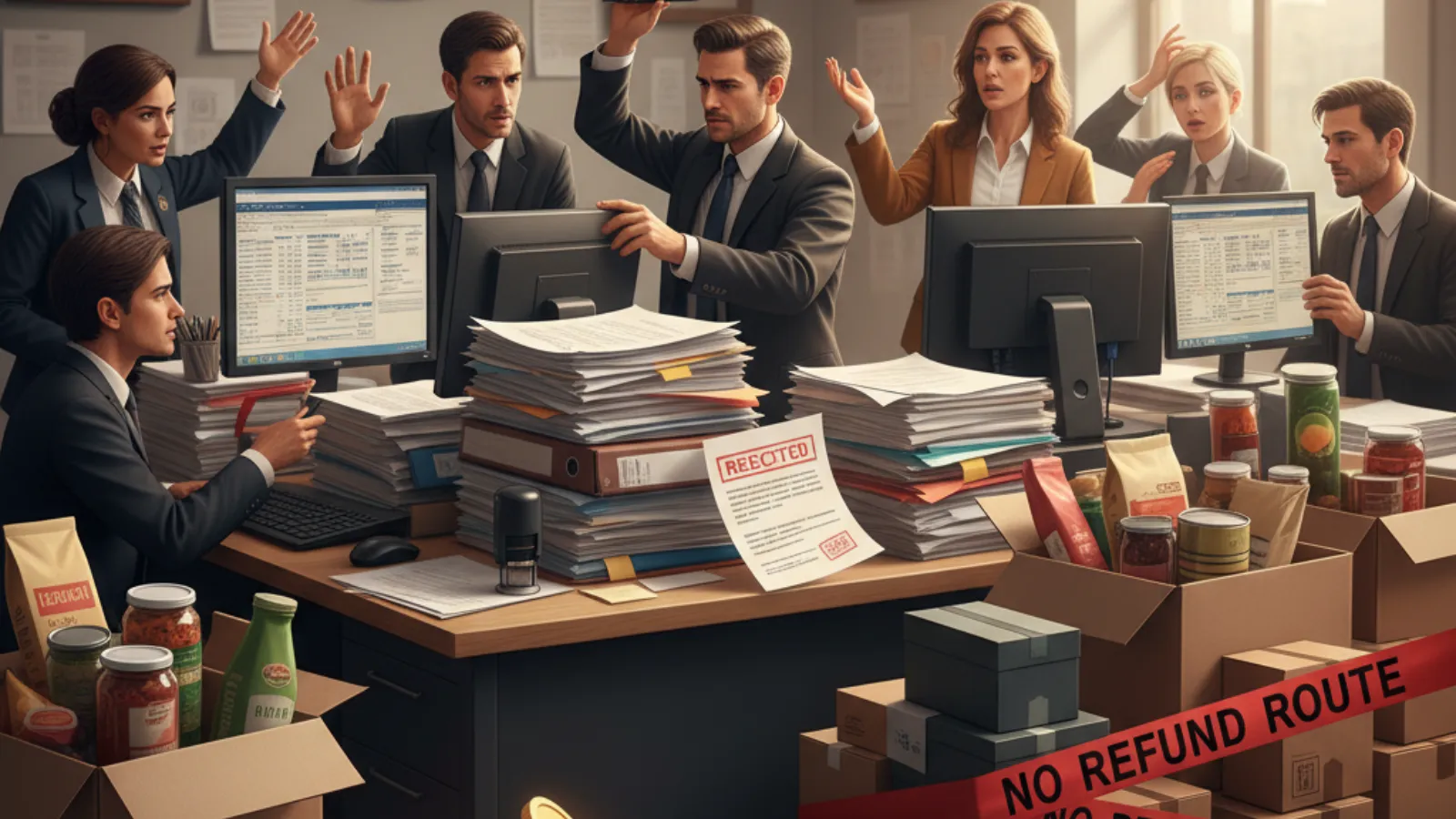
Food and drink firms won the biggest tariff case in fifty years back in February. Six months on, plenty of them still have not been paid. Close to four in ten early refund claims came back rejected.
What the court did
On 20 February 2026 the US Supreme Court struck down the tariffs set under the International Emergency Economic Powers Act. The vote was 6 to 3. The court noted that in fifty years of that law, no president had ever used it to set tariffs.
The US Treasury had already taken in $133bn under those duties. Customs opened a refund portal on 20 April. It is set to work through $166bn in phases, paid out as single payments, with interest where it applies.
The money is real. Getting it back is a paper race.
The 80-day clock
A firm has 80 days from the moment customs finalises the duty on a shipment. File inside that window or lose the right to a refund. After that, the only road left is court.
The clock runs per shipment. It does not run per company. Customs can revise an entry within 90 days under its own rules, so the 80 days leaves a ten-day buffer.
Before any of that, a firm needs a live trade account with customs. One client set one up in fifteen minutes. Another waited two months. Every day, more shipments fall out of the window, and the cash goes with them.
Large groups keep lawyers on retainer. Mid-size food and drink firms often do not. A wave of advisers has moved in, and some have asked for up to 30% of the refund.
The new wall has no refund door
The White House moved to other trade laws: sections 122, 201 and 301. Section 122 caps out at 15% and is meant to be short-lived. The trade court threw out the global version of it.
Even so, there is no general refund route under section 122. A firm that paid has to sue to get the money back. The new tariffs come with no refund door at all.
In late July the US trade office went further. It set duties of 10% to 12.5% on 59 trading partners. The stated reason is that they do too little about forced labour. The Colorado attorney general puts the wider count at 80 countries, or 99.4% of all US imports.
Twenty-five state attorneys general sued in the first week of August. The trade court has named a three-judge panel to hear it. Section 301 is the harder law to beat. It sits on a formal investigation. Trade lawyers flagged months ago that it rests on firmer ground than the emergency route.
This lands on buying rather than legal
The forced labour framing changes who owns the problem. A country duty is a map question. A forced labour duty is a supplier question, and it reaches down to the mills and farms your suppliers use.
Metals sit in the middle of it. A former Nestlé trade compliance chief points at packaging as the most exposed part of many food firms. Cans, lids, closures, kegs and plant kit all carry steel, tin and aluminium.
A soup canner or a sparkling water brand can be more exposed through its packaging than through its recipe. Buying local does not fix it either, because domestic can makers pass on the cost of imported metal.
What to watch next
The EU looks set to sit this round out rather than hit back. China and Brazil have not shown their hand. A proposed 25% duty on Brazilian goods leaves out coffee, beef and some fruit for now. The coverage can still move.
One survey of 250 small firms found 90% are holding off on investment because of trade doubt. That is the wider cost. Trade cost is now a moving number in every contract you sign.
For buyers and investors the practical point is simpler. A refund claim is money owed to you, so treat it like any other debt on the books. In a carve-out or a bolt-on, ask whether the claims went in on time. If the window closed, the seller burned cash that was sitting there to be collected.

Global Aseptic Packaging Market Report 2026
148.4bn litres and 344bn packs in 2025. Aseptic volumes across dairy, dairy alternatives, beverages and food in 39 markets — 2025 actuals and forecasts to 2030. Buy online and receive it within 24 hours.
More information
Global Cheese Database 2026
Production, imports, exports and consumption for 39 cheese types across 48 countries, with actuals through 2025 and forecasts to 2030. Join the waitlist for early access, pre-launch pricing and a free sample country chapter.
Get early accessStrategic Insights
📊 Analytics & Strategic Insight
The refund is a receivable with an expiry date
The decision most in this industry are avoiding:
👉 Most firms fought the tariffs as a legal case and left the money side to someone junior. The win came in February. The cash needs a filing per shipment, and each filing has its own deadline.
👉 The rejection rate is the story, and it does not fall evenly. Groups with in-house lawyers collect. Mid-size food and drink firms are the ones getting tripped up.
👉 The replacement duties were built to survive a court fight. A forced labour case comes with a formal investigation behind it. That is far harder to unwind than an emergency order.
Here's the full context:
→ 2025: Duties go on under emergency powers. The Treasury takes in $133bn. About 90% of the cost lands on US firms and shoppers.
→ February 2026: The Supreme Court strikes the emergency tariffs down by 6 to 3.
→ April 2026: Customs opens its refund portal on 20 April, with $166bn to work through in phases.
→ May 2026: Early data shows close to 40% of claims rejected. The filing window is 80 days from the point the duty is finalised.
→ Most recent: In late July the US trade office set 10% to 12.5% duties on 59 partners over forced labour. Twenty-five state attorneys general sued in the first week of August.
What this means for food and beverage operators and investors:
✅ Count the refund as cash on the table with a date on it. Ask your customs broker for a list of shipments by the date each duty was finalised. Work back from the 80 days.
✅ Move the tariff question from legal to buying. The new duties follow suppliers and labour practice. Your sourcing map is now your exposure map.
✅ Check the metal in your packs before you check the food in them. Cans, lids, closures and kegs carry the duty even when the supplier down the road is local.
3 moves you can make this week:
1️⃣ Pull one page of numbers. What you paid in emergency duties, what you have claimed, and what has come back. Most firms cannot answer the third one.
2️⃣ Put a named owner on the filing deadline. It is a rolling date per shipment. Give it a diary, an owner and a weekly check.
3️⃣ Ask your two biggest packaging suppliers where their metal comes from. Get it in writing. Then put a cost-change clause in the next contract.
Take the Next Step
💬 You don't need a written brief.
Tell us what you are weighing up, and we will come back with the likely project scope, recommended direction and cost range.
→ Tell us what you're planning
Zenith Consulting
Submit your food & beverage project enquiry.
Share your requirements. If there is a strong fit, we’ll come back with an indicative investment range, project timeline and recommended strategic approach.
Reviewed by Zenith Consulting’s senior food & beverage strategy team.
Related analyses
- Sustainability, Regulation & Risk
Raw Milk Cheese Warning Label Petition: Parmigiano Reggiano And Roquefort Cannot Be Pasteurised
A draft FDA petition would put a warning label on every raw milk cheese sold in America, imported cheese included. The US took in 251.3 million pounds of cheese in seven months, and the biggest Italian and French names cannot be pasteurised at all.
Read analysis → - Sustainability, Regulation & Risk
Aseptic Bags Face The EU Recycling Test: ABMA Starts A Three-Year Programme Ahead Of PPWR Requirements
Europe's industrial aseptic bag makers have started a three-year project to make the pack recyclable before the PPWR deadline on 1 January 2030. Zenith puts 4,670 million litres of the world's aseptic food in bag-in-box, and 810 million litres of West European aseptic volume rides in the same format.
Read analysis → - M&A, Investment & Valuation
Parmigiano Reggiano Takes On Australian Parmesan: The EU Trade Deal Protected 53 Cheese Names And Left Parmesan Out
The Parmigiano Reggiano Consortium has opened a three-year campaign in Australia, where cheese output runs at 455,000 tonnes a year. Australia agreed to protect 53 EU cheese names, and parmesan is not one of them.
Read analysis →
Share it with your peers
Pass this analysis to colleagues who track the food and beverage market.
Zenith Market Intel
Need a specific food or beverage market report?
Tell us which category, region or question would be useful for your team.
Sister Publication
Also follow our Water Dispense Market Intelligence
Category analyses, operator briefings, and investor signals across the global water dispense market.