Large PET Fills 25,940 Million Litres Of Aseptic Drinks Against 14,500 Million In Family Cartons
Zenith's Global Aseptic Packaging Market Report 2026 puts large PET at 25,940 million litres of aseptic drinks in 2025, against 14,500 million litres in family cartons. Cartons still lead on pack count, which turns the format split into a pack size split.
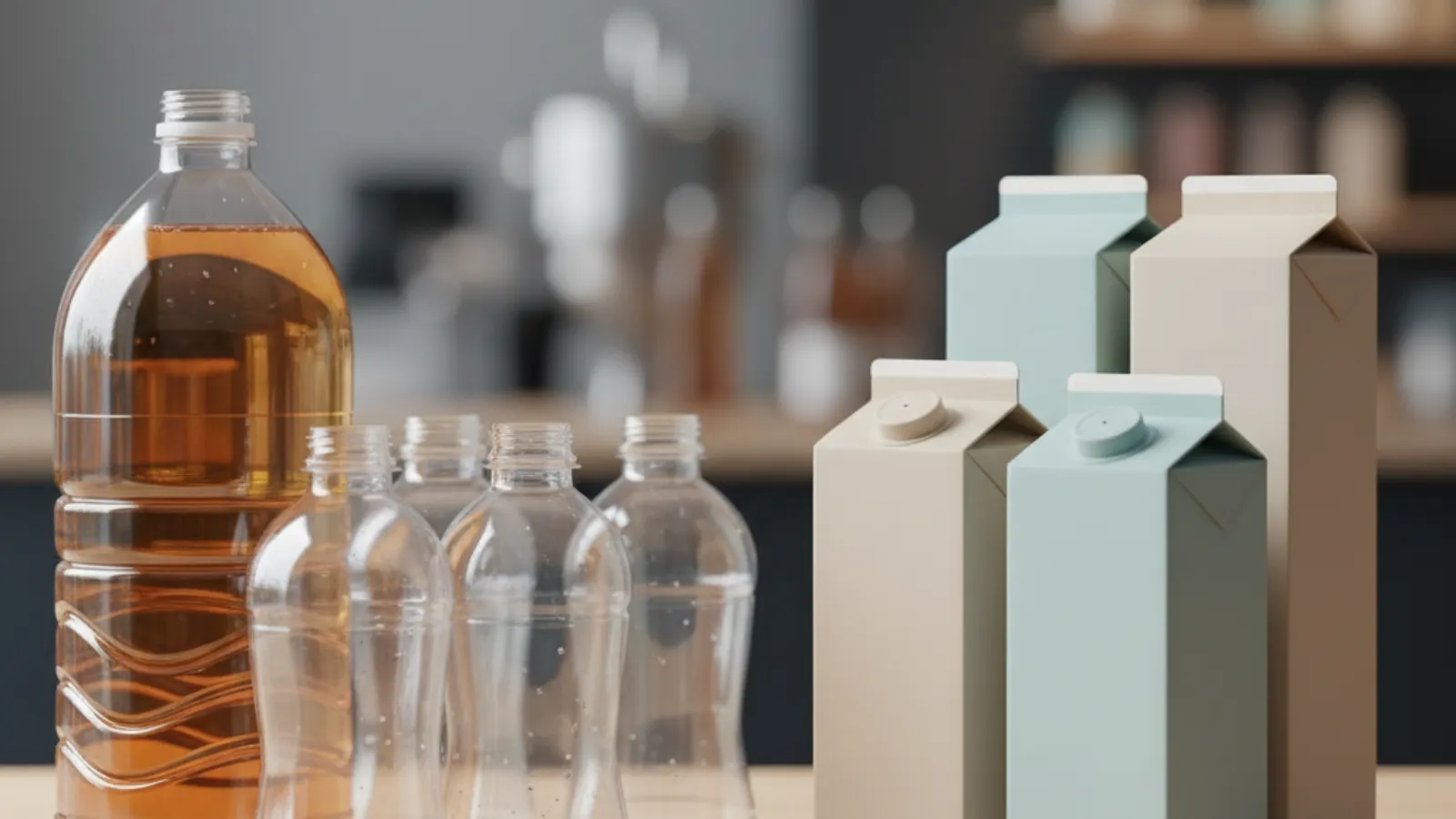
Most coverage of aseptic packaging reads as a carton story. I read the drinks numbers differently. Large PET filled 25,940 million litres of aseptic drinks in 2025, against 14,500 million in family cartons.
The pack that fills most aseptic drinks
Zenith's Global Aseptic Packaging Market Report 2026 puts world aseptic drinks at 60,180 million litres in 2025. Large PET bottles took 25,940 million of that. Family cartons took 14,500 million. Portion cartons added 10,694 million and small PET 8,065 million. Large PET now fills nearly twice the aseptic drink volume of the family carton.
The two formats are moving in opposite directions. Large PET grew 5.6% a year from 2020 to 2025. Family cartons fell 1.0% a year over the same five years. Small PET grew 5.1% a year. Every growing drinks format in the report is a bottle.
Cartons still win on packs
Litres and packs tell different stories. The report counts 47,616 million portion cartons of aseptic drinks in 2025. Large PET comes next at 34,276 million packs. Small PET adds 21,853 million. Family cartons sit at 14,601 million packs.
So the carton has not lost the drinks market. It has lost the large pack. Cartons own the single serve and PET owns the litre. A supplier who reads this as carton decline will price the wrong risk.
Where the growth lands by 2030
The report forecasts large PET at 30,935 million litres by 2030. That is 4,995 million litres above 2025. Family cartons slip to 14,227 million. Portion cartons rise to 11,317 million and small PET to 9,883 million. Large PET takes most of the growth in aseptic drinks to 2030.
The pack count moves the same way. Large PET goes from 34,276 million packs to 41,710 million. Family cartons give back about 140 million packs. One format adds 7,434 million packs while the other shrinks.
PET is pushing into UHT milk
Cartons still carry 91.8% of world aseptic UHT milk. That is 35,268 million litres in family packs and 13,097 million in portion packs. PET is small here at 623 million litres in large bottles. It is also the fastest growing milk pack in the report at 10.4% a year.
Small PET milk grew 16.7% a year from a very low base. HDPE keeps falling at 5.6% a year. Pouches reached 1,452 million litres and keep growing in South East Asia, Latin America and East Africa. The carton hold on milk is strong and no longer fixed.
What pays for the next line
World drinks production reached 166,144 million litres in 2025. RTD tea and coffee is the largest category at 56,859 million litres. Sports and energy drinks grew fastest at 7.2% a year to 39,180 million litres. Those categories sit in bottles far more often than in cartons.
Filling method matters as much as the pack. Aseptic filling held 38.9% of ambient long life drinks in 2025. Hot filling held 42.6% and preservative filling 18.5%. The report has aseptic at 40.0% by 2030 and hot filling at 40.5%. Aseptic gains share mostly in bottles rather than in cartons.
The bottle growth sits in a few regions. China filled 17,950 million litres of aseptic drinks in 2025. Asia Pacific added 11,528 million and South East Asia 7,705 million, growing 4.7% a year. West Europe fell 2.2% a year to 8,759 million litres.
What this means for the investment case
A drinks maker choosing its next aseptic line faces a format question before a supplier one. The carton line is simple to buy and ties the pack cost to one supplier. The bottle line costs more to prove and opens the pack cost to resin, preforms and closures. The cheaper machine and the cheaper pack are rarely the same choice.
Two things should be tested before the money goes in. The first is pack size, because format follows size in this market. The second is category, because tea, energy and juice each pull a different pack. An entrant should size the litre by pack size rather than by format name.
Pack share is easy to state and hard to size. What matters is how many litres and packs each format fills, market by market. Our Global Aseptic Packaging Market Report 2026 splits 39 markets by category, pack type and pack size. It carries 2025 actuals and forecasts to 2030.
Global Aseptic Packaging Market Report 2026
148.4bn litres and 344bn packs in 2025. Aseptic volumes across dairy, dairy alternatives, beverages and food in 39 markets — 2025 actuals and forecasts to 2030. Buy online and receive it within 24 hours.
More information
Global Cheese Database 2026
Production, imports, exports and consumption for 39 cheese types across 48 countries, with actuals through 2025 and forecasts to 2030. Join the waitlist for early access, pre-launch pricing and a free sample country chapter.
Get early accessStrategic Insights
📊 Analytics & Strategic Insight
The format split is really a pack size split
The decision most in this industry are avoiding:
👉 The trade reads carton decline into these numbers. Family carton litres are falling 1.0% a year. Portion cartons are still growing 1.8% a year.
👉 A bottle line is bought on proof rather than on price. Sterilisation and testing carry the cost. A carton filler arrives with that work already done.
👉 Pack count and litre count reward different suppliers. Portion cartons lead on packs at 47,616 million. Large PET leads on litres at 25,940 million.
Here's the full context:
→ 2020: Large PET filled 19,736 million litres of aseptic drinks and family cartons 15,231 million.
→ 2020 to 2025: Large PET grew 5.6% a year while family cartons fell 1.0% a year.
→ 2024: Large PET reached 24,915 million litres and family cartons slipped to 14,696 million.
→ 2025: Aseptic drinks reached 60,180 million litres, with large PET at 25,940 million.
→ Most recent: Zenith puts large PET at 30,935 million litres by 2030. Family cartons slip to 14,227 million.
What this means for aseptic fillers, converters and equipment suppliers:
✅ Carton converters should defend the small pack. Portion cartons still carry 47,616 million drink packs. That is where their volume lives.
✅ Bottle line builders own the growth in litres. Large PET adds 4,995 million litres by 2030. No carton format adds anything close.
✅ Milk is the next contested pack. PET milk grew 10.4% a year in large bottles. Cartons still hold 91.8% of the category.
What this means for market decisions:
1️⃣ Growth in aseptic drinks sits almost entirely in bottles. Litres rise 2.3% a year to 2030. Large PET carries most of that rise.
2️⃣ Carton suppliers hold the packs and bottle suppliers hold the litres. Each one wins a different customer. A single serve dairy brand and a one litre tea brand buy different lines.
3️⃣ An entrant should pick the pack size first. Format follows size in this market. Size the category and the pack together before choosing a supplier.
The Zenith view:
Large PET leading aseptic drinks proves that the litre has moved to the bottle. It does not prove a carton retreat. Cartons still fill 47,616 million drink packs a year. The investment case turns on pack size. Which size holds the growth, and which filling method serves it?
The data behind this story
📦 Global Aseptic Packaging Market Report 2026
148.4 billion litres and 344 billion packs across 39 markets, split by category, pack type and pack size, with 2025 actuals and forecasts to 2030. A free 40-page sample is on the page.
→ Read the free sample
Choosing between carton and PET for a new aseptic line? Zenith helps food and beverage companies assess market size, growth, competitors, pricing and route to market before they invest.
→ Discuss your market
Zenith Consulting
Submit your food & beverage project enquiry.
Share your requirements. If there is a strong fit, we’ll come back with an indicative investment range, project timeline and recommended strategic approach.
Reviewed by Zenith Consulting’s senior food & beverage strategy team.
Related analyses
- Corporate Strategy & Portfolio
Cheese Kingdom Shuts 84 Ukrainian Shops As Cheese Imports Hit 28,300 Tonnes, More Than Three Times Exports
Ukraine's largest specialist cheese chain has stopped trading at all 84 of its shops after 13 years. Cheese imports reached 28,300 tonnes in the seven months to July, more than three times exports, and European cheese now sits in ordinary supermarkets.
Read analysis → - Corporate Strategy & Portfolio
Krones Opens Its Largest Plant Outside Germany In China: An Aseptic Laboratory Lands As Local Line Builders Take The Orders
Krones has opened a second plant at Taicang, giving it 74,000 square metres of buildings and its largest site outside Germany. It arrives in a market where Zenith puts aseptic drinks at 17,950 million litres and local line builders hold more than 30 aseptic lines on order.
Read analysis → - Corporate Strategy & Portfolio
US Cheese Exports Rise 9% To 59,007 Tonnes: Mexico And The Americas Supplied All Of August's Growth
US cheese exports reached 59,007 tonnes in August, up 9% on a year earlier. Mexico, South America and Central America added more than the whole net gain while South Korea fell 12%.
Read analysis →
Share it with your peers
Pass this analysis to colleagues who track the food and beverage market.
Zenith Market Intel
Need a specific food or beverage market report?
Tell us which category, region or question would be useful for your team.
Sister Publication
Also follow our Water Dispense Market Intelligence
Category analyses, operator briefings, and investor signals across the global water dispense market.