Cheese Kingdom Shuts 84 Ukrainian Shops As Cheese Imports Hit 28,300 Tonnes, More Than Three Times Exports
Ukraine's largest specialist cheese chain has stopped trading at all 84 of its shops after 13 years. Cheese imports reached 28,300 tonnes in the seven months to July, more than three times exports, and European cheese now sits in ordinary supermarkets.
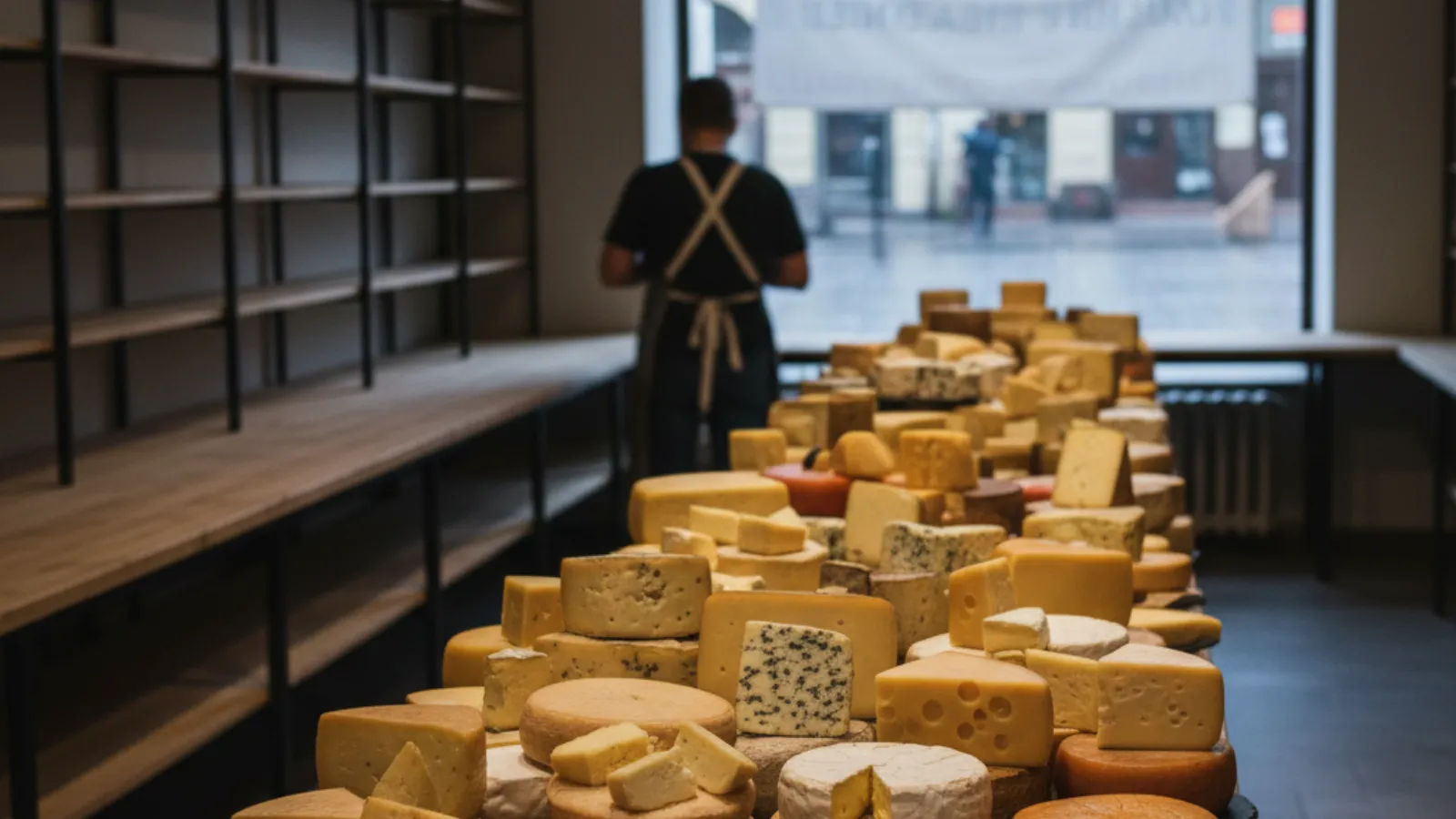
I think this is a shelf story rather than a demand story. Ukraine's largest specialist cheese chain has closed all 84 of its shops. Cheese imports into the country still rose 24.7% to 28,300 tonnes in seven months.
What Cheese Kingdom closed
Cheese Kingdom put the notice on its own website on 16 October. The chain ran 84 shops across Ukraine. It had traded for 13 years. The range ran to Dutch and mould ripened cheese, wine snacks, sauces and gift sets. Co-owner Liubov Nikolaieva named shelling, lost shops in frontline cities and heavy losses.
A Russian drone hit the head office in Kyiv in June 2025. Servers and papers were destroyed. Shops in frontline areas carried the worst of the losses. The company gave no sales figure. It said only that the losses ran into the millions.
The import line tells a different story
The Association of Milk Producers counted 28,300 tonnes of cheese imports from January to July. That was 24.7% more than the same months of 2025. The bill came to USD 168.8 million. Exports over those months reached 8,200 tonnes and USD 37.4 million. Ukraine now buys more than three times the cheese it sells abroad.
Cheese is also the largest single line in the dairy import bill. It made up 58% of imported dairy by volume. Germany supplied 16.3% of the cheese coming in. Exports grew 1.2% over the period while imports grew 24.7%.
The export side is small and narrow. Moldova took 34.8% of Ukrainian cheese exports and Kazakhstan took 25.8%. Germany came third at 13.1%. Three buyers carry 73.7% of the total. A home industry under pressure has little room to sell its way out.
Ukraine has become a net dairy buyer
The Union of Dairy Enterprises put the dairy trade gap at USD 70.3 million for January to August. A year earlier the country ran a surplus of USD 24.1 million. The ratio of exports to imports fell from 1.12 to 0.72. Ukraine turned from a dairy seller into a dairy buyer inside a single year.
Cheese drove most of that swing. Butter export volumes halved over the same months. Whey and fermented dairy held up. The money leaves the country through the cheese aisle.
Poland supplies most of the shelf
Poland supplies 80% to 85% of Ukraine's hard cheese imports. The imported share of the home market went from 38% to 45% during 2025. Domestic semi hard output has kept falling through the first three quarters of 2026. Total rennet cheese output held close to last year, helped by white cheese. The home industry is losing one cheese type while holding another.
Polish processors read the share gain as a trade test. Ukrainian makers call it a food security problem. Both sides agree the shelf has changed hands.
The Polish trade body warns against informal barriers such as extra checks at the border. Its president has pointed to possible Ukrainian access to the single market as early as 2027. Ukrainian makers want state support instead of a formal ban. Neither side expects duties to settle this.
Why a specialist shop still failed
Ordinary supermarkets now stock European cheese. Ukrainian craft makers sell more of their own. The chain was built on access to cheese that nobody else carried. That edge went the moment imports reached the main grocery aisle.
Cost did the rest. A weaker hryvnia lifted the landed price of every imported wheel. Shoppers with less money traded down. A shop charging extra for range had nothing left to charge for.
What this means for the market
Ukraine is a growing cheese market and a shrinking cheese industry. Those are two different things to size. An exporter sees an opening here and a local maker sees a squeeze. Both readings come from the same tonnage.
Two checks matter before anyone acts. The first is which cheese types are gaining and which are being given up. The second is whether the import share holds once prices settle. An entrant should size the import line by type rather than by the whole category.
For producers and exporters, one thing now decides the case. Which cheese types are actually being displaced? Our Global Cheese Database 2026 is being built market by market on exactly that basis. It covers 39 cheese types across 48 countries in tonnes, with actuals to 2025 and forecasts to 2030.

Global Aseptic Packaging Market Report 2026
148.4bn litres and 344bn packs in 2025. Aseptic volumes across dairy, dairy alternatives, beverages and food in 39 markets — 2025 actuals and forecasts to 2030. Buy online and receive it within 24 hours.
More information
Global Cheese Database 2026
Production, imports, exports and consumption for 39 cheese types across 48 countries, with actuals through 2025 and forecasts to 2030. Join the waitlist for early access, pre-launch pricing and a free sample country chapter.
Get early accessStrategic Insights
📊 Analytics & Strategic Insight
Imports took the shelf before the shop closed
The decision most in this industry are avoiding:
👉 The closure is being read as weak cheese demand. Imports rose 24.7% over the same year. Demand moved aisle rather than away.
👉 A category total hides which cheeses are being lost. Semi hard output keeps falling while white cheese holds. One market number tells a maker nothing useful.
👉 Price is doing more work here than taste. A weaker hryvnia raised the landed cost and shoppers still chose the import. That says a lot about the home cost base.
Here's the full context:
→ 2013: Cheese Kingdom opened and built a chain around imported cheese.
→ June 2025: A drone hit the company's head office in Kyiv and destroyed its servers.
→ 2025: Imported cheese rose from 38% to 45% of the Ukrainian market.
→ January to July 2026: Cheese imports reached 28,300 tonnes, against 8,200 tonnes of exports.
→ Most recent: Cheese Kingdom stopped trading at 84 shops. The notice went up on 16 October.
What this means for cheese producers, traders and buyers:
✅ Exporters have an open run at this market. Imports hold 45% of the shelf and keep growing. Poland already carries four in five hard cheese tonnes.
✅ Ukrainian makers need one type to defend. White cheese is holding and semi hard is slipping. A plan that defends everything will defend nothing.
✅ Speciality retail is the weakest link in this chain. Mainstream grocery took the range and the margin. Exporters should plan for supermarket listings.
What this means for market decisions:
1️⃣ Ukraine is attractive on volume and hard on margin. Cheese imports grew 24.7% to 28,300 tonnes in seven months. The shopper is trading down at the same time.
2️⃣ Poland is the competitor to beat here. Polish cheese holds 80% to 85% of hard cheese imports. A new exporter takes share from Poland rather than from Ukraine.
3️⃣ An entrant should test the type split before the country total. The headline tonnage mixes white cheese, semi hard and processed. Each one has a different buyer and a different price.
The Zenith view:
A chain closing proves that speciality retail failed here. It proves nothing about cheese demand, which the import tonnage shows is growing. The investment case turns on one thing: which cheese types are being imported, and at whose expense?
The data behind this story
🧀 Global Cheese Database 2026
Production, imports, exports and consumption for 39 cheese types across 48 countries, in tonnes, with actuals to 2025 and forecasts to 2030. The 2026 edition is being built market by market. Waitlist members get the pre-launch price and a free sample country chapter.
→ Join the waitlist
Evaluating a cheese market where imports are taking share? Zenith helps food and beverage companies assess market size, growth, competitors, pricing and route to market before they invest.
→ Discuss your market
Zenith Consulting
Submit your food & beverage project enquiry.
Share your requirements. If there is a strong fit, we’ll come back with an indicative investment range, project timeline and recommended strategic approach.
Reviewed by Zenith Consulting’s senior food & beverage strategy team.
Related analyses
- Corporate Strategy & Portfolio
Krones Opens Its Largest Plant Outside Germany In China: An Aseptic Laboratory Lands As Local Line Builders Take The Orders
Krones has opened a second plant at Taicang, giving it 74,000 square metres of buildings and its largest site outside Germany. It arrives in a market where Zenith puts aseptic drinks at 17,950 million litres and local line builders hold more than 30 aseptic lines on order.
Read analysis → - Corporate Strategy & Portfolio
US Cheese Exports Rise 9% To 59,007 Tonnes: Mexico And The Americas Supplied All Of August's Growth
US cheese exports reached 59,007 tonnes in August, up 9% on a year earlier. Mexico, South America and Central America added more than the whole net gain while South Korea fell 12%.
Read analysis → - Corporate Strategy & Portfolio
Greatview Faces Hong Kong Delisting: The Aseptic Carton Maker Sold 11.7 Billion Packs Against 30 To 34 Billion Of Chinese Capacity
Greatview Aseptic Packaging has asked for a review of the Hong Kong exchange decision to cancel its listing. The carton maker sold 11.7 billion packs in 2025 against Chinese plants Zenith rates at roughly 30 to 34 billion.
Read analysis →
Share it with your peers
Pass this analysis to colleagues who track the food and beverage market.
Zenith Market Intel
Need a specific food or beverage market report?
Tell us which category, region or question would be useful for your team.
Sister Publication
Also follow our Water Dispense Market Intelligence
Category analyses, operator briefings, and investor signals across the global water dispense market.