UFlex Wins A 20-Year Indian Patent On Its Own Aseptic Filling Machine: Asepto Heads For 24 Billion Packs
UFlex has been granted a 20-year Indian patent on a high-speed twin aseptic filling machine of its own design. For a carton maker heading toward 24 billion packs a year, owning the machine matters more than owning the board.
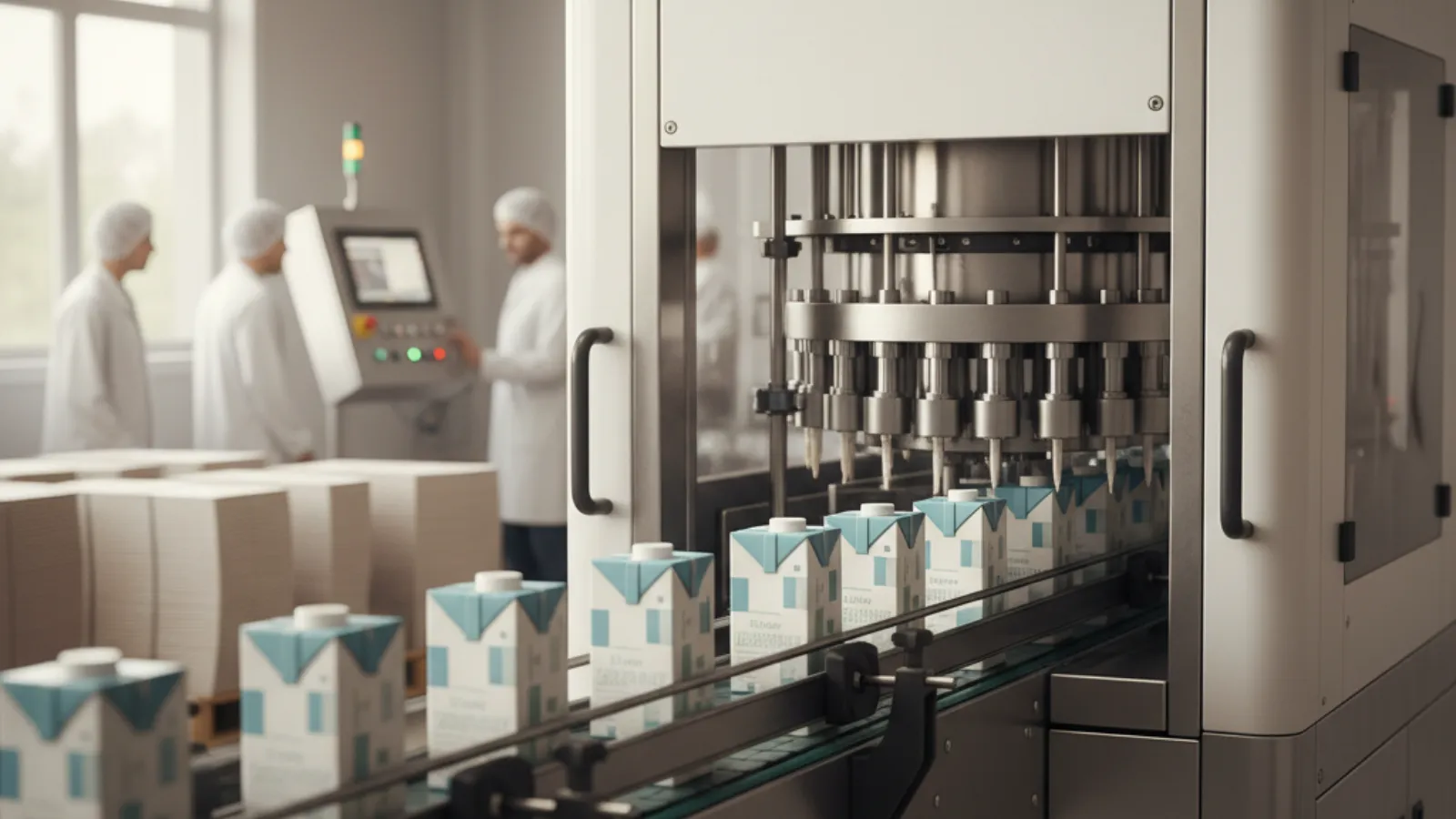
I keep seeing the same ending in aseptic. A maker sells the board, and somebody else owns the machine that fills it. So the patent UFlex just won on its own filling machine is the bigger half of its plan.
What the patent covers
The Indian Patent Office granted UFlex patent 603158 in September 2026. The term runs 20 years from the September 2023 filing. The machine is a high-speed twin aseptic filling machine for liquids. It uses a continuous vertical form-fill-seal layout. A centre seal strip makes the vertical seal. An induction sealing unit makes the cross seal. One PLC and HMI panel runs the whole machine. UFlex told the Indian exchanges the design lifts output, cuts floor space and lowers air and power use.
Why the machine is the lock
Aseptic is sold as a system. A filler buys the machine, then buys sleeves or reels that only that machine runs. Change the material supplier and you usually have to change the machine. That is why the two biggest carton groups sell both. A maker with board and no machine waits for someone else to grow their machine base.
UFlex already sells machines. Its own range runs from the Smart 78 at 7,800 packs an hour to the SpeedPlus 25000 at 25,000. The patent puts a 20-year fence around the fastest part of that range in its home market.
The capacity behind it
Asepto is UFlex's liquid packaging arm. Its Sanand plant in Gujarat makes 12 billion packs a year. A second plant at Ain Sokhna in Egypt adds another 12 billion. That takes the group to 24 billion packs a year once both run full. The Egypt site cost USD 126 million. USD 108 million of that had been spent by June 2026. Asepto wants 30% use in year one, then 60% to 70%, then full use in year three.
Ain Sokhna sits on the Suez route, and Asepto sells the shipping times. It puts the Gulf at 10 days and Europe at about 10. Africa runs 5 to 20 days. The Americas run about 30.
What 24 billion packs is worth
Zenith's Global Aseptic Packaging Market Report 2026 counts 344 billion aseptic packs in 2025. They held 148.4 billion litres. So 24 billion packs is close to 7% of every aseptic pack filled in the world. Cartons carry 66.5% of world aseptic volume. The report has volume reaching 159.6 billion litres by 2030, after growth of 1.4% a year since 2020.
The report also splits those litres by what is filled. White milk holds 52.7 billion litres and drinks hold 60.2 billion. Other dairy holds 27.2 billion and food 8.3 billion. Asepto's packs sell into the first three.
Asepto's own people put world demand near 300 billion packs. Zenith counts 344 billion. The gap between those two counts is wider than Asepto's whole Egyptian plant.
Where the claim is thinner
A patent is not a sale. It covers India alone. UFlex gets no cover in Egypt, Europe or Africa, and that is where the new packs are aimed. No speed has been published for the twin machine. No customer has been named for it. Asepto's own ramp plan has year one at 30% use.
What this means for the market
A market with one machine base is a different market from one with three. Where Asepto places machines, it also places its own material for years. Where it ships reels alone, it meets two larger groups on price.
An entrant should test three things. Whether the local filler base is tied to one supplier's machines. What it costs to qualify a second material on a machine already running. Whether a patent blocks the cheaper machine in that country.
The patent is real, and the harder sum is how much filling capacity it can pull through. That means counting machines, pack sizes and packs by market rather than reading a press release. Our Global Aseptic Packaging Market Report 2026 splits all 39 markets by category, pack type and pack size. The free sample on the page shows how those pack tables are built.
Global Aseptic Packaging Market Report 2026
148.4bn litres and 344bn packs in 2025. Aseptic volumes across dairy, dairy alternatives, beverages and food in 39 markets — 2025 actuals and forecasts to 2030. Buy online and receive it within 24 hours.
More information
Global Cheese Database 2026
Production, imports, exports and consumption for 39 cheese types across 48 countries, with actuals through 2025 and forecasts to 2030. Join the waitlist for early access, pre-launch pricing and a free sample country chapter.
Get early accessStrategic Insights
📊 Analytics & Strategic Insight
UFlex has bought its way into the part of aseptic that keeps a customer
The decision most in this industry are avoiding:
👉 Material share follows machine share. Most carton plans are built on board cost and board capacity. The machine base decides who gets to sell it.
👉 A patent in one country is a weak fence. UFlex is covered in India. Its new packs are aimed at Egypt, Europe and Africa.
👉 Nobody prices the cost of qualifying a second material. Trials, sign-off and waste all sit with the filler. That cost is what keeps a supplier in place.
Here's the full context:
→ 2021: UFlex set out to take its Gujarat plant to 7 billion aseptic packs a year.
→ 2023: UFlex filed the patent for a twin aseptic filling machine in September.
→ 2025: Zenith counts 344 billion aseptic packs and 148.4 billion litres worldwide.
→ 2026: Asepto had spent USD 108 million of the USD 126 million Egypt build by June.
→ Most recent: India granted patent 603158 in September. UFlex filed it with the exchanges on 22 September.
What this means for aseptic fillers, converters and equipment suppliers:
✅ Fillers should price the switch rather than the reel alone. A cheaper reel can cost more once the machine has to change. Put the swap cost in the first quote.
✅ Machine makers now face a converter in their own market. UFlex builds and sells its own fillers. Sidel, Krones and GEA meet a material supplier on price.
✅ Carton groups should watch India for the test case. A patent there shapes what anyone else can build locally. The cheap machine is what opens a market.
What this means for market decisions:
1️⃣ Egypt and East Africa gain a second credible carton supplier. That changes price and lead times for fillers there. It also changes what an entrant can assume about supply.
2️⃣ Reel-only suppliers face the hardest version of this. A maker with board and no machine sells on price. A maker with both sells the whole line.
3️⃣ Map the machine base before the board market. Count installed fillers by brand and by market. That count tells you who can be sold to at all.
The Zenith view:
The patent shows UFlex means to own the line rather than one layer of it. It does not show that 24 billion packs of demand is waiting. Zenith has world aseptic volume growing 1.4% a year to 2025. Most of those packs have to be taken from someone. Whose machine base they come off decides the case.
The data behind this story
📦 Global Aseptic Packaging Market Report 2026
148.4 billion litres and 344 billion packs across 39 markets, split by category, pack type and pack size, with 2025 actuals and forecasts to 2030. A free 40-page sample is on the page.
→ Read the free sample
Evaluating an aseptic carton or filling market?
Zenith helps food and beverage companies assess market size, growth, competitors, pricing and route to market before they invest.
→ Discuss your market
Zenith Consulting
Submit your food & beverage project enquiry.
Share your requirements. If there is a strong fit, we’ll come back with an indicative investment range, project timeline and recommended strategic approach.
Reviewed by Zenith Consulting’s senior food & beverage strategy team.
Related analyses
- Corporate Strategy & Portfolio
Oji Liquid Pak's USD 110 Million Vietnam Aseptic Carton Plant Adds 8 Billion Packs To A Region Already At 62 Billion
Oji Liquid Pak broke ground on a USD 110 million aseptic carton material plant in Dong Nai, rated at up to 8 billion packs a year from 2028. Zenith puts Vietnam at 10,358.7 million aseptic packs in 2025, and South East Asia already holds about 62 billion packs of documented converting capacity.
Read analysis → - Corporate Strategy & Portfolio
Spain Swaps HDPE Milk Bottles For Aseptic PET: 170 Million Litres Left And Only Three Aseptic PET Dairy Lines
Spanish UHT milk in large HDPE bottles fell from 307 million litres in 2020 to 170 million in 2025, and Zenith's model takes it to 88.5 million by 2030. Aseptic PET is taking the volume, and only three aseptic PET dairy lines have been documented in the country.
Read analysis → - Corporate Strategy & Portfolio
US Parmesan Output Jumps 25.9% While Cheddar Slips: Italian Cheese Takes Four In Five Pounds Of Growth
USDA figures published on 5 October show US Parmesan output up 25.9% in August while cheddar fell 0.9%. Italian types have supplied nearly four in every five pounds of US cheese growth so far in 2026.
Read analysis →
Share it with your peers
Pass this analysis to colleagues who track the food and beverage market.
Zenith Market Intel
Need a specific food or beverage market report?
Tell us which category, region or question would be useful for your team.
Sister Publication
Also follow our Water Dispense Market Intelligence
Category analyses, operator briefings, and investor signals across the global water dispense market.