Big Food Is Renting Its Factories. Why Nestlé, Mars and PepsiCo Are Changing Who Owns the Plant
Nestlé's spare cash jumped by nearly half in the first six months of the year, while the cash its trading threw off barely moved. The company says it spent less on plants and machines. Nestlé, PepsiCo, Mars, Mondelez, Kraft Heinz and Ferrero now all hire outside factories on purpose.
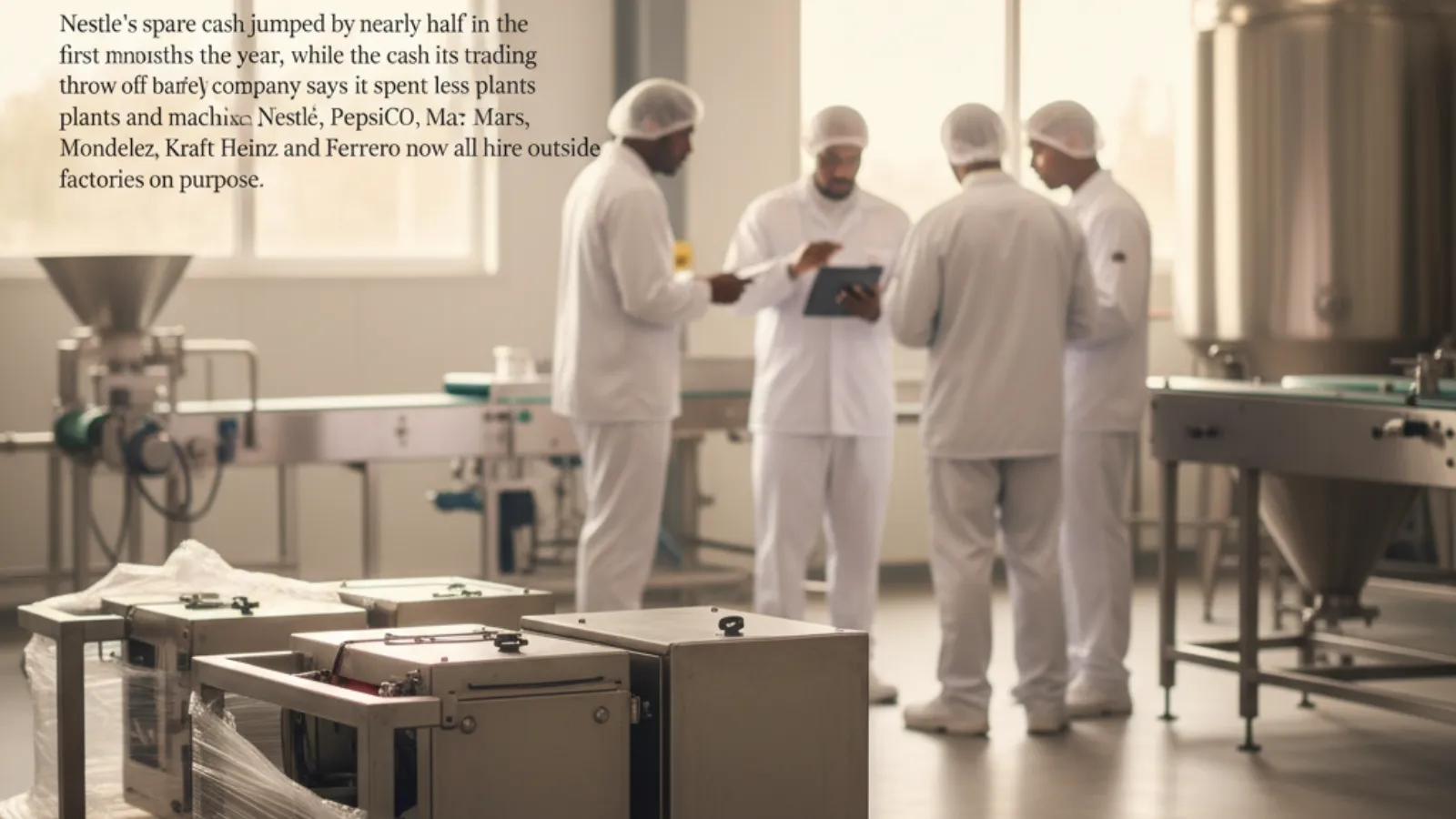
Nestlé's trading barely moved in the first half of this year. Its day to day business threw off 6.3 billion Swiss francs of cash. A year before, the figure was 6.2 billion. The cash left at the end tells a different story. That rose by nearly half, from 2.3 billion francs to 3.4 billion. Nestlé gives the reason in one line of its own report. It spent less on plants and machines. Most of that extra cash came from building less.
The factory is becoming someone else's job
Paying an outside plant to make your food is an old trick. Small brands did it because they could not afford a factory. What has changed is who does it now.
Nestlé, PepsiCo, Mars, Mondelez, Kraft Heinz and Ferrero all hire outside plants on purpose, as part of the plan. FoodNavigator set the shift out in a review on 4 August.
The sums are simple. A food plant costs tens of millions of dollars. It takes one to three years to get from a yes to the first case out of the door. A good outside plant can do it in three to six months. A fad can rise and fade inside a year. So a three year build is a bet on that fad lasting.
Covid taught the lesson in public. General Mills used about 200 outside plants before 2020. When demand ran past what its own sites could make, it added up to a fifth more partners. Owning every line turned out to be a cap on growth.
Watch where the saved money goes
Nestlé did not sit on the money. It moved it. Spend on ads and marketing rose to 8.9% of sales. Spend on research held flat at 1.8%. Its cost cutting plan is called Fuel for Growth. It has saved 1.7 billion francs so far, against a target of 3 billion by the end of next year. Nestlé also owes 56.3 billion francs. That debt is the other reason cash matters more than concrete this year.
The money is moving off the factory floor and onto the brand. That is a swap, and both sides carry a price. A plant you own gives you control and secrecy. A plant you hire gives you speed and the freedom to change your mind.
They still build. They just build in fewer places
None of these firms is walking away from making food. They are picking their spots with more care.
Nestlé is putting $563 million into one Nescafé plant in Thailand. Mars is spending £190 million on its chocolate plant in Slough, up to 2028. That came months after it paid $36 billion for Kellanova. In the same year Mars filed notice to shut its Nature's Bakery site in Hazelwood, Missouri. It is moving 345 jobs of work to Salt Lake City and Carson City. Kraft Heinz has pulled buying and supply into one team.
The rule under all of it is short. Build where the making is the secret. Hire where anyone could do it. Instant coffee and moulded chocolate need skill a rival cannot copy in a season. A protein bar, a flavoured water, a bag of sweets: those are a recipe and a machine. Machines are easy to rent.
What you give up
The bill turns up later, in three parts.
First, money. An outside plant takes a cut, so the same case earns you less.
Second, control. You still sign off the quality even when you do not own the line. A recall lands on your name and someone else's floor.
Third, secrets. Your recipe and your know how walk into someone else's plant. That plant may be making something close to it for a rival next quarter.
The cost most firms miss is the power to argue about price. A firm that has not run a line for ten years cannot say what a case should cost. The plant that makes it knows the true cost. The brand owner only knows the bill.
What comes next
Three things follow from here. Tight spending will keep flattering cash for another year or two. Read those gains for what they are. Outside plants with clean safety records will gain the upper hand. The best of them will start charging for it. The make or buy call will also move up, from a plant manager's sheet to a board paper.
Ask which skills you could never afford to lose, then keep those in house. Get that wrong and the saving shows up this year, while the cost shows up in three.
Global Aseptic Packaging Market Report 2026
148.4bn litres and 344bn packs in 2025. Aseptic volumes across dairy, dairy alternatives, beverages and food in 39 markets — 2025 actuals and forecasts to 2030. Buy online and receive it within 24 hours.
More information
Global Cheese Database 2026
Production, imports, exports and consumption for 39 cheese types across 48 countries, with actuals through 2025 and forecasts to 2030. Join the waitlist for early access, pre-launch pricing and a free sample country chapter.
Get early accessStrategic Insights
📊 Analytics & Strategic Insight
The factory has become a money call, and most boards still treat it as an engineering one
The decision most in this industry are avoiding:
👉 What you spend on plant is a growth forecast in disguise. Cut it and cash goes up today. It also tells the market you think you will need less space to make things later. Few finance teams say that part out loud.
👉 The plant that makes your product knows your costs better than you do. They see the waste, the yield and the hours. You see a price per case. That gap decides who wins the next round of talks.
👉 Owning less works until two of your brands want the same line in the same week. Hired line time is priced for a normal week. Deals, hot weather and a viral post all land as spikes. A spike you cannot serve is a loss that shows up in no report.
Here's the full context:
→ 2020: General Mills uses about 200 outside plants. Covid demand outruns its own sites. It adds up to a fifth more.
→ Early 2026: Mars pays $36 billion for Kellanova, then puts £190 million into one chocolate plant in Slough, up to 2028.
→ July 2026: Mars files notice to shut its Nature's Bakery plant in Hazelwood, Missouri. It moves 345 jobs of work to Salt Lake City and Carson City.
→ 23 July 2026: Nestlé reports 3.4 billion francs of spare cash for the half year, up from 2.3 billion. Cash from trading was flat. It names lower plant spend as the main cause.
→ Most recent: FoodNavigator reports that six of the biggest food firms now hire outside plants as part of the plan. Nestlé, PepsiCo, Mars, Mondelez, Kraft Heinz and Ferrero all do it.
What this means for food and beverage operators and investors:
✅ Check the plant spend line before you call a cash gain progress. A jump in spare cash on flat trading cash is a spending choice. It can be the right one. It is a different thing from selling more.
✅ Outside plants are about to gain the upper hand on price. Partners with clean audits and tight allergen control are getting scarce. Anyone on an old rate should expect that talk to reopen.
✅ Plant values are moving two ways at once. Sites with real skill behind them are worth more than the books say. Plain filling and packing lines are worth less, because a buyer can rent the same thing by the week.
3 moves you can make this week:
1️⃣ Split your range onto two lists: skill and recipe. Skill means the making is the edge. Recipe means anyone could make it. Anything you own on the recipe list is money tied up in the wrong place.
2️⃣ Ask finance what you spent on plant as a share of sales for the last three years. If it has fallen and nobody chose that, you have drifted into it.
3️⃣ Cost one hired out product from the ground up. Take the food, the packs, the line time, the labour and the waste. Compare it with what you pay. That one page changes the next supplier meeting.
Take the Next Step
🎯 This is the thinking we bring to client projects.
If today's topic touches a decision on your desk this quarter, start the conversation before the window closes.
→ Start the conversation
Zenith Consulting
Submit your food & beverage project enquiry.
Share your requirements. If there is a strong fit, we’ll come back with an indicative investment range, project timeline and recommended strategic approach.
Reviewed by Zenith Consulting’s senior food & beverage strategy team.
Related analyses
- Corporate Strategy & Portfolio
Oji Liquid Pak's USD 110 Million Vietnam Aseptic Carton Plant Adds 8 Billion Packs To A Region Already At 62 Billion
Oji Liquid Pak broke ground on a USD 110 million aseptic carton material plant in Dong Nai, rated at up to 8 billion packs a year from 2028. Zenith puts Vietnam at 10,358.7 million aseptic packs in 2025, and South East Asia already holds about 62 billion packs of documented converting capacity.
Read analysis → - Corporate Strategy & Portfolio
Spain Swaps HDPE Milk Bottles For Aseptic PET: 170 Million Litres Left And Only Three Aseptic PET Dairy Lines
Spanish UHT milk in large HDPE bottles fell from 307 million litres in 2020 to 170 million in 2025, and Zenith's model takes it to 88.5 million by 2030. Aseptic PET is taking the volume, and only three aseptic PET dairy lines have been documented in the country.
Read analysis → - Corporate Strategy & Portfolio
US Parmesan Output Jumps 25.9% While Cheddar Slips: Italian Cheese Takes Four In Five Pounds Of Growth
USDA figures published on 5 October show US Parmesan output up 25.9% in August while cheddar fell 0.9%. Italian types have supplied nearly four in every five pounds of US cheese growth so far in 2026.
Read analysis →
Share it with your peers
Pass this analysis to colleagues who track the food and beverage market.
Zenith Market Intel
Need a specific food or beverage market report?
Tell us which category, region or question would be useful for your team.
Sister Publication
Also follow our Water Dispense Market Intelligence
Category analyses, operator briefings, and investor signals across the global water dispense market.