US Cheese Warning Labels Move Closer: Bongards Adds 180 Million Pounds Of Process Cheese Anyway
A US Senate committee has advanced a bill that would put a front-of-pack warning on whole milk, all cheese and most yogurt. Bongards is still spending $135 million on 180 million pounds more process cheese, and the channel split explains why.
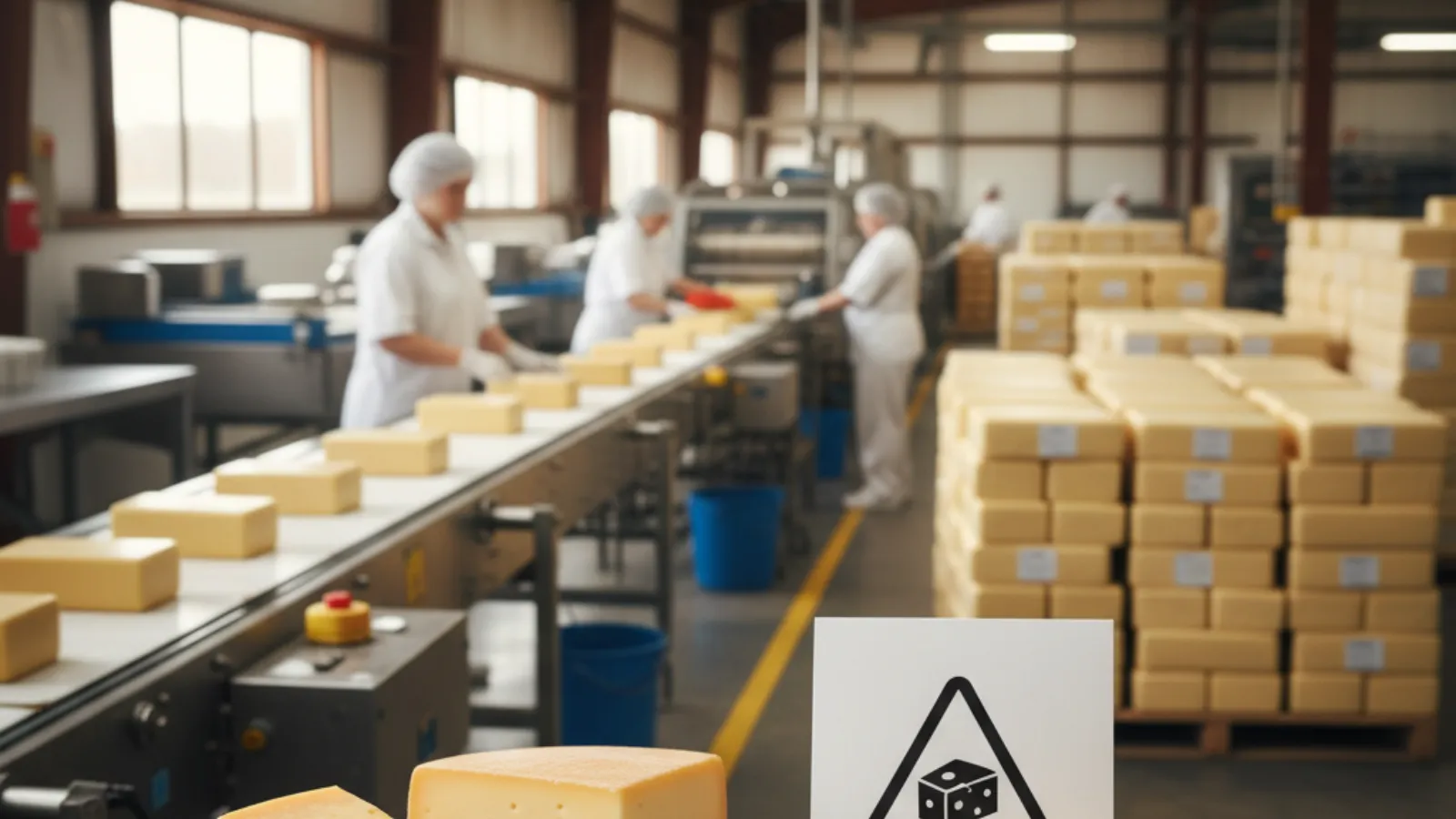
Most of the coverage reads S. 5026 as a nutrition fight. I read it as a channel one. A front-of-pack warning is paid for by the retail pack, and most American cheese never sees one.
What The Bill Would Do
The vote was 12-10 on 22 July. The Senate Health, Education, Labor and Pensions Committee advanced S. 5026, the Childhood Diabetes Reduction Act of 2026. The bill changes the Federal Food, Drug, and Cosmetic Act. It sets a warning rule for four groups of food and drink.
Ultra-processed food is one of those groups. The bill defines it as food with industrial ingredients such as emulsifiers, stabilisers or flavour enhancers. Those products would carry a front-of-pack warning about weight gain, obesity and type 2 diabetes.
A second route is the nutrient of concern. Added sugar, saturated fat and sodium are all named. Each one triggers a High in line on the pack. The rules would start one year after the bill becomes law.
Why All Cheese Gets Caught
The dairy trade has done the sums. IDFA and NMPF wrote to congressional leaders on 9 September. Seventy-six dairy companies, co-ops and producer groups signed with them. The letter went to John Thune, Charles Schumer, Mike Johnson and Hakeem Jeffries.
Their reading is blunt. Warning labels would be required for whole milk, all cheese and ice cream. Most yogurts and cultured products would carry one too. The only likely escapes are plain nonfat or lowfat milk and some plain lowfat yogurts.
Cheese gets caught twice over. Saturated fat and sodium are both named as nutrients of concern. Process cheese is caught a third time, because emulsifying salts are industrial ingredients.
The Bongards Bet In Minnesota
Bongards' Creameries announced its spend on 11 August. The farmer-owned co-op will put $135 million into its process cheese plant in Minnesota. Capacity rises by 180 million pounds of process cheese a year.
The project adds 120,000 square feet. Of that, 50,000 is new plant and 70,000 is an automated warehouse. Building starts in the fourth quarter of 2026. Commercial output is due in early 2028. It is one of the largest spends in the co-op's 118-year history.
The money goes in during the same window a label rule would land. Chief executive Dennis Thomas called it a bet on value-added dairy. Chief revenue officer Scott Tomes pointed at growth in process cheese at home and abroad.
Where The Label Actually Lands
Read the Bongards release again. It names four markets for the new volume: foodservice, retail, industrial ingredient and export. That list is the whole story.
A front-of-pack warning applies to the principal display panel of a consumer pack. A 40 pound block sold to a sauce maker has no such panel. Nor does a foodservice bag of shred going to a pizza chain. Nor does a container of cheese on a boat to the Gulf.
Three of the four markets Bongards named sit outside the front-of-pack rule. The advertising ban in the bill works the same way. It bites on branded consumer marketing. Ingredient cheese carries no brand to a shopper at all.
The bill prices the pack rather than the cheese. For scale, 180 million pounds is about 1.2% of the 14.8 billion pounds US plants made in 2025. That national figure was itself 4.0% up on the year before.
Europe Shows The Other Squeeze
European cheese prices are already falling hard. The Commission's Milk Market Observatory put EU cheddar at 322 euros per 100kg in the week to 30 August. That is 28% below the same week a year earlier. Gouda fell 23% and edam 22%. Emmental fell 14%.
Whey powder went the other way. It reached 144 euros per 100kg, up 46% on the year. The curd is getting cheaper while the whey stream is getting dearer. So a retail label would land on a product whose world price is already sliding.
What Producers Should Do Now
Split your book by pack before you model the rule. Count what leaves your site in a consumer pack. Count what leaves as block, barrel, shred or export. Price the first pool for label risk and artwork cost. Leave the second pool where it is for now. Then test whether your growth plan sits in the exposed pool. A plant with a retail brand and a plant with a barrel line face very different bills.
The vote matters. The harder thing to measure is how many tonnes actually sit behind a retail pack. Our Global Cheese Database 2026 splits cheese eaten as cheese from cheese used as an ingredient. It does that across 39 types and 48 markets. The waitlist is open and comes with a free sample country chapter.

Global Aseptic Packaging Market Report 2026
148.4bn litres and 344bn packs in 2025. Aseptic volumes across dairy, dairy alternatives, beverages and food in 39 markets — 2025 actuals and forecasts to 2030. Buy online and receive it within 24 hours.
More information
Global Cheese Database 2026
Production, imports, exports and consumption for 39 cheese types across 48 countries, with actuals through 2025 and forecasts to 2030. Join the waitlist for early access, pre-launch pricing and a free sample country chapter.
Get early accessStrategic Insights
📊 Analytics & Strategic Insight
Label risk sits in the pack, so sort your tonnage by channel before you sort it by recipe
The decision most in this industry are avoiding:
👉 Most label models start with the product. Start with the pack instead. The rule attaches to a consumer panel. Two sites making the same cheese can carry very different risk.
👉 Own label is more exposed than brands. A shop can drop a line in one review cycle. A brand has contracts, listings and a reason to fight.
👉 Reformulating out of the rule may cost more than the label. Emulsifying salts do the work in process cheese. Take them out and the melt changes.
Here's the full context:
→ 2025: US plants made 14.8 billion pounds of cheese, 4.0% more than the year before.
→ July 2026: The Senate HELP Committee voted 12-10 to advance S. 5026.
→ August 2026: Bongards committed $135 million to 180 million more pounds of process cheese.
→ August 2026: EU cheddar fell to 322 euros per 100kg, down 28% on the year.
→ Most recent: IDFA, NMPF and 76 dairy groups asked Congress to reject the bill. Their letter says every cheese would carry a warning.
What this means for cheese producers, traders and buyers:
✅ Retail lines carry the cost. Artwork, claims and shelf reviews all sit on the consumer pack. None of that touches a barrel.
✅ Ingredient volume is the quiet hedge. Foodservice, industrial and export cheese stay outside the panel rule as drafted.
✅ Buyers will start asking for the split. Boards and lenders will want tonnage by channel before they sign off the next plant.
3 moves you can make this week:
1️⃣ Split your tonnage by pack type. One line for consumer packs. One line for block, barrel, shred and export.
2️⃣ Cost the artwork now. Ask your printer for a per SKU figure for a front-of-pack change.
3️⃣ Test the growth plan. Check whether the next plant's volume lands in the exposed pool.
The data behind this story
🧀 Global Cheese Database 2026
Production, imports, exports and consumption for 39 cheese types across 48 countries, in tonnes, with actuals to 2025 and forecasts to 2030. The 2026 edition is being built market by market. Waitlist members get the pre-launch price and a free sample country chapter.
→ Join the waitlist
Zenith Consulting
Submit your food & beverage project enquiry.
Share your requirements. If there is a strong fit, we’ll come back with an indicative investment range, project timeline and recommended strategic approach.
Reviewed by Zenith Consulting’s senior food & beverage strategy team.
Related analyses
- Market & Category Growth
Tetra Pak Takes Tetra Recart Into Chinese Dessert Soups: World Aseptic Food Is Stuck At 8.3 Billion Litres
Tetra Pak and Shanghai Meilin have put two ready-to-eat dessert soups into Tetra Recart, a carton that is sterilised after filling rather than aseptically filled. Zenith's Global Aseptic Packaging Market Report 2026 puts world aseptic food at 8,286 million litres in 2025, 5.6% of world aseptic volume, and flat to 2030.
Read analysis → - Market & Category Growth
Foremost Farms Exits 40lb Block Cheese: $13 Billion Of New US Dairy Capacity Is Closing Old Cheddar Lines
Foremost Farms will close its Marshfield, Wisconsin cheese plant in December and stop making 40lb block cheddar, and it names new US cheese capacity as a reason. With $13 billion of dairy plants under way and blocks trading below barrels, the old bulk line is the first casualty.
Read analysis → - Corporate Strategy & Portfolio
Cheddar Jumps 16.5% While Mozzarella Falls 6%: The GDT Cheese Spread Swung $824 A Tonne In Two Weeks
Cheddar rose 16.5% and mozzarella fell 6.0% at the same Global Dairy Trade auction on 15 September. Two cheeses made from the same milk moved $824 a tonne apart in a fortnight, and the reason sits in the vats.
Read analysis →
Share it with your peers
Pass this analysis to colleagues who track the food and beverage market.
Zenith Market Intel
Need a specific food or beverage market report?
Tell us which category, region or question would be useful for your team.
Sister Publication
Also follow our Water Dispense Market Intelligence
Category analyses, operator briefings, and investor signals across the global water dispense market.