Tetra Pak Takes Tetra Recart Into Chinese Dessert Soups: World Aseptic Food Is Stuck At 8.3 Billion Litres
Tetra Pak and Shanghai Meilin have put two ready-to-eat dessert soups into Tetra Recart, a carton that is sterilised after filling rather than aseptically filled. Zenith's Global Aseptic Packaging Market Report 2026 puts world aseptic food at 8,286 million litres in 2025, 5.6% of world aseptic volume, and flat to 2030.
I will say this plainly. The carton is taking shelf from the can in shelf-stable food. Almost none of that win lands in the aseptic numbers.
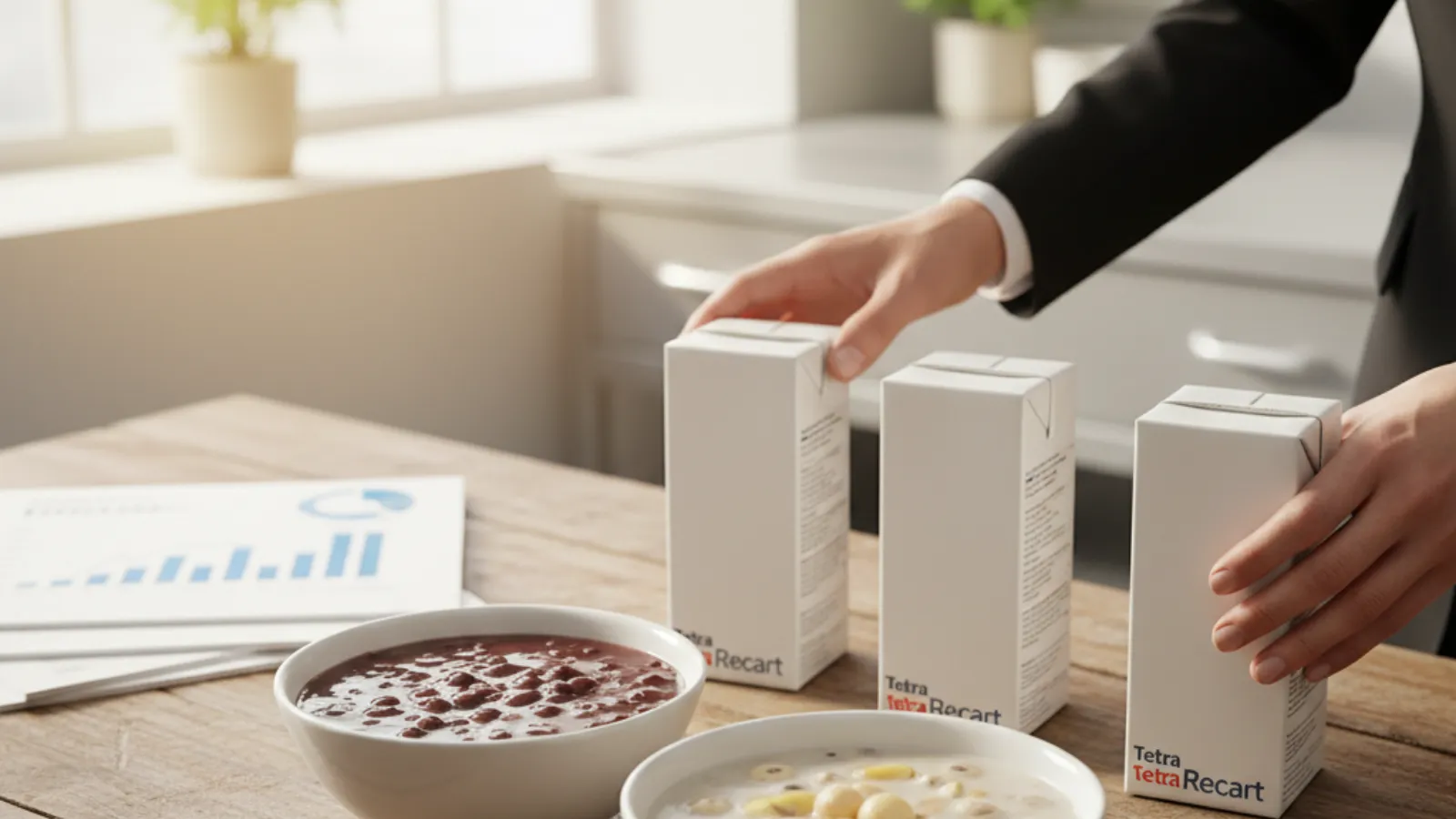
Tetra Pak and Shanghai Meilin have put two ready-to-eat dessert soups into Tetra Recart. The packs are Rock Sugar Mung Bean Soup and Rock Sugar Snow Fungus Soup. Tetra Recart is sterilised after filling, so it is a retort carton rather than an aseptic one. That one fact decides which market the volume belongs to.
What The Two Companies Have Done
Shanghai Meilin is a brand of Shanghai Bright Meat Group. The soups are traditional Chinese desserts, sold ready to eat. They sit at room temperature. Tetra Pak says the pack holds them for up to 18 months without a chiller.
The format runs in six sizes, from 100ml to 500ml. It takes small pieces, solid bits and thick liquids. A normal drinks carton cannot do that. The pack opens in three steps with no sharp edge. A spoon can be fixed to it. The brand is aiming at supermarkets, convenience stores and online.
Why The Pack Type Matters
Aseptic filling sterilises the product first. It is then filled cold into a pack sterilised separately. Retort puts the sealed pack into the heat with the food inside. Tetra Pak describes Recart itself as in-container sterilisation.
So a Recart pack looks like an aseptic carton on shelf. It is made by a very different process. Zenith's Global Aseptic Packaging Market Report 2026 counts retort cartons outside the aseptic total. Mixing the two is the most common error we see in food packaging models. It flatters carton growth in the aseptic block.
A Small And Flat Food Block
The report puts world aseptic food at 8,286 million litres in 2025. That is 5.6% of the 148.4 billion litres packed aseptically worldwide. The block grew 0.4% a year from 2020. The forecast takes it to 8,358 million litres by 2030. That is no growth at all.
The mix explains why. Bag-in-box carries 4,670 million litres, or 56.4% of the block. Cartons take 2,470 million litres across both size bands. North America alone is 5,695 million litres. Most of that is the Californian bulk tomato trade rather than a retail shelf.
China Is Where The Fight Sits
China packed 21.8 million litres of food aseptically in 2025. That is 0.1% of its national aseptic pool of 37,391 million litres. It is also the fastest food block in the study, up 30.3% a year since 2020. The report carries it to 44.4 million litres by 2030.
Plastic pots take 91.7% of that Chinese volume, at 20.0 million litres. Family cartons take 1.8 million. Aseptic food in China is a dessert pot business. A retort carton aimed at ready-to-eat dessert soup lands on top of it.
One Plant Makes The Material
Recart has a supply feature that buyers rarely price in. Tetra Pak's Budaors plant in Hungary is the only producer of Tetra Recart material in the world. It makes around 2.7 billion packs a year and ships to more than 50 countries. Every Recart pack sold in China travels from one site in central Europe.
The format is moving on several fronts at once. Tetra Pak Mexico launched Recart there in May 2026. The sizes are 200, 340 and 440ml, aimed at sauces, beans, soups and tomato. That is a second retail market opened inside a year.
Where The Can Is Losing
Argentina is the clearest case on record. Marolio and Molto sell crushed tomato in Recart at 500g. Salsas run at 200g and 340g. Agroandina has run a Recart line at Chilecito since April 2012. The portion carton's share of the Argentine ambient pack mix has risen from 2% to 5%. Recart is taking shelf from cans. None of those litres are aseptic.
Brazil shows the same split inside one category. Cepera's tomato sauce runs in Recart. Cargill's Elefante and Pomodoro ranges are aseptic brick. Two cartons, two processes, one aisle.
Treat this as a planning problem rather than a headline. Check which shelf-stable lines could move to a carton at all. Separate the ones that need cold aseptic filling. Price both routes on landed pack cost, line speed and changeover time. Ask your carton supplier where the material is made. Then look at what the can still does better.
For food makers and converters, this is now a sorting job. Which shelf-stable lines can move into a carton? Which of those moves actually needs aseptic filling? The 2026 report keeps retort cartons outside the aseptic total in all 39 markets. A free sample is on the report page.
Global Aseptic Packaging Market Report 2026
148.4bn litres and 344bn packs in 2025. Aseptic volumes across dairy, dairy alternatives, beverages and food in 39 markets — 2025 actuals and forecasts to 2030. Buy online and receive it within 24 hours.
More information
Global Cheese Database 2026
Production, imports, exports and consumption for 39 cheese types across 48 countries, with actuals through 2025 and forecasts to 2030. Join the waitlist for early access, pre-launch pricing and a free sample country chapter.
Get early accessStrategic Insights
📊 Analytics & Strategic Insight
The carton is beating the can in two different ways, and only one of them shows up in aseptic volume
The decision most in this industry are avoiding:
👉 Your carton growth may sit in the wrong column. Retail food cartons split between retort and aseptic. A model that books both as aseptic will overstate the block it is meant to size.
👉 Food is the smallest aseptic block and the least planned for. At 5.6% of world volume it rarely gets its own line review, yet it is where format switching is fastest.
👉 Single-source material is a real risk and rarely costed. One plant supplies the world with Recart board. Most buyers treat that as a supply detail rather than a board decision.
Here's the full context:
→ 2012: Agroandina starts a Recart line at Chilecito in Argentina, sterilised by autoclave.
→ 2020: World aseptic food stands at 8,131 million litres, with bag-in-box already over half of it.
→ 2025: World aseptic food reaches 8,286 million litres. China holds 21.8 million of that, 91.7% of it in pots.
→ May 2026: Tetra Pak Mexico launches Recart at 200, 340 and 440ml for sauces, beans, soups and tomato.
→ Most recent: Tetra Pak and Shanghai Meilin put two dessert soups into Recart. The target format in China is the pot.
What this means for aseptic fillers, converters and equipment suppliers:
✅ Sell the process rather than the shape. A buyer asking for a carton may be asking for retort. Find out before you quote a filler.
✅ Watch the pot, because that is what is already there. In China the format under attack is plastic. The volume at stake is small and growing 30.3% a year.
✅ Board freight is now part of the pack price. Material shipped from one plant to a distant market carries cost and lead time that a local laminate does not.
3 moves you can make this week:
1️⃣ Split your shelf-stable list in two. Mark each line retort or aseptic, then check which side your volume forecast assumed.
2️⃣ Ask your carton supplier one question. Where is the material made, and what is the lead time to your plant?
3️⃣ Cost a pot-to-carton switch on one dessert or soup line. Use landed pack cost, line speed and changeover, rather than shelf appearance.
The data behind this story
📦 Global Aseptic Packaging Market Report 2026
148.4 billion litres and 344 billion packs across 39 markets, split by category, pack type and pack size, with 2025 actuals and forecasts to 2030. A free 17-page sample is on the page.
→ Read the free sample
Zenith Consulting
Submit your food & beverage project enquiry.
Share your requirements. If there is a strong fit, we’ll come back with an indicative investment range, project timeline and recommended strategic approach.
Reviewed by Zenith Consulting’s senior food & beverage strategy team.
Related analyses
- Market & Category Growth
US Cheese Warning Labels Move Closer: Bongards Adds 180 Million Pounds Of Process Cheese Anyway
A US Senate committee has advanced a bill that would put a front-of-pack warning on whole milk, all cheese and most yogurt. Bongards is still spending $135 million on 180 million pounds more process cheese, and the channel split explains why.
Read analysis → - Market & Category Growth
Foremost Farms Exits 40lb Block Cheese: $13 Billion Of New US Dairy Capacity Is Closing Old Cheddar Lines
Foremost Farms will close its Marshfield, Wisconsin cheese plant in December and stop making 40lb block cheddar, and it names new US cheese capacity as a reason. With $13 billion of dairy plants under way and blocks trading below barrels, the old bulk line is the first casualty.
Read analysis → - Corporate Strategy & Portfolio
Cheddar Jumps 16.5% While Mozzarella Falls 6%: The GDT Cheese Spread Swung $824 A Tonne In Two Weeks
Cheddar rose 16.5% and mozzarella fell 6.0% at the same Global Dairy Trade auction on 15 September. Two cheeses made from the same milk moved $824 a tonne apart in a fortnight, and the reason sits in the vats.
Read analysis →
Share it with your peers
Pass this analysis to colleagues who track the food and beverage market.
Zenith Market Intel
Need a specific food or beverage market report?
Tell us which category, region or question would be useful for your team.
Sister Publication
Also follow our Water Dispense Market Intelligence
Category analyses, operator briefings, and investor signals across the global water dispense market.