Hershey's Salty Snacks Sales Rose 23% in Q2 2026. The Profit From Them Fell 6%
Hershey beat second-quarter estimates by a wide margin and lifted its full-year outlook, and the shares still fell. The segment carrying its snacking strategy grew almost entirely by acquisition and earned less money than it did a year ago.
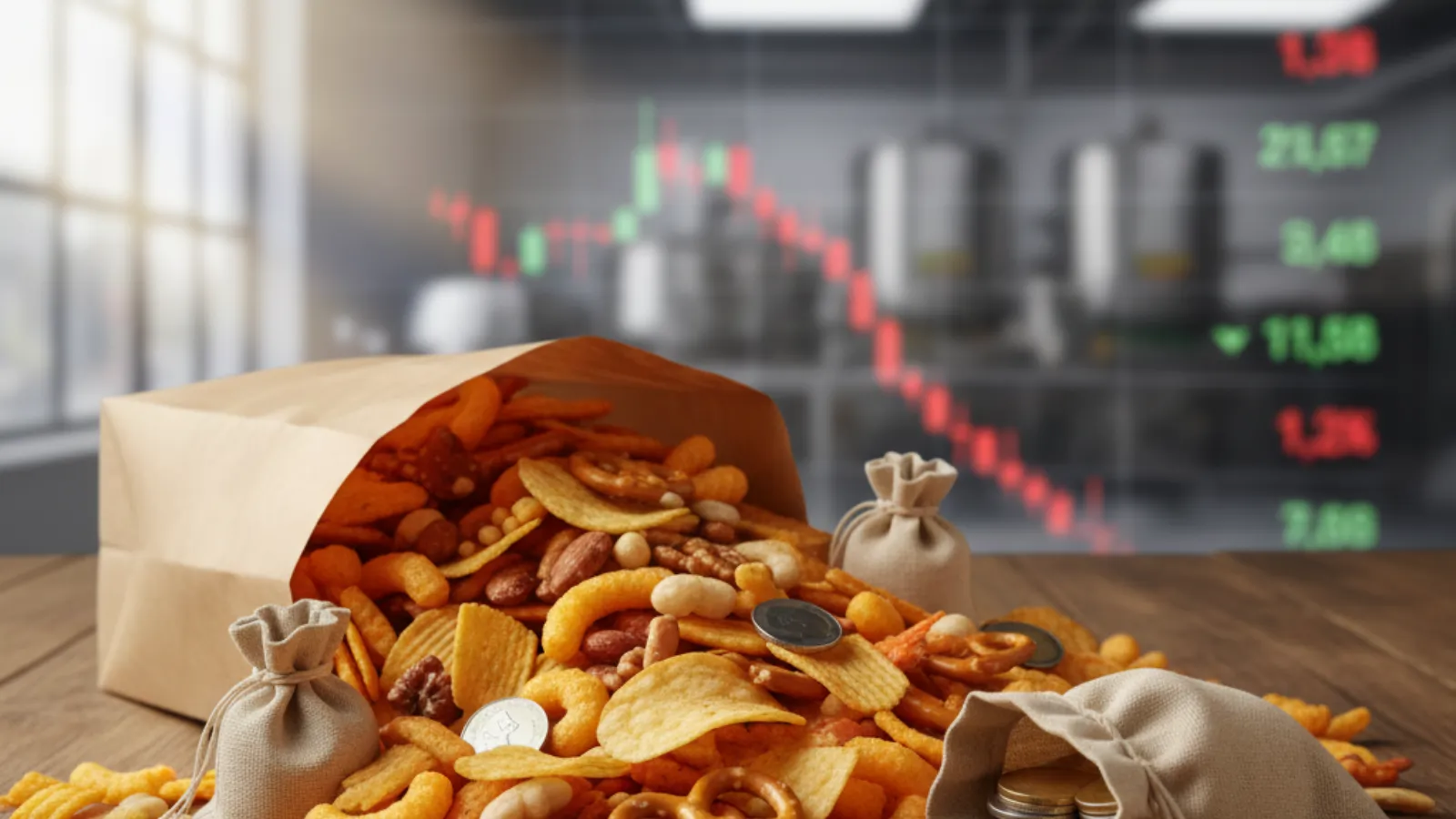
Hershey sold fewer sweets in the second quarter of 2026 and made much more money from them. Volume in its North America confectionery business fell about 10 points. Income from that same business rose 40.1%. The whole quarter sits on that trade.
Adjusted earnings per share came in at $1.90 against a consensus near $1.43. Net sales were $2,787.3 million, up 6.6%. Hershey then narrowed its full-year outlook upward, to net sales growth of 4.5% to 5% and adjusted earnings per share of $8.36 to $8.52, against $6.31 in 2025. The shares fell about 1% on the day.
Twelve points of price against eight points of volume
Organic constant currency sales grew 3.6% in the quarter. Price added about 12 points. Volume took away about 8. North America Confectionery was wider again, at roughly 14 points of price and a 10 point volume decline. The International segment ran 10 points of price against 8 points of volume and posted a $5.1 million segment loss, a fall of $24.9 million on last year.
US candy, mint and gum takeaway rose 3.7% in the 12 weeks to 19 July. Hershey's share of that category fell. The company gave the reason in a single line: increased competitive innovation. Rivals are taking share with new products while Hershey holds the P&L together with price.
The growth engine grew 0.6% on its own
North America Salty Snacks reported net sales of $387.8 million, up 22.9%. About 22 of those points came from LesserEvil, the better-for-you snack business Hershey bought in 2025. Organic constant currency growth was 0.6%.
Segment income was $62.6 million, down 5.9% on last year. Margin fell 500 basis points to 16.1%. Hershey pointed to higher logistics costs, lower price realisation, heavier consumer marketing and weaker mix. Volume did grow about 4 points, held back by supply limits and execution problems on multipacks and Dot's Pretzels.
So the segment Hershey has built its strategy around sold nearly a quarter more product and earned less money doing it. Confectionery margin in the same three months was 32.5%. Salty snacks was 16.1%. Every point of mix that moves from the first to the second costs the company money before anything else happens. At its March investor day, Hershey told the market it was built to lead next generation snacking across sweet, salty and functional. This quarter puts a number on what that shift costs while it is being built.
How much of the profit came from hedging
The reported figures look spectacular. Reported earnings per share of $2.26, up 629%. Reported operating profit of $642.6 million, up 233.3%. Reported gross margin of 45.3% against 30.5% a year ago. A large share of that is accounting. Hershey booked a $102.9 million mark-to-market gain on commodity derivatives in the quarter, against a $200.7 million loss in the same quarter of 2025. That is a swing of more than $303 million with no cases of chocolate attached.
Take the hedging out and adjusted gross margin was 41.6%, up 350 basis points. Adjusted operating profit rose 37.3%. That is a real recovery at roughly a quarter of the headline size. Anyone reading a competitor release this earnings season should find the derivative line before they read the growth rate.
Cocoa fell hard. Shelf prices did not
Cocoa futures traded near $5,327 a tonne in late July, down about 34% over a year and around 70% below the late 2024 peak of nearly $12,000. Hershey still took 14 points of price in its largest segment. Lindt has said it may make selective price cuts in the second half to protect volume. The gap between falling cocoa and standing shelf prices is where the next fight in chocolate happens.
Forward buying explains part of the lag. Chocolate makers cover beans months ahead, so cheaper cocoa reaches the profit line slowly. That buffer is also a clock. Once the expensive cover runs off and one large player cuts, holding price stops being a cost decision and becomes a share decision.
What the second half tests
Hershey has guided to about $100 million of savings from its automation programme and capital spending of $425 million to $475 million. It says it has cost visibility and operating flexibility. The open question is whether it can grow units again without handing back the price. Two quarters of falling volume can be read as elasticity. Four quarters with falling share is a positioning problem.
For operators, the read is plain. Price carried the first half across most of packaged food, and that engine has a limit that arrives with the first competitor cut. For investors, the segment table matters more than the headline number: a company trading a 32.5% margin category for a 16.1% margin one needs unit growth to make the maths work, and units are the line that is falling. For buyers, LesserEvil shows both faces of a deal at once. It gave Hershey a growth story in a quarter when the organic business grew 0.6%, and it diluted the margin while doing it.

Global Aseptic Packaging Market Report 2026
148.4bn litres and 344bn packs in 2025. Aseptic volumes across dairy, dairy alternatives, beverages and food in 39 markets — 2025 actuals and forecasts to 2030. Buy online and receive it within 24 hours.
More information
Global Cheese Database 2026
Production, imports, exports and consumption for 39 cheese types across 48 countries, with actuals through 2025 and forecasts to 2030. Join the waitlist for early access, pre-launch pricing and a free sample country chapter.
Get early accessStrategic Insights
📊 Analytics & Strategic Insight
Price bought the earnings recovery. The bill arrives as volume, share and mix.
The decision most in this industry are avoiding:
👉 Most boards are still reading the headline margin. Hershey's reported gross margin jumped 1,480 basis points and most of that was a hedging swing. The underlying gain was 350 basis points. Both numbers are true. Only one of them repeats.
👉 Buying growth in a lower margin category is a decision to earn less per unit for years. Salty snacks pays 16.1%. Confectionery pays 32.5%. That trade rarely appears on the slide that recommends the deal.
👉 Falling input costs are a share risk before they are a margin gift. The first large player to pass cocoa relief to the shelf resets the whole category. Sitting on the relief is a decision, and it is being made quietly across chocolate right now.
Here's the full context:
→ Late 2024: Cocoa futures peaked near $12,000 a tonne and forced the largest price rises confectionery had taken in decades.
→ 2025: Hershey acquired LesserEvil, adding a better-for-you snack platform and about 150 basis points to 2026 net sales growth.
→ March 2026: At its investor day, Hershey set out a plan to lead next generation snacking across sweet, salty and functional, and reaffirmed full-year guidance.
→ July 2026: Cocoa traded near $5,327 a tonne, roughly 70% below the peak, while retail chocolate prices stayed high and Lindt flagged possible selective cuts.
→ Most recent: Q2 results on 30 July. Adjusted EPS of $1.90 against $1.43 expected, price up 12 points, volume down 8, confectionery share lower and salty snacks profit down 5.9%. The shares fell.
What this means for food and beverage operators and investors:
✅ Segment margin decides whether a portfolio pivot creates value. Model the blended margin after the mix shift, then work out how much extra volume you need simply to stand still.
✅ Acquired growth and built growth belong on separate lines in the board pack. In this quarter, 22.9% and 0.6% describe the same business.
✅ Elasticity is now measurable in public, so use it. Hershey gave the market a clean read: about 10 points of volume for 14 points of price in its core category. Most categories have a similar ratio and very few teams have written theirs down.
3 moves you can make this week:
1️⃣ Strip the hedging out of three competitor releases. Rebuild their margin without the derivative line. The ranking of who is actually recovering usually changes.
2️⃣ Split your last eight quarters of growth into bought and built. Put both lines on one chart and take it to the next review.
3️⃣ Write your price-cut trigger down before a rival sets it for you. Name the input cost level and the share loss that would make you move, and agree it now while nobody is panicking.
Take the Next Step
🧭 Got a project in mind?
Send us your thoughts and project requirements and our consultants will build you a project plan.
→ Start a project enquiry
Zenith Consulting
Submit your food & beverage project enquiry.
Share your requirements. If there is a strong fit, we’ll come back with an indicative investment range, project timeline and recommended strategic approach.
Reviewed by Zenith Consulting’s senior food & beverage strategy team.
Related analyses
- Corporate Strategy & Portfolio
Cheddar Jumps 16.5% While Mozzarella Falls 6%: The GDT Cheese Spread Swung $824 A Tonne In Two Weeks
Cheddar rose 16.5% and mozzarella fell 6.0% at the same Global Dairy Trade auction on 15 September. Two cheeses made from the same milk moved $824 a tonne apart in a fortnight, and the reason sits in the vats.
Read analysis → - Corporate Strategy & Portfolio
SIG Backs India's Regional Drinks: Aseptic Filling Has Fallen To 40.3% Of Indian Ambient Beverage Volume
SIG argues that aseptic cartons can take India's regional drinks national. Zenith's India data shows aseptic filling losing 17 points of ambient beverage share since 2020, while UHT milk grows at 12.3% a year.
Read analysis → - Corporate Strategy & Portfolio
China Aseptic Packaging: Litres Keep Rising, Packs Have Stopped, And The Average Pack Is Now 343ml
China filled 37,391 million litres of aseptic product in 2025 and used no more packs than it did in 2020. Zenith's Global Aseptic Packaging Market Report 2026 shows why the litre line and the pack line have split.
Read analysis →
Share it with your peers
Pass this analysis to colleagues who track the food and beverage market.
Zenith Market Intel
Need a specific food or beverage market report?
Tell us which category, region or question would be useful for your team.
Sister Publication
Also follow our Water Dispense Market Intelligence
Category analyses, operator briefings, and investor signals across the global water dispense market.