India Drops Front Of Pack Warning Labels: What Coca-Cola, Nestle And PepsiCo Just Bought
India's food watchdog has dropped its push for red warning marks on the front of packs after a tense March meeting with the trade. Nearly 80% of a $100 billion market would have carried a red mark, and the Supreme Court is now looking at that call.
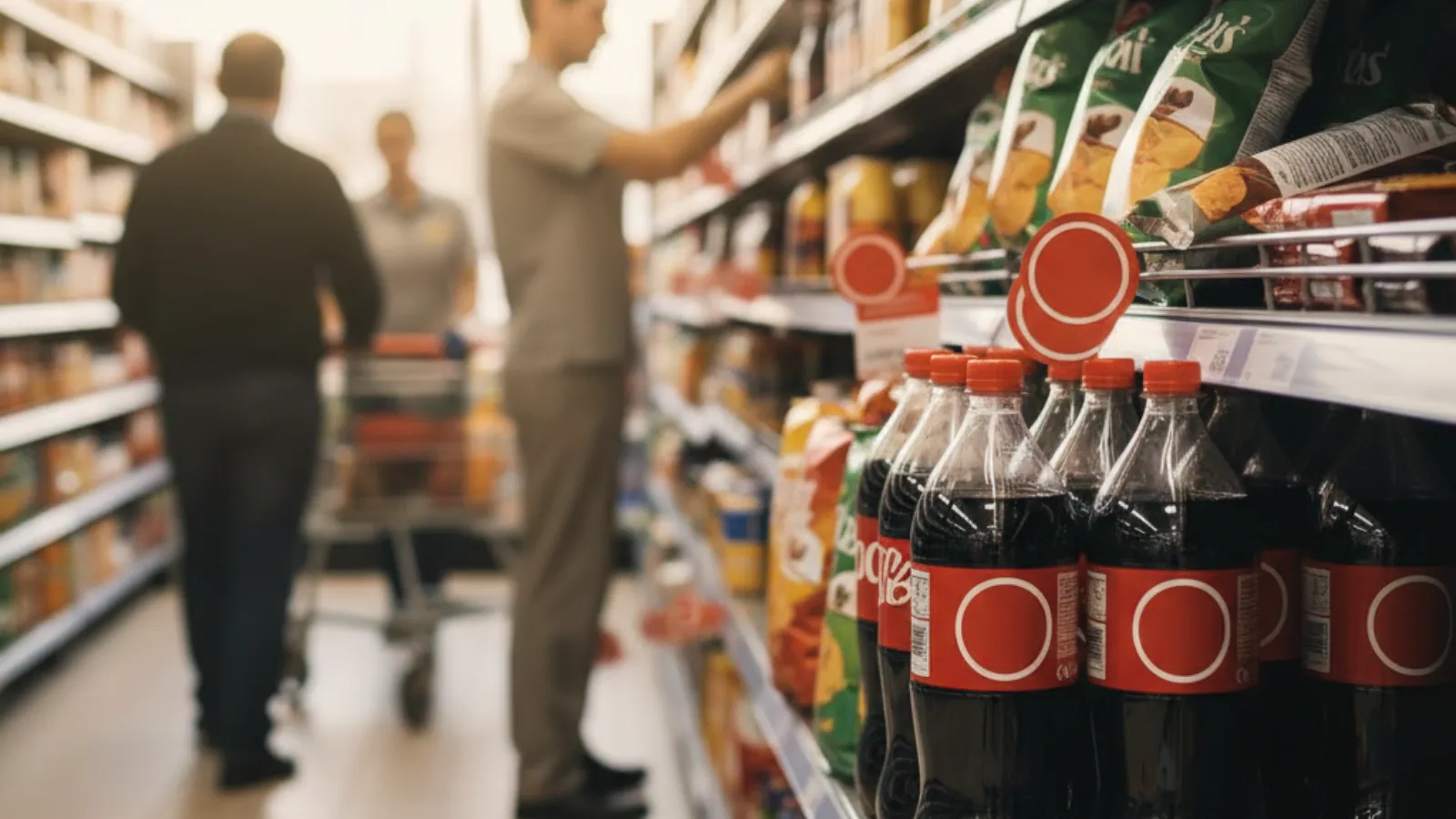
I had this filed as a printing row. Then one number changed my read. Nearly 80% of India's packed food and drink would carry a red mark.
On 25 August 2026 Reuters set out how the fight was won. India's food watchdog, the FSSAI, has dropped its push for coloured warnings on the front of packs. It has offered a black and white table of sugar, fat and salt instead. India's Supreme Court is now looking at that call.
The 80% figure came from the trade itself. Deepak Jolly of the Ind Food and Beverage Association gave it to watchdog staff at a March meeting. India's packed food and drink market is worth more than $100 billion. So the label fight was never about ink.
What the marks would have shown
A can of Fanta in London holds 63 calories. The same brand in India holds three times the sugar. It also uses a dye that needs a health warning on packs in Europe. In India that dye sits in small print on the back.
The gap runs well past drinks. An Indian KitKat has 4.5% cocoa solids. The Australian milk bar has at least 22%. Every Maggi pack sold in India uses palm oil. Many packs sold in Britain use a dearer oil.
The Maggi pack that gives the game away
Here is the part that should worry a board. Many Maggi packs sold in Britain are made in India. Those packs carry a red front mark for high salt. So the same plant prints the warning today. It just prints it for one market.
That guts the cost case. The plant can do it. The line can do it. The artwork can do it. What stays dear is the mix inside the pack.
A win that buys time, and time has a price
Coca-Cola and its bottlers put traffic light marks on drinks in about two dozen European markets by choice. Coca-Cola HBC calls those marks clear and open on its own site. Nestle has used the same style in Britain since 2013.
So the case made in India rests on price. Mili Bhattacharya of Coca-Cola India told the March meeting that a mark on a pack changes little. Parul Sharma, once a boss at Mondelez, put it plainer. Price drives most of the gap between recipes across borders.
The pressure that needs no rule
Rules are one route to the shelf. Shoppers are the other. Revant Himatsingka posts as Food Pharmer and used to work at McKinsey. More than 5 million people follow him on YouTube and Instagram. He holds an Indian pack next to a European one on video.
PepsiCo took him to a Delhi court in 2023 over a clip on its Sting drink. It won a take down order. The clip went. The habit did not. Other food firms in India have filed against posters too. That route buys quiet, and it buys it in public.
What the delay is really worth
A red mark forces one of two moves. Cut the sugar, salt or fat, and pay for that. Or print the mark and watch the shelf. Both cost money. A firm that wins a delay banks the gap between those two bills.
The bill still lands in the end. Roughly 20 nations now use red and green front marks. India's judges told the FSSAI the world should know India cares about health. Sales of weight loss drugs in India are up 400% since early 2025, per Pharmarack. A Lancet study says 450 million Indians could be obese or too heavy by 2050.
What happens next
The Supreme Court holds the file now. If it sends the FSSAI back, the trade loses its delay in one ruling. Firms that have started to trim sugar will pay less than firms that waited.
For buyers and boards the read is short. Value the delay, then value the mix. A win at the watchdog does not change what is in the pack. Nestle moved once here, putting sugar free Cerelac into India in 2024 after 50 years. The next move will cost more, because it will be forced.

Global Aseptic Packaging Market Report 2026
148.4bn litres and 344bn packs in 2025. Aseptic volumes across dairy, dairy alternatives, beverages and food in 39 markets — 2025 actuals and forecasts to 2030. Buy online and receive it within 24 hours.
More information
Global Cheese Database 2026
Production, imports, exports and consumption for 39 cheese types across 48 countries, with actuals through 2025 and forecasts to 2030. Join the waitlist for early access, pre-launch pricing and a free sample country chapter.
Get early accessStrategic Insights
📊 Analytics & Strategic Insight
The label fight is a recipe audit in fancy dress
The decision most in this industry are avoiding:
👉 The cost sits in the mix rather than the ink. Most boards price a label change as artwork and print. The bill that bites is cutting sugar, salt and fat while holding the taste and the price.
👉 A win at the watchdog has a shelf life. Delay is worth money. Very few firms put a date or a number on it, so nobody owns the day it runs out.
👉 Your own export packs are the proof. A plant that prints a red mark for Britain has shown the job can be done. That fact will be used against the cost case.
Here's the full context:
→ 2013: Nestle began using front of pack marks in Britain by choice. It kept the plain back label in India.
→ 2017: India's watchdog first floated coloured warnings and star ratings. Makers still only had to list detail on the back.
→ February 2026: India's Supreme Court told the FSSAI to look at warning marks. It pointed at the red and green system used in Israel.
→ March 2026: Bosses met the FSSAI on 19 March. They argued the marks confuse shoppers and do not shift diets.
→ Most recent: In August 2026 the FSSAI dropped the coloured warnings. Reuters set out the meeting tapes on 25 August 2026.
What this means for food and beverage operators and investors:
✅ Price the delay. Put a date on when the rule lands and a cost on what it forces. A win with no number is just a good mood.
✅ Two recipes, one story. Shoppers now hold both packs up side by side and post the photo. The gap gets read as a slight, whatever the price logic behind it.
✅ Watch the court rather than the watchdog. The FSSAI has moved once already. The judges hold the file and the last word.
3 moves you can make this week:
1️⃣ Put your India pack next to your Britain pack. Do it for your top five lines. If the gap would shame you in a photo, you have a job to start.
2️⃣ Cost the cut. Ask what 20% less sugar does to the line, the taste and the shelf price. Do it now, while it is your choice.
3️⃣ Ask your plants what they print for export. If a line runs red marks for one market, you hold both the kit and the risk.
Take the Next Step
🎯 This is the thinking we bring to client projects.
If today's topic touches a decision on your desk this quarter, start the conversation before the window closes.
→ Start the conversation
Zenith Consulting
Submit your food & beverage project enquiry.
Share your requirements. If there is a strong fit, we’ll come back with an indicative investment range, project timeline and recommended strategic approach.
Reviewed by Zenith Consulting’s senior food & beverage strategy team.
Related analyses
- Health, Nutrition & Functional
Dreher Adds A 12,000 Carton An Hour Elopak Aseptic Line Into A German Juice Market Down To 1,915 Million Litres
Dreher Group has started filling its own aseptic cartons at Stockach on an Elopak E-PS120AH running up to 12,000 cartons an hour. It joins a German market where Zenith's own data shows aseptic volume falling 2.6% a year and juices and nectars down to 1,915 million litres.
Read analysis → - Health, Nutrition & Functional
SIG Targets 85% Paper In Aseptic Cartons: Aluminium-Free Still Has Enormous Room To Scale
SIG says it is working towards 85% paper content in its aseptic cartons, with polymer and fibre barriers doing the work aluminium used to do. Set against the 344 billion aseptic packs filled worldwide in 2025, the aluminium-free carton is still a rounding error.
Read analysis → - Health, Nutrition & Functional
Saputo Creates A Dairy Ingredients Division: Cheese Plants Are Now Judged On Their Whey
Saputo has split dairy ingredients into its own division under Steve Douglas. US cheese output rose 2.1% in July while whey protein concentrate output fell 2.3%.
Read analysis →
Share it with your peers
Pass this analysis to colleagues who track the food and beverage market.
Zenith Market Intel
Need a specific food or beverage market report?
Tell us which category, region or question would be useful for your team.
Sister Publication
Also follow our Water Dispense Market Intelligence
Category analyses, operator briefings, and investor signals across the global water dispense market.