Lactalis Takes Its Nutri-Score Fight to Europe's Top Court: Why a Dairy Giant's Labelling Battle Could Reshape Front-of-Pack Rules
Lactalis has taken its challenge to France's Nutri-Score labelling to the EU's top court, arguing one country cannot impose its own mandatory front-of-pack rules. The case lands as Danone quits the scheme and France lobbies Brussels to make the label compulsory across Europe.
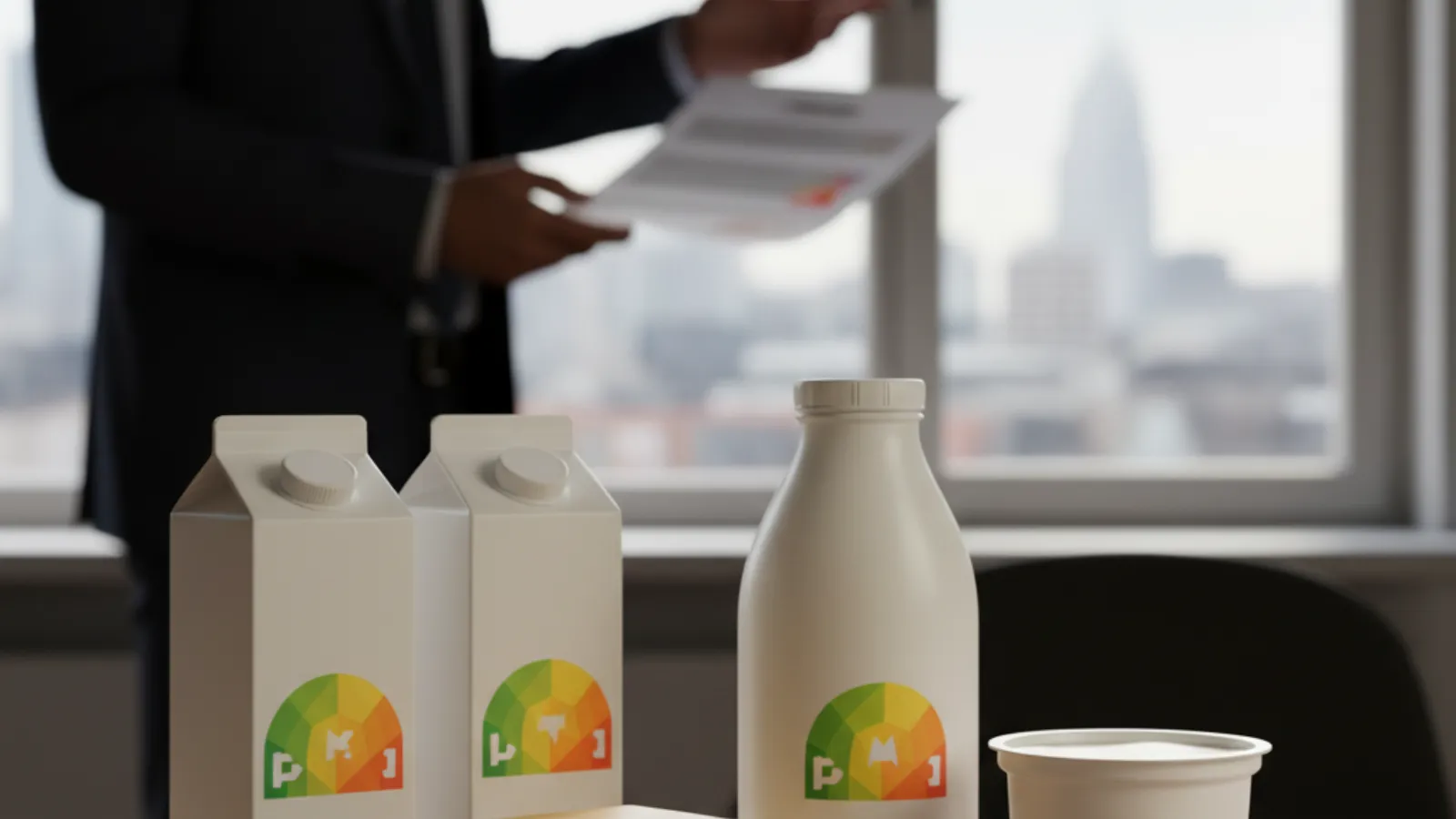
The world's largest dairy company is now fighting France in Europe's highest court. The weapon is a coloured label the size of a stamp.
Lactalis, the privately owned French group behind Parmalat, Galbani and Président, has confirmed that its legal challenge to Nutri-Score will go before the Court of Justice of the European Union. France's Council of State, the Conseil d'État, has paused its own ruling and asked the EU court to interpret the law first. For a fight about front-of-pack labels, the stakes are unusually large.
What Lactalis is actually arguing
Nutri-Score grades food and drink from a green A to a red E. France built the system in 2017 and changed how it works in March 2025. Lactalis filed an appeal in September 2025 to cancel that change. Its case is simple: nutrition information on packs is set by one EU-wide rule, the INCO Regulation (Regulation 1169/2011), so a single country should not be able to bolt on its own mandatory version.
The March 2025 update is what stings dairy. Milk, flavoured milks, drinkable yogurts and plant-based drinks are now scored with the algorithm used for soft drinks. Water is the only drink that can earn an A. Drinks with sweeteners dropped from a B to somewhere between C and E. A category that sells itself on protein and calcium now sits on the same scale as cola.
Lactalis is not alone
Rivals have already voted with their feet. Danone pulled out of Nutri-Score, calling it "a major inconsistency" that lumps dairy drinks in with soft drinks. Nestlé said last year it would start stripping the labels off some products in Switzerland as shopper use faded, while keeping them elsewhere in Europe. Portugal backed away from rolling out the labels in 2024 over "confusing classifications." Italy decided back in 2022 that the scheme could mislead people.
So Nutri-Score stays voluntary, and only six countries use it: France, Belgium, Spain, Germany, Luxembourg and the Netherlands. That voluntary status is the whole battlefield. France has been pushing the European Commission to make the label compulsory across the bloc, with another attempt last November. A win for Lactalis at the EU court would make that much harder. A loss could clear the runway for a mandatory, France-shaped label on every pack in Europe.
Why a label fight is really a margin fight
Front-of-pack scores look cosmetic. They are not. A letter on the front of the box changes what shoppers buy, what retailers stock and how hard a company has to reformulate. A B that turns into a D can push a product off a supermarket's "better choice" shelf or out of a school contract. When the rules of the score change, the worth of a recipe changes with it, overnight, with the product itself untouched.
This is why the case matters well beyond cheese. Every large food and drink maker now runs its portfolio partly to the test of these scores. Sugar, salt, fat and sweetener choices are tuned to them. If the EU court says a national government cannot set its own mandatory label on top of the shared EU rule, it limits how far France, or any member state, can move the goalposts. If the court sides with France, makers face a future where one country's algorithm can reprice their whole range.
What to watch next
The case now runs at European level, which means a wait. Referrals to the EU court often take more than a year. The bigger signal is that Big Food has stopped treating Nutri-Score as a marketing nicety and started treating it as regulation worth fighting in court. Danone exited. Lactalis is suing. Nestlé is trimming. The mood has turned from polite participation to open resistance.
For operators and investors, the read-across is direct. Front-of-pack labelling is moving from a voluntary badge to a contested legal standard, and the result will set how much power any single market has to grade your products. Anyone selling dairy, drinks or reformulated snacks in Europe should treat this referral as a live risk to shelf position and pricing. The cheese headline understates how far it reaches.

Global Aseptic Packaging Market Report 2026
148.4bn litres and 344bn packs in 2025. Aseptic volumes across dairy, dairy alternatives, beverages and food in 39 markets — 2025 actuals and forecasts to 2030. Buy online and receive it within 24 hours.
More information
Global Cheese Database 2026
Production, imports, exports and consumption for 39 cheese types across 48 countries, with actuals through 2025 and forecasts to 2030. Join the waitlist for early access, pre-launch pricing and a free sample country chapter.
Get early accessStrategic Insights
📊 Analytics & Strategic Insight
When the Label Becomes the Law: Front-of-Pack Scores Are Now a Boardroom Risk
The decision most in this industry are avoiding:
👉 Owning Nutri-Score in the brand team. It used to be a marketing badge. It is now a regulatory and pricing question that belongs with the C-suite.
👉 Reformulating to chase a moving score. A single government can rewrite the algorithm, so a recipe tuned to today's rules can fail tomorrow's.
👉 Reading "voluntary" as "optional". The real contest is whether one country can make its own version mandatory for the whole bloc.
Here's the full context:
→ 2017: France launches Nutri-Score (A to E) at the health ministry's request; six EU countries later adopt it voluntarily.
→ 2022 to 2024: Italy calls the scheme misleading; Portugal backs away over "confusing classifications."
→ March 2025: France changes the algorithm; milk, drinkable yogurts and plant-based drinks get scored like soft drinks, and sweetened drinks fall from B to C-E.
→ September 2025: Lactalis appeals to France's Council of State to annul the change, citing the EU INCO Regulation; Danone exits the scheme and Nestlé starts pulling labels in Switzerland.
→ Most recent: France's Council of State refers the question to the EU's top court, while France keeps lobbying Brussels to make Nutri-Score mandatory across Europe.
What this means for food and beverage operators and investors:
✅ Label risk is now portfolio risk. A score change can reprice a whole range without anyone touching the recipe.
✅ This case is really national power versus EU law. The ruling sets how far any one market can grade the products you sell there.
✅ Dairy and better-for-you drinks are most exposed. The soft-drink algorithm punishes the protein and calcium products that used to score well.
3 moves you can make this week:
1️⃣ Map your exposed SKUs. List every product you sell in Nutri-Score countries and flag which ones lost a grade after the March 2025 change.
2️⃣ Plan for both endings. Pressure-test your reformulation roadmap against France winning (voluntary stays) and France losing (a mandatory EU label gets likelier).
3️⃣ Put legal and commercial in one room. Decide shelf, pricing and compliance off a single view so a label change never blindsides the commercial plan.
Take the Next Step
🧭 Got a project in mind?
Send us your thoughts and project requirements and our consultants will build you a project plan.
→ Start a project enquiry
Zenith Consulting
Submit your food & beverage project enquiry.
Share your requirements. If there is a strong fit, we’ll come back with an indicative investment range, project timeline and recommended strategic approach.
Reviewed by Zenith Consulting’s senior food & beverage strategy team.
Related analyses
- Health, Nutrition & Functional
Dreher Adds A 12,000 Carton An Hour Elopak Aseptic Line Into A German Juice Market Down To 1,915 Million Litres
Dreher Group has started filling its own aseptic cartons at Stockach on an Elopak E-PS120AH running up to 12,000 cartons an hour. It joins a German market where Zenith's own data shows aseptic volume falling 2.6% a year and juices and nectars down to 1,915 million litres.
Read analysis → - Health, Nutrition & Functional
SIG Targets 85% Paper In Aseptic Cartons: Aluminium-Free Still Has Enormous Room To Scale
SIG says it is working towards 85% paper content in its aseptic cartons, with polymer and fibre barriers doing the work aluminium used to do. Set against the 344 billion aseptic packs filled worldwide in 2025, the aluminium-free carton is still a rounding error.
Read analysis → - Health, Nutrition & Functional
Saputo Creates A Dairy Ingredients Division: Cheese Plants Are Now Judged On Their Whey
Saputo has split dairy ingredients into its own division under Steve Douglas. US cheese output rose 2.1% in July while whey protein concentrate output fell 2.3%.
Read analysis →
Share it with your peers
Pass this analysis to colleagues who track the food and beverage market.
Zenith Market Intel
Need a specific food or beverage market report?
Tell us which category, region or question would be useful for your team.
Sister Publication
Also follow our Water Dispense Market Intelligence
Category analyses, operator briefings, and investor signals across the global water dispense market.