Ground Beef At $6.89: Trump Calls Tyson, Cargill And JBS A Monopoly While The US Herd Sits At A 75-Year Low
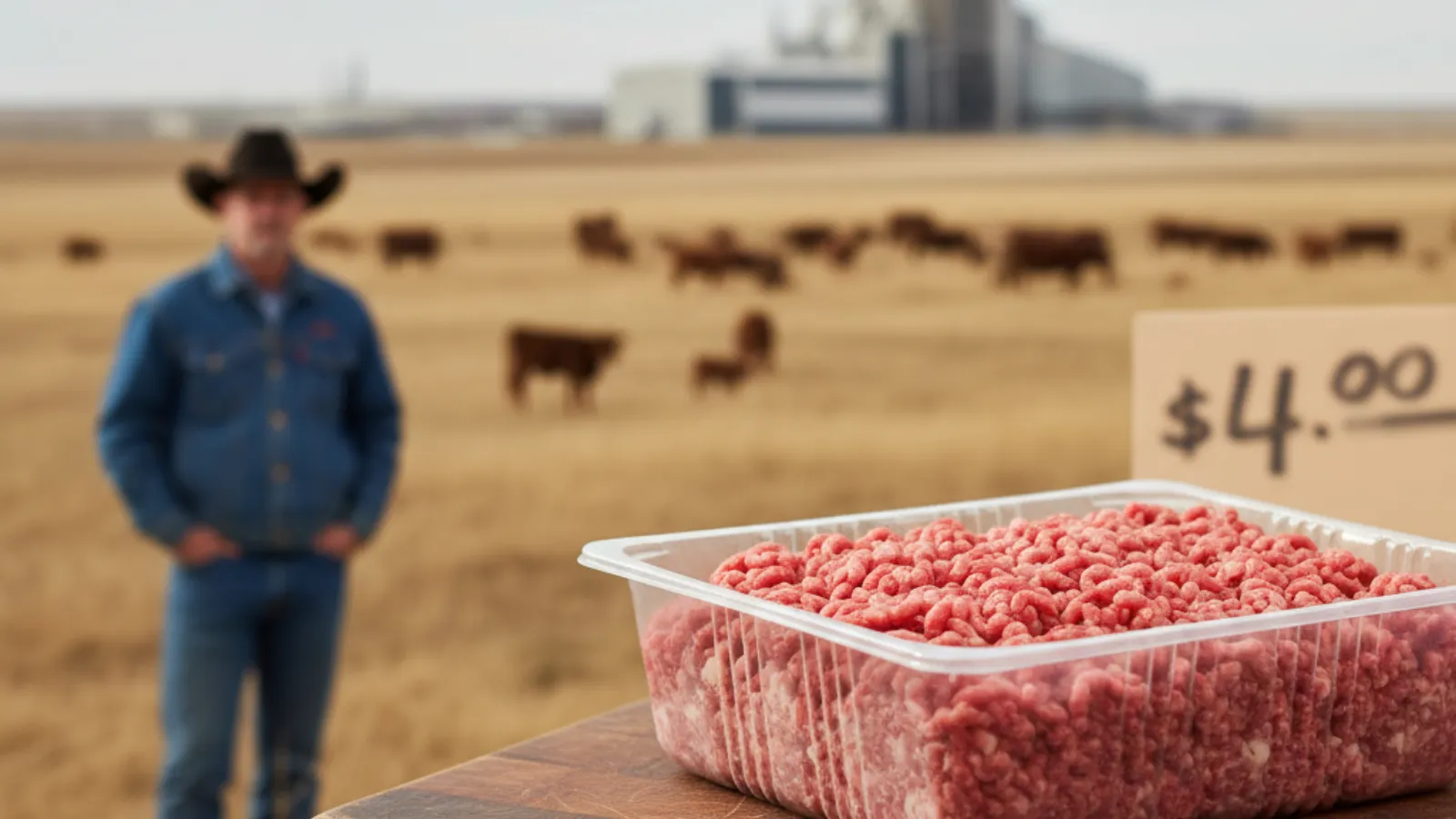
Trump has called Tyson, Cargill, JBS and National Beef a nasty Monopoly and wants ranchers to process their own meat. With ground beef at $6.89 a pound and the US herd the smallest since 1951, the shortage sits in the pasture and not in the plant.
I keep seeing the same move. A price runs hot, so the state goes after the middle of the supply chain. The shortage nearly always sits at the front of it.
Washington is now going after the middle of the beef chain. On Friday 28 August, President Trump posted on Truth Social. He is drawing up legal papers to let farmers and ranchers process their own food. He called the four big meat firms a "nasty Monopoly." He did not name them. They are Tyson, Cargill, JBS and National Beef, and they handle about 85% of US meat.
The shortage sits at the front of the chain, in the herd. The USDA counted 86.2 million cattle and calves in January. That is the smallest US herd since 1951. Beef cows came in at 27.6 million. Cattle on feed fell 3% to 13.8 million.
The price that started this
Ground beef hit $6.885 a pound in July. US labour data puts that at roughly 83% above the 2017 low of $3.77. The price crossed $5 in 2023 and $6 in 2025. Drought abroad and a shrinking US herd did most of that work.
The packers are feeling it too. Tyson booked a $707m loss in its beef arm over nine months. Beef volumes fell 15.9% in the quarter to 27 June. Prices Tyson charged shops and restaurants rose 12.1%. A firm with real power over price does not lose money that way.
Two moves in eight days
This is the second push in a week. On 21 August the White House opened a 90-day window. It will let in up to 300,000 tonnes of ground beef product with no out of quota tariff. Trump said he had a promise that the beef would sell 25% below market. The cattle trade group opposed both moves.
Colin Woodall, chief of the National Cattlemen's Beef Association, said the import plan trades long-run health for a short-run headline. After Friday's post, the same group warned that constant meddling by the state makes ranchers hold back on long-term bets.
Why a new plant will not fix the shelf price
Farm Secretary Brooke Rollins said the USDA would start on Monday, cutting red tape and helping small plants. That could help ranchers in time. A new small plant takes years to build and needs cattle to run. The rules in play date to the Wholesome Meat Act of 1967. A House bill called the PRIME Act would let states clear small plants to sell in state. It has not moved.
Even so, more small plants will not add a single calf. Herd rebuilding runs on a slow clock. A rancher who holds back a heifer gives up the sale today. Then the wait runs about two years before the calf reaches weight. Cheap imports cut the price signal that would pay for that wait.
The read across the wider food chain
Beef sits inside far more than a steak. It is in ready meals, pet food, soups, sauces, frozen goods and every burger menu in the country. Firms in those aisles have carried a rising input cost for three years. Most have paid for it with smaller packs or a higher shelf price.
The import window hands some of them 90 days of cheaper trim. That is a real saving for a firm buying lean beef in bulk. It is also a trap. A buyer who prices a deal off 90-day beef will find the floor gone in December.
What changes for food and drink buyers
The price risk here has turned into rule risk. A buyer can hedge a price. No one can hedge a rule that shifts inside eight days. Two moves landed in that window. Neither has been signed yet.
The monopoly claim carries a cost even without an order. Four firms now sit under a public light on how they price and sign deals. Any buyer with beef in a recipe should pull up its supply deals and read the renewal dates.
There is an opening here as well. The cattle group asked the state to back mid-size and regional plants. If the USDA follows through, a slice of kill and cut work moves out of the big four. Anyone buying beef at scale should start scouting regional plants now. The firms that line up a second source this autumn will buy better in 2027.

Global Aseptic Packaging Market Report 2026
148.4bn litres and 344bn packs in 2025. Aseptic volumes across dairy, dairy alternatives, beverages and food in 39 markets — 2025 actuals and forecasts to 2030. Buy online and receive it within 24 hours.
More information
Global Cheese Database 2026
Production, imports, exports and consumption for 39 cheese types across 48 countries, with actuals through 2025 and forecasts to 2030. Join the waitlist for early access, pre-launch pricing and a free sample country chapter.
Get early accessStrategic Insights
📊 Analytics & Strategic Insight
Why the beef fix will not land where the shortage is
The decision most in this industry are avoiding:
👉 The four big packers are losing money on beef. A firm squeezing a market does not book a $707m loss in nine months. The margin sits with the rancher this cycle.
👉 The import window is a discount you cannot build a plan on. Ninety days of trim will move a quarter. It will move nothing in a contract year.
👉 Small plants help ranchers and will not cut the shelf price. Kill and cut is a thin slice of the retail dollar. Sharing that slice among more firms moves cents.
Here's the full context:
→ 2022 to 2025: Drought across the plains forced ranchers to sell cows. The US herd shrank for a fourth straight year.
→ January 2026: The USDA counted 86.2 million cattle and calves. That is the smallest US herd since 1951.
→ July 2026: Ground beef hit $6.885 a pound in US labour data. The 2017 low was $3.77.
→ August 2026: Tyson cut its outlook. Its beef arm had lost $707m over nine months.
→ Most recent: Trump called the big four a "nasty Monopoly" on 28 August. He said he is drawing up papers to let ranchers process their own meat.
What this means for food and beverage operators and investors:
✅ Rain sets your beef cost more than any rule will. Watch the herd count and the drought map before you watch the White House.
✅ Rule risk now sits alongside price risk. Two moves landed in eight days and neither is signed. Build a plan that survives both outcomes.
✅ A second source is worth more than a better price. If regional plants get help, the buyers who called them first get the slots.
3 moves you can make this week:
1️⃣ Pull your beef contracts and list the renewal dates. Anything renewing inside the 90-day window will be priced off a floor that vanishes.
2️⃣ Call two regional plants this week. Ask about spare capacity and lead times. Ask what a red tape cut would let them add.
3️⃣ Rerun your 2027 budget on the July herd count. Cattle and calves stood at 94.2 million on 1 July, up under 1%. That is the real supply signal.
Take the Next Step
🧭 Got a project in mind?
Send us your thoughts and project requirements and our consultants will build you a project plan.
→ Start a project enquiry
Zenith Consulting
Submit your food & beverage project enquiry.
Share your requirements. If there is a strong fit, we’ll come back with an indicative investment range, project timeline and recommended strategic approach.
Reviewed by Zenith Consulting’s senior food & beverage strategy team.
Related analyses
- Corporate Strategy & Portfolio
Oji Liquid Pak's USD 110 Million Vietnam Aseptic Carton Plant Adds 8 Billion Packs To A Region Already At 62 Billion
Oji Liquid Pak broke ground on a USD 110 million aseptic carton material plant in Dong Nai, rated at up to 8 billion packs a year from 2028. Zenith puts Vietnam at 10,358.7 million aseptic packs in 2025, and South East Asia already holds about 62 billion packs of documented converting capacity.
Read analysis → - Corporate Strategy & Portfolio
Spain Swaps HDPE Milk Bottles For Aseptic PET: 170 Million Litres Left And Only Three Aseptic PET Dairy Lines
Spanish UHT milk in large HDPE bottles fell from 307 million litres in 2020 to 170 million in 2025, and Zenith's model takes it to 88.5 million by 2030. Aseptic PET is taking the volume, and only three aseptic PET dairy lines have been documented in the country.
Read analysis → - Corporate Strategy & Portfolio
US Parmesan Output Jumps 25.9% While Cheddar Slips: Italian Cheese Takes Four In Five Pounds Of Growth
USDA figures published on 5 October show US Parmesan output up 25.9% in August while cheddar fell 0.9%. Italian types have supplied nearly four in every five pounds of US cheese growth so far in 2026.
Read analysis →
Share it with your peers
Pass this analysis to colleagues who track the food and beverage market.
Zenith Market Intel
Need a specific food or beverage market report?
Tell us which category, region or question would be useful for your team.
Sister Publication
Also follow our Water Dispense Market Intelligence
Category analyses, operator briefings, and investor signals across the global water dispense market.