Elopak's European Aseptic And Fresh Carton Sales Rose 10.7% While America Stood Still On Rationed Board
Elopak's European carton sales rose 10.7% in the third quarter while its American carton line held flat at EUR 85.5m. Rationed board, rather than weak demand, set the American number, and that changes how a carton market should be read.
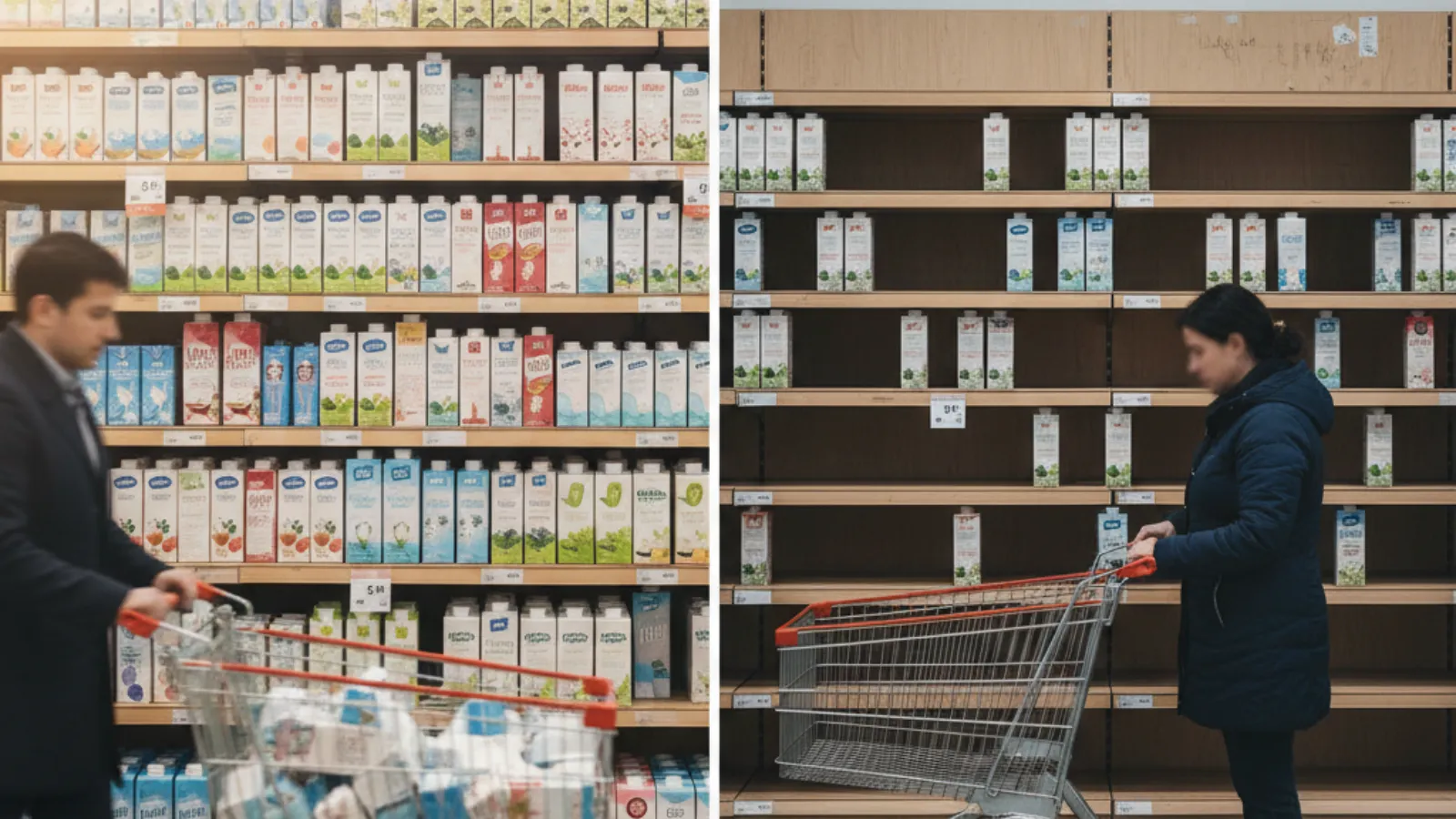
My view is simple. Elopak's American carton sales did not stand still because dairies stopped buying cartons. They held flat at EUR 85.5m for the quarter while Europe's rose 10.7%. The board ran short, so supply wrote the number before demand could.
What the quarter actually showed
Elopak reported its third quarter on 27 October. Revenue reached EUR 308.4m, up 6.5% on the year. Trading profit came in at EUR 51.9m, a record for a quarter at the group. The margin on it was 16.8%, against 17.0% a year earlier. So sales grew and the margin slipped at the same time. That happens because the extra sales arrived with extra cost. Board bought away from the usual mill costs more to buy. It travels further to reach the plant. More of it ends up as waste when the line runs it. Insurance money has started to come back against those costs. More of it is due, and it lands later than the cost did. The group also carries a new 50% American duty on caps shipped in from Canada. Cartons and board moving the other way are still clear of it.
Europe carried it, and surcharges did much of the work
The European side did the lifting. Its sales rose 7.5% to EUR 218.1m, with cartons and closures up 10.7%. Elopak said buyer surcharges fully covered higher input costs this time. In the spring they covered only part of them. Here is why that gap matters so much. A surcharge clause resets on a published price after the cost has landed. The maker carries the rise for a quarter and bills it the quarter after. So a line that reads as growth can be an old cost coming home. Carton volume did grow as well, in UHT long-life milk and in fresh dairy. Germany led that, and Roll Fed packs grew on new work in Poland. Volumes went the other way in the Middle East and North Africa, on price and one lost tender. India was a shade lower. Machine sales tell a third story. Group equipment sales fell to EUR 27.7m for the nine months, from EUR 49.7m. The reason is simple. More fillers are going out on lease rather than being sold outright. A leased filler brings in almost nothing in the year it starts work.
The American carton line did not move
The American business looks healthy at first glance. Sales there rose 5.9% to EUR 97.5m. The cartons and closures inside that were flat at EUR 85.5m. The growth came from machines and spares instead. Equipment sales in the region reached EUR 6.1m, close to double the year before. School milk drove most of those commissions. That happens because Elopak held the board it could get for the buyers it already had. A carton maker cannot sign a new dairy it may not be able to supply. Losing a contract on short shipments costs more than never taking it. So the quarter shows new lines being started while the carton volume behind them waits. A region can look busy on equipment and go nowhere on packs.
What a supply ceiling costs, and who pays it
The cost shows up in the margin. The American margin fell to 20.6% from 23.8%. Elopak said it would have been about 23% without the supply trouble. The mill behind the shortage is still not running properly. Most of its people went back to work in October, five months after the accident that stopped it. The owner has agreed to keep paying idled staff into January. That matters because insurance covers the maker's extra cost rather than the buyer's missing cartons. A dairy with orders to fill goes and finds a second supplier. Qualifying that supplier takes months of trials and paperwork. Here is the part that lasts. A buyer who has done that work rarely hands the volume back in full. So the bill for a mill failure is split. The converter claims its costs. The market share moves anyway.
Why a carton maker's sales line is a poor read on aseptic packs
This is where market sizing goes wrong. Elopak made 16 billion cartons in 2025, and aseptic work was 31% of its carton sales. The rest is chilled fresh milk and juice. Zenith counts about 344 billion aseptic packs filled around the world in that same year. So Elopak is a large fresh carton maker and a modest aseptic one. Cartons still carry 66.5% of world aseptic volume, so carton makers are the right place to look. The mechanism is simple. A revenue line mixes price, surcharge, machines and packs together. Packs are the only part of it that measures the market. A group can grow 6.5% on surcharge recovery while the packs stand still. The reverse happens too. A maker can place more fillers on lease and show less equipment revenue for it. Anyone sizing a market from supplier sales alone will read both of those backwards.
The Zenith read on where this lands
We think American carton volume at Elopak stays capped into the first half of next year. The company guides to a full-year margin of about 15%. That sits below what it has just printed. So the group is telling the market its own supply has not been fixed. The mill is the gate, and it has no public date for full output. That matters because a converter cannot promise volume off a mill with no restart date. We therefore expect two more quarters where machines and spares grow faster than cartons. The figure we watch is the American cartons and closures line. When it moves off EUR 85.5m, the board has come back and the ceiling has gone. A third line goes into Arkansas in the second half of 2027. It is aimed at small school packs rather than long-life work. That tells you where Elopak thinks its American growth sits. Our opening claim settles here. Supply, rather than demand, wrote this quarter's American number, and a market read off that number will be wrong.
We will be watching what this does to North American carton volumes as board supply comes back. That region is one of the markets we track in our Global Aseptic Packaging Market Report 2026. It counts packs and litres by market, pack type and pack size. A supply-capped year then shows up as what it is.
Going deeper on this market? See the Global Aseptic Packaging Market Report 2026.
Cheese Market Sizer
Size any of 48 cheese markets: 2025 consumption, kg per person, your market share and headroom.
Open free tool
Global Cheese Database 2026
Production, imports, exports and consumption for 39 cheese types across 48 countries, with actuals through 2025 and forecasts to 2030. Buy one market or any five with a single-user, departmental or corporate licence, or get your free database and report sample first.
Get your free database & report sampleStrategic Insights
📊 Analytics & Strategic Insight
A rationed supplier turns a demand market into a supply market, and the data does not say so
The decision most in this industry are avoiding:
👉 The record profit line is partly an insurance cheque. Recoveries booked in the period sit inside it, and the rest of the claim lands in later quarters. Read the trading strength and the claim timing apart, or the next quarter looks like a fall.
👉 The risk from a paper mill failure sat with the converter rather than the paper maker. Elopak bought dearer board, paid more freight, wasted more and lost the chance to take new dairies. A buyer checking supply risk should ask who carries that cost in the contract.
👉 Published North American carton growth for this period is a floor rather than a reading. Volume was capped by board, so the figures understate what buyers wanted. Any model built on 2026 actuals for that region starts from a number that was rationed.
Here's the full context:
→ 2025: Elopak opens its first American plant in Arkansas and makes 16 billion cartons in the year.
→ May 2026: A tank fails at the Longview board mill in Washington and the site stops.
→ August 2026: Elopak tells the market that board supply stays tight into 2027.
→ October 2026: Most of the Longview workforce returns, with the mill still short of full output.
→ Most recent: Elopak reports revenue of EUR 308.4m, up 6.5%. Its American carton line held flat while Europe grew 10.7%.
What this means for aseptic fillers, converters and equipment suppliers:
✅ The buying manager at a dairy that dual sourced this year now holds the renewal. Two qualified suppliers is a price position as well as a safety one. Price it in before the first supplier asks for the volume back.
✅ The line planner at a UHT plant should treat board as a lead-time item. It behaves like a machine part with one source, rather than like a bulk input. Build the trial time for a second grade into the plan now.
✅ The sourcing head should read the surcharge clause before the price. A clause tied to a published index pays the maker back with a lag. One settled by talks each year leaves the cost sitting somewhere, and it may be with you.
What this means for market decisions:
1️⃣ North American liquid carton demand looks flat this year and is not. The volume was set by what one mill could ship. Market attractiveness there should be judged on dairy filling plans rather than on last year's carton sales.
2️⃣ The gainers are the suppliers whose board comes from somewhere else. Share moved on availability rather than on price or product. Check which converter sits on which mill before reading any share table.
3️⃣ An entrant should size the board behind a carton market before sizing the fillers. Lines can be bought and installed inside a year. A paper machine cannot, so the mill list sets the ceiling on entry.
The Zenith view:
This proves one mill can cap a region's carton supply for more than a year. It also proves insurance settles the converter's cost rather than the market's. It does not prove American demand fell. The figure that settles it is Elopak's quarterly American carton line. We expect it to move only when the mill runs properly.
The data behind this story
📦 Global Aseptic Packaging Market Report 2026
148.4 billion litres and 344 billion packs across 39 markets, split by category, pack type and pack size, with 2025 actuals and forecasts to 2030. A free 40-page sample is on the page.
→ Read the free sample
Evaluating a carton or aseptic filling market? Zenith helps food and beverage companies assess market size, growth, competitors, pricing and supply before they invest.
→ Discuss your market
Zenith Consulting
Submit your food & beverage project enquiry.
Share your requirements. If there is a strong fit, we’ll come back with an indicative investment range, project timeline and recommended strategic approach.
Reviewed by Zenith Consulting’s senior food & beverage strategy team.
Our market reports
All reports and databases Available now
Global Aseptic Packaging Market Report 2026
39 markets, 2025 actuals and forecasts to 2030 by category, region and pack type.
View report- Available now
Global Cheese Database 2026
48 markets and 39 cheese types: production, trade and consumption to 2030.
View report  Available now
UK Water Drinks Reports 2026
Plain, flavoured and functional water in the UK: companies, brands, own label and forecasts to 2030.
View report Register interest
Global Water Database 2026
Packaged, bulk, flavoured and premium water in 86 markets, to 2030.
View report Register interest
Global Premium Bottled Water Report 2026
Premium water volume, value and brands, with six country deep dives.
View report Available now
Global Water Dispense Market Reports 2026
Coolers, dispensers and operators across 35+ markets, with forecasts to 2030.
View report- Free tool
Cheese Market Sizer
Size any of 48 cheese markets: 2025 consumption, kg per person, your market share and headroom.
Open free tool
Related analyses
- Corporate Strategy & Portfolio
Britain Reopens French Raw Milk Cheese Imports After 16 Months While Italy And Spain Stay Shut
Defra cleared France's entry on its dairy import list on 26 October, 16 months after raw cow milk cheese was suspended. Italian and Spanish raw milk cheese is still shut out, and the growing end of the British cheese shelf is the part that feels it.
Read analysis → - Corporate Strategy & Portfolio
SIG Sets A 20% Aseptic Carton Margin Target And Writes Down The Rest Of The Portfolio
SIG has raised its margin guidance, set a mid-term aseptic carton target above 20% and booked a charge of about 250 million euros against everything else. Zenith's data puts the world aseptic market at 344 billion packs, so the growth SIG has promised has to be taken from somebody else's lines.
Read analysis → - Corporate Strategy & Portfolio
Aseptic Other Dairy Fills A Third Of The World's Packs On 27,177 Million Litres: Family Cartons Grow 6% A Year While Portion Cartons Stall
Aseptic other dairy filled 27,177 million litres and 115,532 million packs in 2025, a third of the world total. Family cartons grew 6.0% a year while portion cartons went backwards.
Read analysis →
Share it with your peers
Pass this analysis to colleagues who track the food and beverage market.
Zenith Market Intel
Need a specific food or beverage market report?
Tell us which category, region or question would be useful for your team.
Sister Publication
Also follow our Water Dispense Market Intelligence
Category analyses, operator briefings, and investor signals across the global water dispense market.