FrieslandCampina Engro, Nestlé And Pakistan's 18% Milk Tax: How A Sales Tax Shrank Aseptic UHT Cartons
Pakistan's aseptic UHT milk fell by more than a tenth in a single year after an 18% sales tax landed on packaged milk while loose milk stayed untaxed. Zenith's Global Aseptic Packaging Market Report 2026 shows a carton market shaped by tax policy more than by technology.
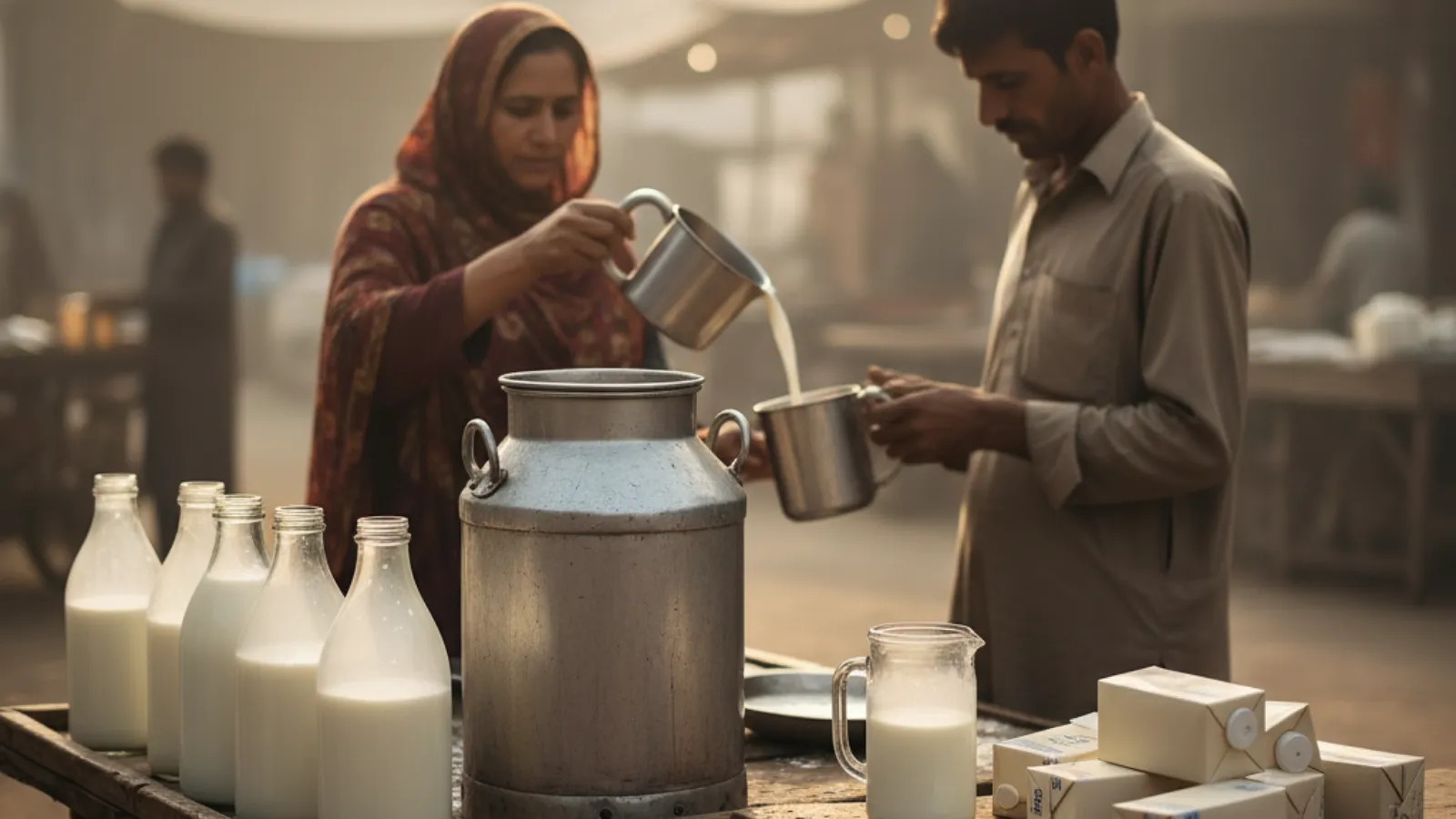
Most people read Pakistan's dairy market as a cold chain story. I read it as a tax story. In July 2024 an 18% sales tax landed on packaged milk. Milk sold loose from the churn stayed outside the tax. Pakistan's aseptic white milk then fell 11.7% in a single year. No new technology and no new rival did that. The shelf price did.
A carton market built on missing cold chains
Zenith's Global Aseptic Packaging Market Report 2026 puts Pakistan at 1,086 million litres filled aseptically in 2025. Cartons carry 97% of that volume. There is no aseptic PET line in the country at all. The reason is simple. Pakistan has no national chilled network for liquid milk. A pack that must stay cold cannot reach most of the country's shops. So the packaged milk that competes with the milk shop is UHT milk in an ambient carton. Most homes buy milk every day from a local shop. They boil it at home before use. That habit means loose milk does not need a long shelf life. The carton has to win on safety and convenience instead. Pasteurised milk was only 86.0 million litres in 2025. UHT white milk was 790 million litres. In Pakistan the choice on the shelf is a UHT carton or loose milk. That makes the carton more exposed to price than in most markets.
The tax that moved the shelf
Before July 2024, packaged milk sat outside the sales tax net. Then the 18% charge arrived. It came one year after consumer price inflation peaked at 38.0%. Household budgets were already stretched. That matters because packaged milk already cost more than loose milk. The tax widened a gap that shoppers could see every morning. Processors had little room to absorb the charge. Their own costs for fuel, power and packaging had risen too. So most of the tax passed through to the shelf price. Many households went back to the churn. FrieslandCampina Engro Pakistan is the largest processor. Its audited dairy output was 375.9 million litres in 2023. By 2025 it had fallen to 334.1 million litres. The company now names the tax as a lasting drag on formal milk volumes.
Why loose milk wins on price
Pakistan has one of the four largest milk pools in the world, at more than 65 million tonnes a year. Most of it never sees a factory. It moves from farm to milk shop in cans and is sold the same day. Here is why that matters for cartons. A loose litre pays no tax, no carton and no UHT plant. A carton litre pays for all three. Every point of tax lands on the packaged side only. The tax did not change what milk costs to make. It changed which milk pays the state. When the price gap widens, the cheapest option wins volume first. In a poor market, that option is loose milk.
Smaller packs kept the filling lines busy
Pack counts fell more slowly than litres. The average aseptic pack in Pakistan shrank from 307 ml in 2020 to 284 ml in 2025. That happens because a small pack keeps the ticket price low. A shopper who cannot afford a litre can still buy a small carton for tea. Tea whitener is part of this story. It is a cheaper milk based product, filled on the same UHT lines. It goes into the same small cartons. Tetra Pak makes most of that carton material at its Lahore plant. A small pack runs through the filler quickly, but each one holds less milk. Pakistan filled 3,823 million aseptic packs in 2025. For a converter, a shift to small packs softens a fall in litres. Each litre now needs more packs, so the carton plant loses less than the dairy does.
Where the volume moved instead
Some aseptic lines kept growing. Aseptic cream rose to 19.0 million litres in 2025. Fast food outlets and bakeries buy it ambient because chilled delivery is not reliable. The mechanism is the same as for milk. Ambient packs win where cold chains fail. Aseptic pouches also grew, to 36.3 million litres. Their appeal is a lower cost per pack than a carton. Flavoured milk held up for a similar reason. It is bought as a treat in a small carton. A shopper notices the tax less on a small ticket than on a family pack. Fruit juice went the other way. An excise duty of 20% on sugary juices hit a category already hurt by floods and import limits. Tax decided the winners in drinks as well as in milk.
The Zenith read: the tax rate decides the forecast
We expect Pakistan's aseptic volume to recover to 1,274 million litres by 2030. That is growth of 3.2% a year. The driver is population and town growth rather than packaging. Even then, white milk reaches only 885 million litres in 2030. That is still below its 2020 level of 900 million litres. That gap exists because the tax reset demand to a lower base. A rule change in July 2026 kept the rate where it was. It brought milk under printed retail prices, which tightens how the tax is collected. The dairy trade has asked the government to cut the rate to 10%. We think a cut to that level would bring white milk back to growth within two years. The figure that would change our call is the tax rate itself. A higher effective charge would push more litres back to the churn.
The tax is the headline. The bigger issue is how many litres come back to the carton if the rate falls. Pack size matters as much as volume. Our Global Aseptic Packaging Market Report 2026 splits Pakistan by product, pack type and pack size to 2030. It shows how much of the market sits in small cartons and pouches.
Going deeper on this market? See the Global Aseptic Packaging Market Report 2026.
Global Water Database 2026
Packaged, bulk, flavoured and premium water in 86 markets, to 2030.
More information
Global Cheese Database 2026
Production, imports, exports and consumption for 39 cheese types across 48 countries, with actuals through 2025 and forecasts to 2030. Buy one market or any five with a single-user, departmental or corporate licence, or get your free database and report sample first.
Get your free database & report sampleStrategic Insights
📊 Analytics & Strategic Insight
In Pakistan, the tax office sets the carton count
The decision most in this industry are avoiding:
👉 Pasteurised milk is the fastest growing milk line in the country. Zenith expects it to reach 131 million litres by 2030 from city routes in Karachi and Lahore.
👉 Tea whitener is two brands and a long tail. Trade press audits put Tarang at 52% of the segment. Any tax change lands hardest on that duopoly.
👉 The juice slump shows idle lines rather than lost lines. Shezan reported Tetra Pak output of 18.0 million dozen packs against capacity of 70.4 million dozen.
Here's the full context:
→ 2020: Lockdowns cut FrieslandCampina Engro dairy output to 315.0 million litres.
→ 2023: Excise on sugary juices doubles to 20% in July, as inflation peaks at 38.0%.
→ 2024: An 18% sales tax lands on packaged milk in July. Loose milk stays untaxed.
→ 2026: Milk moves into the retail price marking regime in July. The rate stays at 18%.
→ Most recent: FrieslandCampina Engro reports nine month revenue up 10.1%. It still names the tax as a drag on volume.
What this means for aseptic fillers, converters and equipment suppliers:
✅ The carton converter should plan for small packs. Flavoured milk alone filled 429 million portion cartons in 2025.
✅ The dairy line planner should price a pouch line next to a carton line. Family size aseptic pouches are forecast to grow 18.5% a year to 2030.
✅ Aseptic PET sellers have an open field and a weak case. No aseptic PET installation has been found in the country, and the ticket price argues against it.
What this means for market decisions:
1️⃣ Attractiveness rests on one policy lever. A tax cut would lift demand faster than any plant could.
2️⃣ Competition in material is narrow. Tetra Pak converts at Lahore, Greatview supplies Nestlé, and Ecolean runs a pouch plant there too.
3️⃣ An entrant should start in cream and flavoured milk. Those small ticket lines grew through the tax shock.
The Zenith view:
This proves the tax cut demand for packaged milk sharply. It does not prove the loss is permanent. The figure that settles it is the rate in the June budget. A cut would show up in processor volumes within two quarters.
The data behind this story
📦 Global Aseptic Packaging Market Report 2026
148.4 billion litres and 344 billion packs across 39 markets, split by category, pack type and pack size, with 2025 actuals and forecasts to 2030. A free 40-page sample is on the page.
→ Read the free sample
Weighing a dairy or carton move in Pakistan? Zenith helps food and beverage companies assess market size, growth, competitors, pricing and route to market before they invest.
→ Discuss your market
Zenith Consulting
Submit your food & beverage project enquiry.
Share your requirements. If there is a strong fit, we’ll come back with an indicative investment range, project timeline and recommended strategic approach.
Reviewed by Zenith Consulting’s senior food & beverage strategy team.
Our market reports
All reports and databases Available now
Global Aseptic Packaging Market Report 2026
39 markets, 2025 actuals and forecasts to 2030 by category, region and pack type.
View report Available now
Global Cheese Database 2026
48 markets and 39 cheese types: production, trade and consumption to 2030.
View report Available now
UK Water Drinks Reports 2026
Plain, flavoured and functional water in the UK: companies, brands, own label and forecasts to 2030.
View report- Available now
Global Water Database 2026
Packaged, bulk, flavoured and premium water in 86 markets, to 2030.
View report  Available now
Global Premium Bottled Water Report 2026
Premium water volume, value and brands, with six country deep dives.
View report Available now
Global Water Dispense Market Reports 2026
Coolers, dispensers and operators across 35+ markets, with forecasts to 2030.
View report- Free tool
Cheese Market Sizer
Size any of 48 cheese markets: 2025 consumption, kg per person, your market share and headroom.
Open free tool
Related analyses
- Corporate Strategy & Portfolio
FDA Clears Salt Substitutes In 41 Cheese Standards, And The Last Sodium Push Moved The Median Just 3%
The FDA has opened 41 cheese standards to salt substitutes, with the rule effective 14 December 2026. The cheese part can still be objected to until 12 November, and the last US sodium push moved the median by 3%.
Read analysis → - Innovation & Technology
US Cottage Cheese Curd Hits 514 Million Pounds: AMPI Hands A Cheddar Plant Over And The Sweet Whey Goes With It
US cottage cheese curd output reached 514.3 million pounds in 2025, up 14.7%, while all other cheese grew 4.0%. AMPI is switching its Blair cheddar plant to cottage cheese and Westby has just cut the ribbon on a 50% capacity lift.
Read analysis → - M&A, Investment & Valuation
Arla and DMK Are Building a €19 Billion Dairy Giant. The Real Antitrust Fight Is Over Farmers, Not Shoppers.
Arla Foods and DMK are weeks from forming Europe's largest dairy cooperative — around €19 billion in revenue, 12,200 farmer-owners, and roughly 13% of all EU milk. With the European Commission's decision due 28 May, the real antitrust fight is over farmers' options to sell their milk, not what shoppers pay.
Read analysis →
Share it with your peers
Pass this analysis to colleagues who track the food and beverage market.
Zenith Market Intel
Need a specific food or beverage market report?
Tell us which category, region or question would be useful for your team.
Sister Publication
Also follow our Water Dispense Market Intelligence
Category analyses, operator briefings, and investor signals across the global water dispense market.