South East Asia Fills 18.1 Billion Litres Of Aseptic Product: One Region Carries A Third Of World Growth To 2030
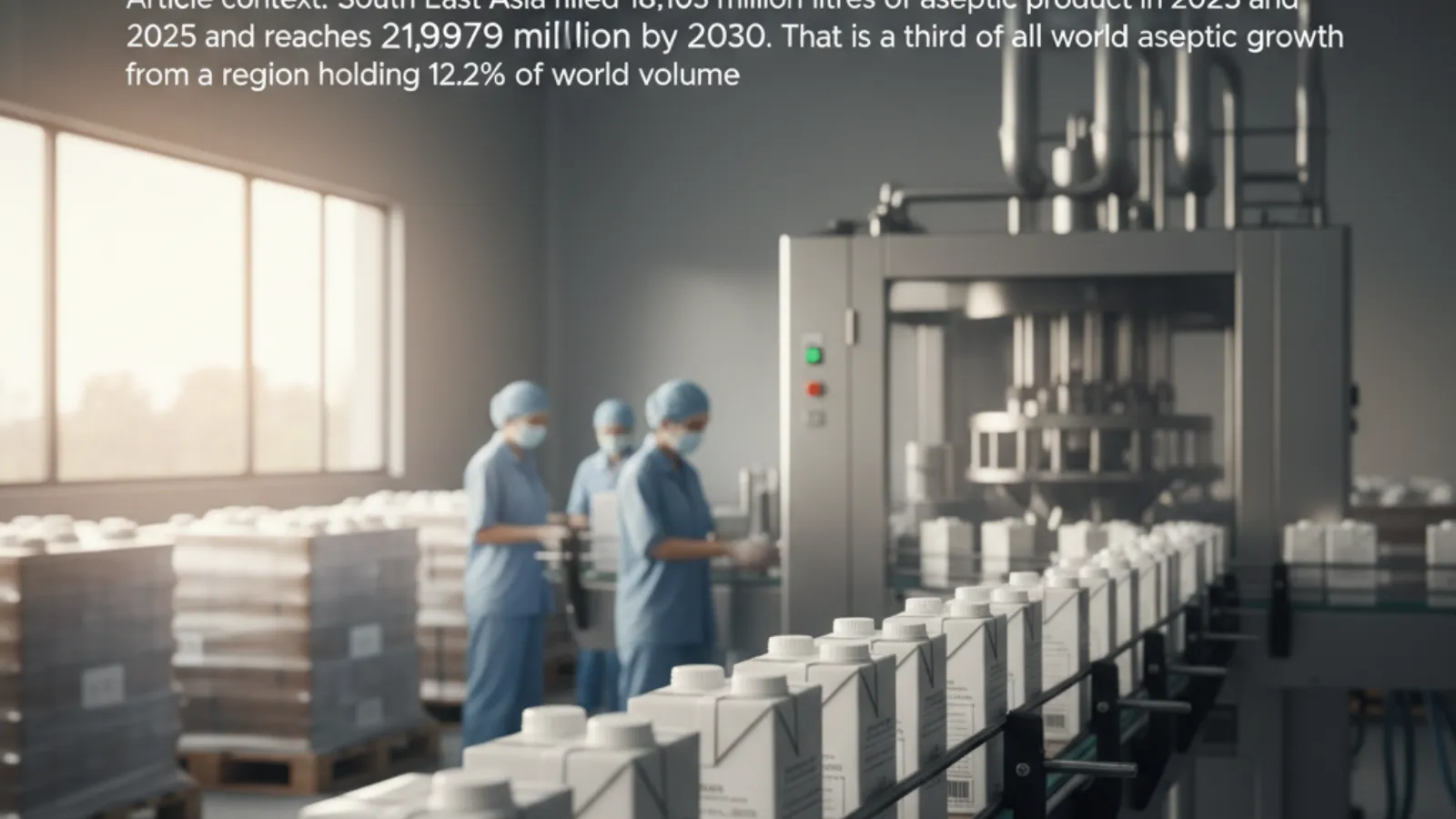
South East Asia filled 18,103 million litres of aseptic product in 2025 and reaches 21,979 million by 2030. That is a third of all world aseptic growth from a region holding 12.2% of world volume.
I will say this plainly. The aseptic growth map has one honest answer, and it is South East Asia. Zenith's Global Aseptic Packaging Market Report 2026 puts the region at 18,103 million litres in 2025. It reaches 21,979 million litres by 2030.
Where the growth sits
That is 3,876 million litres of new volume. The world adds 11,275 million litres over the same five years. So one region holding 12.2% of world volume carries 34.4% of the growth. China adds a little more in litres, and it starts from twice the base.
The pace is steady rather than a spike. The region grew 4.0% a year from 2020 to 2025. Zenith forecasts the same 4.0% a year to 2030. Packs rise faster still, from 63,133 million in 2025 to 78,386 million by 2030.
The country league table
The region holds seven modelled markets. India fills 5,074 million litres, a third of the modelled volume. Thailand follows at 2,823 million and Vietnam at 2,504 million. Indonesia adds 2,020 million litres and grew 7.2% a year since 2020. The Philippines is the fastest at 10.5% a year, and one of the smallest at 832 million litres. Pakistan went the other way and fell to 1,086 million litres before a forecast recovery.
The product mix is unusually even. Beverages hold 42.6% of regional aseptic litres at 7,705 million. Other dairy drinks hold 30.2% at 5,468 million. White milk holds 27.2% at 4,924 million, and it grows fastest to 2030 at 4.9% a year.
Cartons carry four fifths
Cartons take 81.7% of the region's aseptic litres. The portion pack leads by a wide margin. Single-serve cartons under 500ml carry 9,468 million litres. Family sizes carry 5,330 million. The split follows the price points shoppers can afford.
PET holds 15.3% at 2,762 million litres. Most of it sits in Indonesian and Thai drinks. Small pouches fill 478 million litres of milk in Pakistan, India and Thailand. Pouches grew 13.0% a year since 2020, the fastest pack in the region.
Hot filling still leads
A growing region does not make an aseptic region. Zenith counts 26,491 million litres of ambient long-life drinks in 2025. Hot filling took 55.3% of that. On the report's figures that is 14,646 million litres of Thai, Indonesian and Vietnamese teas and juices. Aseptic filling took 29.1% and preservative filling took 15.6%. South East Asia is one of the study's two great hot-fill regions, with North America.
Inside aseptic drinks the packs split three ways. Portion cartons carry 2,882 million litres. Family cartons carry 2,193 million. PET carries 2,614 million litres across both sizes. That is 33.9% of the region's aseptic drink pool.
The empty food quadrant
Food is the region's blank space. Aseptic food filling came to 6 million litres in 2025. That volume sat in 24 million packs, mostly soup and sauce in portion cartons in Pakistan and Thailand. Zenith forecasts 8 million litres by 2030. Ambient food here runs through cans, retort pouches and fresh cooking.
What market entrants should test
The region rewards a narrow plan. Growth of 4.0% a year is real, and it is spread across seven markets with different packs. A carton plan and a PET plan point at different countries. India and the Philippines pull the average up. Pakistan drags it down. Anyone sizing an entry should test three things. Which country the litres actually sit in. Whether the pack is a 200ml carton or a small PET bottle. And whether the drink is filled hot today.
Regional totals are only a start. What I want to quantify is how much of that growth lands in each country and each pack. The Global Aseptic Packaging Market Report 2026 splits all 39 markets by category, pack type and pack size. A free 17-page sample sits on the page.
Global Aseptic Packaging Market Report 2026
148.4bn litres and 344bn packs in 2025. Aseptic volumes across dairy, dairy alternatives, beverages and food in 39 markets — 2025 actuals and forecasts to 2030. Buy online and receive it within 24 hours.
More information
Global Cheese Database 2026
Production, imports, exports and consumption for 39 cheese types across 48 countries, with actuals through 2025 and forecasts to 2030. Join the waitlist for early access, pre-launch pricing and a free sample country chapter.
Get early accessStrategic Insights
📊 Analytics & Strategic Insight
A region can grow fast and still be the wrong place to put a line
The decision most in this industry are avoiding:
👉 Regional growth rates hide the market you would actually enter. South East Asia grows 4.0% a year as a block. Inside it the Philippines runs at 10.5% while Pakistan fell over the same five years.
👉 The fastest-growing market in the region is one of the smallest. The Philippines fills 832 million litres. Growth of 10.5% a year on that base adds fewer litres than 4% on India.
👉 More than half the region's ambient drinks are filled hot. An aseptic line here competes with a hot-fill line that is already paid for.
Here's the full context:
→ 2020: The region filled 14,848 million litres of aseptic product in 52,424 million packs.
→ 2020 to 2025: Volume grew 4.0% a year, the fastest of any large region in the study.
→ 2025: India reached 5,074 million litres, a third of the modelled volume.
→ 2025: Cartons held 81.7% of regional litres, with the portion pack ahead of the family pack.
→ Most recent: Zenith puts the region at 18,103 million litres in 2025. It reaches 21,979 million by 2030.
What this means for aseptic fillers, converters and equipment suppliers:
✅ Converting capacity follows the portion carton here. Fillers put out 48,965 million portion cartons in 2025, against 5,375 million family cartons. Sleeve demand is a single-serve business.
✅ Small PET is the fastest pack for beverage fillers. It carries 1,987 million litres of aseptic drinks and grows 4.3% a year to 2030.
✅ Equipment makers should price against hot fill rather than against each other. The 14,646 million litres already filled hot is the pool an aseptic line has to win from.
What this means for market decisions:
1️⃣ The region adds 3,876 million litres by 2030, a third of world growth. That makes it the first place to look. The totals alone will not tell you where to build.
2️⃣ India, Indonesia and the Philippines gain share while Pakistan loses it. A plan built on the regional average will be wrong in at least two of the seven markets.
3️⃣ Format decides the entry cost more than country choice does. A portion carton plan needs sleeve supply. A small PET plan needs blowing, sterilising and filling in one line.
The Zenith view:
South East Asia proves that aseptic volume still grows where buyers are young and cartons are cheap. It does not prove that an aseptic line is the right way in. Hot filling holds 55.3% of ambient drinks here. So the deciding test is what a converted hot-fill customer would pay for shelf life.
The data behind this story
📦 Global Aseptic Packaging Market Report 2026
148.4 billion litres and 344 billion packs across 39 markets, split by category, pack type and pack size, with 2025 actuals and forecasts to 2030. A free 17-page sample is on the page.
→ Read the free sample
Evaluating South East Asia? Zenith helps food and beverage companies assess market size, growth, competitors, pricing and route to market before they invest.
→ Discuss your market
Zenith Consulting
Submit your food & beverage project enquiry.
Share your requirements. If there is a strong fit, we’ll come back with an indicative investment range, project timeline and recommended strategic approach.
Reviewed by Zenith Consulting’s senior food & beverage strategy team.
Related analyses
- Corporate Strategy & Portfolio
Cheddar Jumps 16.5% While Mozzarella Falls 6%: The GDT Cheese Spread Swung $824 A Tonne In Two Weeks
Cheddar rose 16.5% and mozzarella fell 6.0% at the same Global Dairy Trade auction on 15 September. Two cheeses made from the same milk moved $824 a tonne apart in a fortnight, and the reason sits in the vats.
Read analysis → - Corporate Strategy & Portfolio
SIG Backs India's Regional Drinks: Aseptic Filling Has Fallen To 40.3% Of Indian Ambient Beverage Volume
SIG argues that aseptic cartons can take India's regional drinks national. Zenith's India data shows aseptic filling losing 17 points of ambient beverage share since 2020, while UHT milk grows at 12.3% a year.
Read analysis → - Corporate Strategy & Portfolio
China Aseptic Packaging: Litres Keep Rising, Packs Have Stopped, And The Average Pack Is Now 343ml
China filled 37,391 million litres of aseptic product in 2025 and used no more packs than it did in 2020. Zenith's Global Aseptic Packaging Market Report 2026 shows why the litre line and the pack line have split.
Read analysis →
Share it with your peers
Pass this analysis to colleagues who track the food and beverage market.
Zenith Market Intel
Need a specific food or beverage market report?
Tell us which category, region or question would be useful for your team.
Sister Publication
Also follow our Water Dispense Market Intelligence
Category analyses, operator briefings, and investor signals across the global water dispense market.