Leprino's 35 Million Dollar Lubbock Whey Expansion Will Finish Other Cheese Makers' Protein
Leprino Nutrition has completed a 35 million dollar expansion at Lubbock, Texas, quadrupling its microparticulated whey capacity. The new line will finish whey solids bought in from other cheese makers, which moves the tight step in the chain away from the vat.
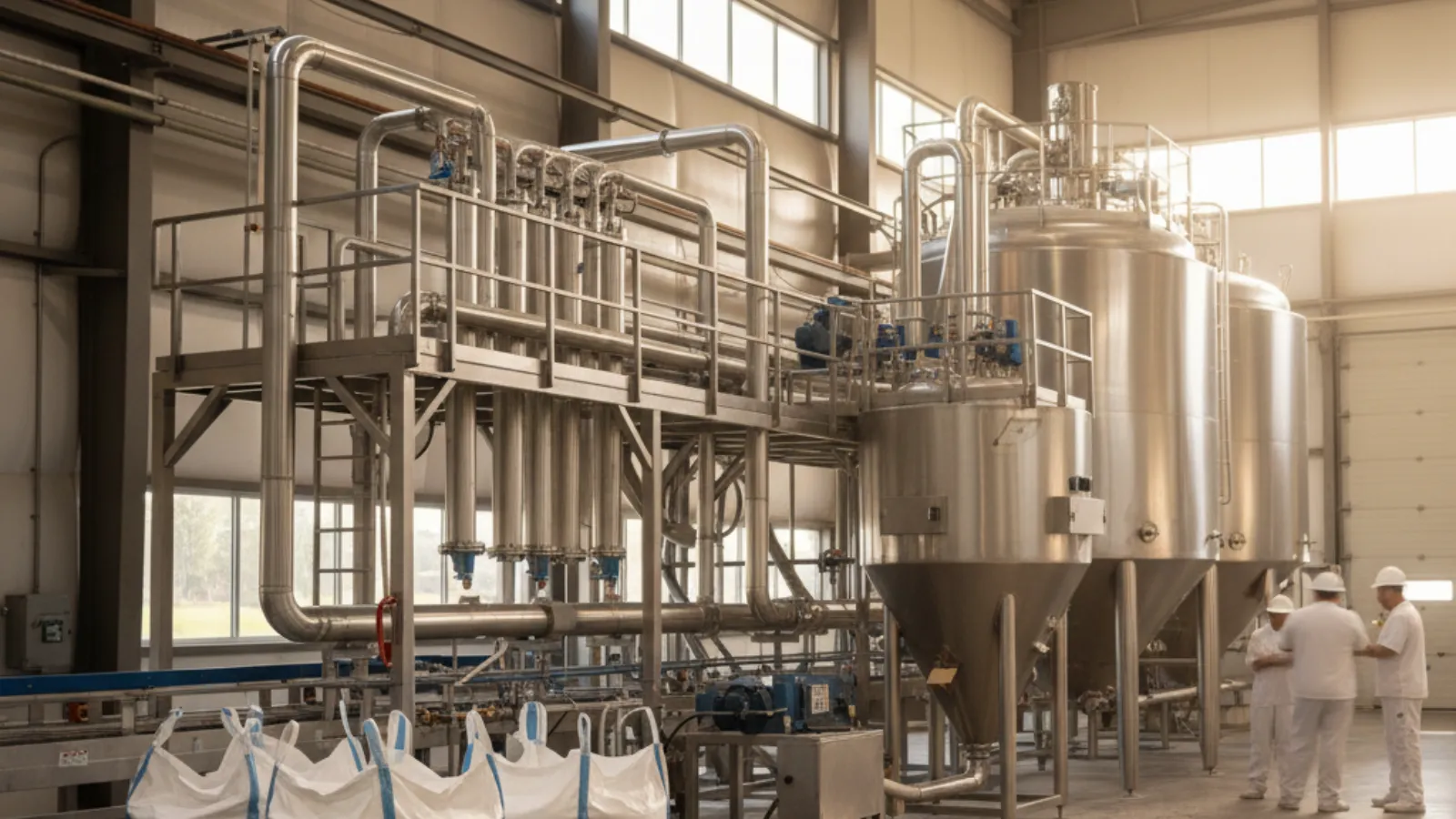
I keep seeing cheese groups spend at the same point in the chain. The money goes past the vat and lands on the whey plant. Leprino has just finished a 35 million dollar expansion at Lubbock, Texas. It quadruples one line, and that line does not make cheese.
What Leprino has built at Lubbock
Leprino Nutrition said on 27 October that the work is done. The spend quadruples the plant's microparticulated whey capacity. The release puts the new volume at about 9,100 tonnes (20 million pounds). It does not say over what period that lands. The product is MP PRO C80, a whey protein concentrate put through a patented process. That process breaks the protein down into very small particles. That matters because of texture. Milk fat sits in the mouth as tiny globules, and these particles copy them. So a drink can carry high protein and still feel smooth rather than chalky. Leprino lists puddings, desserts, baked goods, dips, sauces and ice cream as the targets. Lubbock and Fort Morgan in Colorado are the only two sites it runs for this work.
The word that matters here is external
One line in the release does the real work. The new capacity will focus on whey solids bought in from outside. Leprino makes more mozzarella than any other company in the world. Its cheese plant at Lubbock alone turns out more than 450 tonnes a day. That site cost close to a billion dollars to build. This group is not short of whey of its own. It buys other people's anyway. That happens because of what whey is at the moment it leaves the vat. Every cheese vat makes two things at once. One is curd. The other is a thin liquid that is mostly water. It sours within hours unless it is chilled, separated and dried. A cheese plant with no drier has to sell it wet and sell it close to home. Haulage then eats most of what it was worth.
What the protein is paying right now
Price explains the spend. USDA prices whey protein concentrate at 34% protein. It sold mostly between 2.45 and 2.75 dollars a pound in the week to 23 October. The top of that range is close to 6.00 dollars a kg. The higher 80% grade changed hands in the nines and tens a pound. USDA also reported spot supply as very tight. Makers are charging a premium that pulls the lower grade up towards the higher one. Here is why that happens. Both grades come off the same vats and the same driers. When the finishing step is full, the cheaper grade cannot be made in any greater volume either. Scarcity travels up the whole ladder rather than sitting on one rung.
The arithmetic for a cheese plant with no drier
Set the two prices next to each other. Cheddar blocks closed at 1.7350 dollars a pound in that same week. That is about 3.82 dollars a kg. So the whey concentrate fetched more a pound than the cheese did. The reason is simple. Cheese is sold by weight and most of that weight is water and fat. Dried protein has the water taken out of it. A pound of powder therefore holds far more of the thing the buyer is paying for. So the drier, rather than the vat, now sets what a plant earns on its milk. A mid-size cheese maker has three ways to go. It can build a drier, which costs money it may not have. It can sell the whey wet at a haulage-cut price. Or it can ship solids to a finisher such as Leprino and split the gain. Milk is not getting any cheaper either. Spot Class III loads in the Central states traded at flat to 4.00 dollars over Class in the same week.
Why the squeeze tightens as cheese grows
The cheese side of this keeps expanding. Zenith's Global Cheese Database 2026 puts fresh cheese at over a third of world consumption. Mozzarella sits inside that family. The database has fresh cheese growing about 2.4% a year to 2030. Imports across the 48 markets in it grow almost twice as fast as consumption does. That matters because whey is made in step with cheese. Nobody sits down and decides to make more whey. It arrives with every extra tonne of curd, wanted or not. So a growing mozzarella market pushes more liquid at a finishing stage that is already full. The gap widens on its own unless somebody spends against it. That is what makes an external-solids line worth building rather than a bigger vat.
The Zenith read on where this lands
We think finishing capacity stays the tight link in this chain through 2027. Leprino has added about 9,100 tonnes of it. That is a real addition rather than a decisive one. So we expect the 34% grade to hold above 2.00 dollars a pound into next year. The figure we watch is the gap between the two concentrate grades. USDA has that gap narrowing now. That happens because the driers are full. A buyer who cannot get the high grade will pay up for the low one instead. When it widens again, finishing has caught up with the vats and the pressure comes off. The hook of this piece settles there. The next dollar of margin on a cheese vat sits after the vat, in the drier.
One plant is one plant. What I want to quantify is how much cheese sits behind the whey, country by country. Our Global Cheese Database 2026 covers 39 cheese types across 48 markets. It gives production, trade and consumption in tonnes, with forecasts to 2030.
Going deeper on this market? See the Global Cheese Database 2026.
Global Water Dispense Market Reports 2026
Coolers, dispensers and operators across 35+ markets, with forecasts to 2030.
More information
Global Cheese Database 2026
Production, imports, exports and consumption for 39 cheese types across 48 countries, with actuals through 2025 and forecasts to 2030. Buy one market or any five with a single-user, departmental or corporate licence, or get your free database and report sample first.
Get your free database & report sampleStrategic Insights
📊 Analytics & Strategic Insight
The tight asset in dairy protein has moved out of the cheese plant
The decision most in this industry are avoiding:
👉 The trade is reading this as a protein launch. It is also a toll-processing move. A maker that finishes other firms' whey turns rivals into customers and sees their volumes before anyone else does.
👉 Most whey contracts are still written as waste disposal. They were signed when the stream was a cost. The buyer now captures the upgrade, and the cheese plant that signed a long one has given the margin away.
👉 Capacity built at the finishing end can cool the very price that paid for it. Every new drier adds supply to a market that is tight because of driers. The firms moving first get the premium years.
Here's the full context:
→ 2021: Leprino picks Lubbock for what becomes its largest cheese plant.
→ 2022: Work starts on the 850,000 square foot site in East Lubbock.
→ 2025: The cheese plant reaches full running at more than 450 tonnes a day.
→ October 2026: USDA reports spot whey concentrate supply very tight and premiums climbing.
→ Most recent: Leprino completes a 35 million dollar expansion at Lubbock. It quadruples microparticulated capacity and will take in outside whey.
What this means for cheese producers, traders and buyers:
✅ The whey buyer at a mid-size cheese plant holds the weakest hand in the chain. The seller has a perishable load and one road out. Price that weakness into the next contract or lose it again.
✅ The plant scheduler now has a second product to plan around. Vat runs used to be set by cheese orders alone. Whey solids with a buyer waiting change which days are worth running.
✅ The ingredient buyer at a food brand should expect longer lead times. Spot loads are thin and contracts are being priced at a premium. Cover the year rather than the quarter.
What this means for market decisions:
1️⃣ The value inside a cheese vat is shifting towards the protein stream. That changes how a cheese market should be sized. Count the drying and finishing capacity behind it, rather than the vats alone.
2️⃣ Groups with driers are quietly gaining on groups without them. The split has little to do with cheese quality or brand. It turns on who owns the equipment that takes the water out.
3️⃣ An entrant should price the whey outlet before it prices the cheese line. A vat with no home for its whey carries a cost that never appears in the cheese price. Check the outlet first.
The Zenith view:
This proves that one very large maker will pay to finish other firms' whey rather than wait for its own. It does not prove the shortage is ending. The figure that settles it is the premium between the two concentrate grades. We should see that move inside two quarters.
The data behind this story
🧀 Global Cheese Database 2026
Production, imports, exports and consumption for 39 cheese types across 48 countries, in tonnes, with actuals to 2025 and forecasts to 2030. Country workbook plus market insights dossier, delivered by Akos Petri, with a free sample country chapter on the page.
→ See the database
Evaluating a cheese or dairy protein market? Zenith helps food and beverage companies assess market size, growth, competitors, pricing and route to market before they invest.
→ Discuss your market
Zenith Consulting
Submit your food & beverage project enquiry.
Share your requirements. If there is a strong fit, we’ll come back with an indicative investment range, project timeline and recommended strategic approach.
Reviewed by Zenith Consulting’s senior food & beverage strategy team.
Our market reports
All reports and databases Available now
Global Aseptic Packaging Market Report 2026
39 markets, 2025 actuals and forecasts to 2030 by category, region and pack type.
View report- Available now
Global Cheese Database 2026
48 markets and 39 cheese types: production, trade and consumption to 2030.
View report  Available now
UK Water Drinks Reports 2026
Plain, flavoured and functional water in the UK: companies, brands, own label and forecasts to 2030.
View report Register interest
Global Water Database 2026
Packaged, bulk, flavoured and premium water in 86 markets, to 2030.
View report Register interest
Global Premium Bottled Water Report 2026
Premium water volume, value and brands, with six country deep dives.
View report- Available now
Global Water Dispense Market Reports 2026
Coolers, dispensers and operators across 35+ markets, with forecasts to 2030.
View report
Related analyses
- Health, Nutrition & Functional
Cheese Gets $3.76 Billion Of A $15 Billion US Dairy Build-Out While Milk And Cream Take $5.63 Billion
United States dairy firms are building more than $15 billion of new plant capacity across 23 states. Cheese holds $3.76 billion of it, and milk and cream have overtaken cheese at $5.63 billion.
Read analysis → - Health, Nutrition & Functional
West Europe Aseptic Volume Falls To 27.2 Billion Litres While Pack Numbers Return To Growth: UHT Milk Drops 2.1% A Year
West Europe filled 27,191 million litres of aseptic product in 2025. It is the only region falling on litres both to 2025 and to 2030, yet its pack count returns to growth by 2030.
Read analysis → - Health, Nutrition & Functional
Sports And Energy Drinks Reach 39,180 Million Litres, And Aseptic Filling Has Almost None Of It
Sports and energy drinks are the fastest growing group on the world drinks shelf at 39,180 million litres in 2025, up 7.2% a year since 2020. Zenith's Global Aseptic Packaging Market Report 2026 books just 100 million litres of the United States total as aseptic.
Read analysis →
Share it with your peers
Pass this analysis to colleagues who track the food and beverage market.
Zenith Market Intel
Need a specific food or beverage market report?
Tell us which category, region or question would be useful for your team.
Sister Publication
Also follow our Water Dispense Market Intelligence
Category analyses, operator briefings, and investor signals across the global water dispense market.