US Milk For Powder Now Pays 5.38 Dollars More Than Cheese Milk As Class IV Leaves Class III Behind
USDA priced October milk for butter and powder 5.38 dollars a hundredweight above milk for cheese. A year ago cheese milk paid more, and US cheese plants may now have to pay over the formula to keep their supply.
If I ran a US cheese plant, I would pull out my milk supply contracts this week. Here is why. In October, milk for butter and powder was priced 5.38 dollars a hundredweight above milk for cheese. That is about 11.9 cents more for every kg of milk. A year ago the order ran the other way. My view is that cheese plants will have to pay more to keep their milk. They will have to do it while their cheese earns less.
Powder milk now outprices cheese milk
USDA set its October federal milk prices on 4 November. Class III is the price for milk made into cheese. It came in at 15.16 dollars a hundredweight. That is 33.4 cents a kg of milk. Class IV is the price for milk made into butter and skim milk powder. It reached 20.54 dollars a hundredweight. That is 45.3 cents a kg. The gap between them is the second widest of the year, just behind May. A year earlier cheese milk was worth more. Class III then stood 2.61 dollars above Class IV. So the balance has swung by about 8 dollars a hundredweight in twelve months. That matters because the two prices compete for the same cows. A farmer, or the co-op that sells the milk, can see both numbers every month.
How the two milk prices are built
Both prices come from formulas. Each starts from a monthly average of wholesale dairy prices. Class III leans on the block cheddar price, with a smaller part from dry whey. Class IV leans on butter and on nonfat dry milk, the US name for skim milk powder. The mechanism is the same in both. USDA takes the product price and takes off a fixed make allowance. It then turns what is left into a value for the milk. So each class price is a mirror of its product. When cheese falls and powder rises, the two milk prices pull apart. No one sets the gap by hand. The wholesale markets set it, and the formula passes it straight back to the milk. That is why a farmer can be paid very different sums for the same load. It depends on which plant turns it into what.
Why the gap swung so far in a year
The product prices explain it. Cheese is the weak side of the trade. October's block cheese price averaged 1.44 dollars a pound (3.18 dollars a kg). That was 17% below a year earlier. Nonfat dry milk averaged 2.01 dollars a pound (4.43 dollars a kg). That is 73% more than a year ago. Butter fell too, and it drags on both classes. Here is why cheese is weak. The US has built cheese plants much faster than drying plants. IDFA's count of new plant spend puts cheese at about twice butter and powder combined. More cheese vats means more milk turned into cheese. That extra cheese has to clear at home or abroad. The price falls until it does. Our reading is that powder moved the other way for the same reason. Less new drying space means less spare powder to sell. So each tonne of powder has found a buyer at a better price.
What the gap does to the milk
In the short run, cheese vats keep running. Plants have orders to fill and staff to pay. But the gap works at the edge. That happens because a lot of US milk is sold by co-ops that own both kinds of plant. When powder pays more, the spare load goes to the drier first. The gap also hits the pools. Federal orders pool milk money and pay farmers a blended price. A plant using Class IV milk can leave the pool when its class price runs highest. That way it keeps the extra money for its own farmers. Farmers who ship to cheese plants are left with a thinner blend price. So the cheese plant has to pay more on top of the formula to keep them. Its milk bill rises. Its cheese still sells at about 1.44 dollars a pound.
Cheese output kept rising anyway
The price signal has not yet cut cheese output. US cheese production rose 0.7% in September on the year. It reached about 558,000 tonnes (1.23 billion pounds). Saputo said this week that it expects more US cheese as herds grow. The reason is simple. New vats are built to run full. A plant that cost hundreds of millions cannot slow down because powder pays better this month. So the extra cheese keeps coming, and exports are where it has to go. Zenith's Global Cheese Database 2026 shows imports across its 48 markets growing almost twice as fast as consumption. That is good news for an exporter with low milk costs. It is less good for a US plant that must now pay up to hold its milk.
The Zenith read: cheese plants pay up for milk into 2027
We think the gap narrows but stays open into 2027. Futures traded on 3 November put November Class III at 17.81 dollars. Class IV traded at 21.02 dollars. That leaves a gap of 3.21 dollars, smaller but still open. That happens because cheese capacity keeps growing while drying space does not. So we expect US cheese plants to pay more over the formula to hold milk through the winter. Plants that dry whey protein can afford it. Plain cheese plants will feel it first. The figure that would change our call is the nonfat dry milk price. If it falls back toward 1.50 dollars a pound, the gap closes and the pressure goes. Until then, the milk contract matters more than the cheese contract. That is why I would read it first.
For US cheese makers, the commercial test now is simple. Can a plant hold its milk when powder pays more? The answer depends on where the extra cheese can be sold. Our Global Cheese Database 2026 tracks US production, trade and consumption in tonnes, with forecasts to 2030. It also shows which import markets are growing fast enough to take it.
Going deeper on this market? See the Global Cheese Database 2026.
Global Water Database 2026
Packaged, bulk, flavoured and premium water in 86 markets, to 2030.
More information
Global Cheese Database 2026
Production, imports, exports and consumption for 39 cheese types across 48 countries, with actuals through 2025 and forecasts to 2030. Buy one market or any five with a single-user, departmental or corporate licence, or get your free database and report sample first.
Get your free database & report sampleStrategic Insights
📊 Analytics & Strategic Insight
America's milk formula now pays more for powder than for cheese
The decision most in this industry are avoiding:
👉 A low Class III price can still mean dear milk for a cheese plant. The formula sets the floor. The premium needed to hold farmers sits on top, and nobody publishes it.
👉 Butterfat has lost much of its pull on the milk cheque. The October butterfat price was 1.38 dollars a pound. A year earlier it was 1.83 dollars.
👉 The protein in cheese milk is worth far less than a year ago. October's protein price was 2.40 dollars a pound. A year earlier it stood at 2.88 dollars.
Here's the full context:
→ 2025: USDA's new milk formulas took effect in June. Make allowances rose for every class.
→ 2026: IDFA counted about 13 billion dollars of new US dairy plant spend. Cheese took the largest share.
→ May: Class IV ran 5.40 dollars above Class III. It was the widest gap of the year.
→ September: US cheese output rose 0.7% on the year. Powder prices kept climbing.
→ Most recent: USDA priced October Class IV milk 5.38 dollars above Class III. It was the second widest gap this year.
What this means for cheese producers, traders and buyers:
✅ The milk buyer should price the premium needed to hold each supply group. The class price is now only the floor. What it takes to keep farmers sits above it.
✅ The cheese sales desk should avoid chasing volume into a falling block market. Each extra load sold cheap pushes the class price lower again.
✅ The co-op planner should check which pool each plant sits in. Class IV milk that leaves the pool lowers the blend paid to cheese suppliers.
What this means for market decisions:
1️⃣ US drying capacity now looks more attractive than new cheese vats. Right now powder pays the farmer better. New money tends to follow the higher milk price.
2️⃣ Plants with whey protein lines and owned milk hold their ground. Plain cheese plants that buy milk on the open market lose it first.
3️⃣ An entrant should test export demand before adding US cheese vats. Zenith forecasts India, Indonesia, China, Vietnam and Thailand to grow above 5% a year. That is where spare US cheese has to go.
The Zenith view:
This proves the US milk formula now rewards powder over cheese. It does not prove milk is leaving cheese, since output still rose in September. The figure that settles it is the gap in the prices USDA sets in early December. If it stays above 3 dollars, expect cheese plants to raise their premiums.
The data behind this story
🧀 Global Cheese Database 2026
Production, imports, exports and consumption for 39 cheese types across 48 countries, in tonnes, with actuals to 2025 and forecasts to 2030. Country workbook plus market insights dossier, delivered by Akos Petri, with a free sample country chapter on the page.
→ See the database
Weighing a US cheese plant or a dairy export move? Zenith helps food and beverage companies assess market size, growth, competitors, pricing and route to market before they invest.
→ Discuss your market
Zenith Consulting
Submit your food & beverage project enquiry.
Share your requirements. If there is a strong fit, we’ll come back with an indicative investment range, project timeline and recommended strategic approach.
Reviewed by Zenith Consulting’s senior food & beverage strategy team.
Our market reports
All reports and databases Available now
Global Aseptic Packaging Market Report 2026
39 markets, 2025 actuals and forecasts to 2030 by category, region and pack type.
View report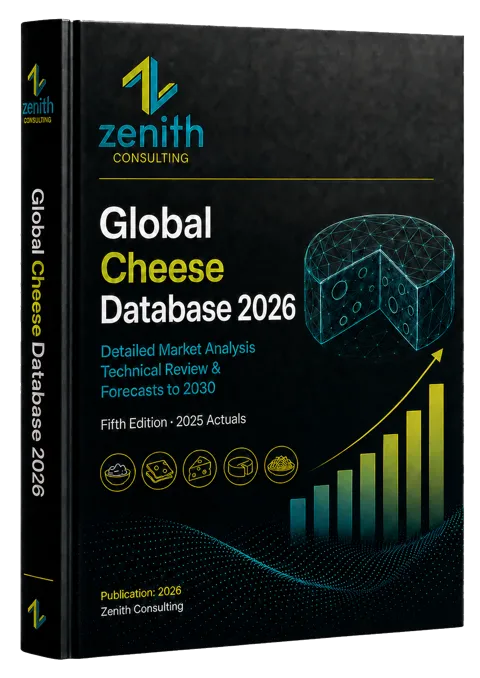 Available now
Global Cheese Database 2026
48 markets and 39 cheese types: production, trade and consumption to 2030.
View report Available now
UK Water Drinks Reports 2026
Plain, flavoured and functional water in the UK: companies, brands, own label and forecasts to 2030.
View report- Available now
Global Water Database 2026
Packaged, bulk, flavoured and premium water in 86 markets, to 2030.
View report  Available now
Global Premium Bottled Water Report 2026
Premium water volume, value and brands, with six country deep dives.
View report Available now
Global Water Dispense Market Reports 2026
Coolers, dispensers and operators across 35+ markets, with forecasts to 2030.
View report- Free tool
Cheese Market Sizer
Size any of 48 cheese markets: 2025 consumption, kg per person, your market share and headroom.
Open free tool
Related analyses
- Health, Nutrition & Functional
Goodman Fielder Opens A NZ$100m UHT Plant In Christchurch: New Zealand's Liquid Milk Exports Are Flat At 255,000 Tonnes
Goodman Fielder has opened a NZ$100 million high-value dairy centre in Christchurch, built around long-life milk for China and South East Asia. New Zealand's liquid milk exports have sat flat near 255,000 tonnes, so the plant sells more protein in the litre rather than more litres.
Read analysis → - Health, Nutrition & Functional
After the NZ$4.22 Billion Brand Exit: How Fonterra Is Becoming the World's Most Important Dairy Protein Supplier
Fonterra completed the NZ$4.22 billion sale of its Mainland consumer business to Lactalis on April 1, returned NZ$3.2 billion to its farmers, and is now executing a focused B2B dairy protein strategy — at exactly the moment global demand for high-protein ingredients is accelerating fastest.
Read analysis → - Sustainability, Regulation & Risk
US Puts 50% On Canadian Cheddar And Gouda Over A 6,376 Tonne Cheese Quota That Is Already 97% Full
Named Canadian cheeses have paid a 50% US duty since 15 September 2026, and a New Jersey food firm sued on 20 October to stop it. The quota rule behind the fight covers 6,376 tonnes and was filled to about 97% last year.
Read analysis →
Share it with your peers
Pass this analysis to colleagues who track the food and beverage market.
Zenith Market Intel
Need a specific food or beverage market report?
Tell us which category, region or question would be useful for your team.
Sister Publication
Also follow our Water Dispense Market Intelligence
Category analyses, operator briefings, and investor signals across the global water dispense market.